
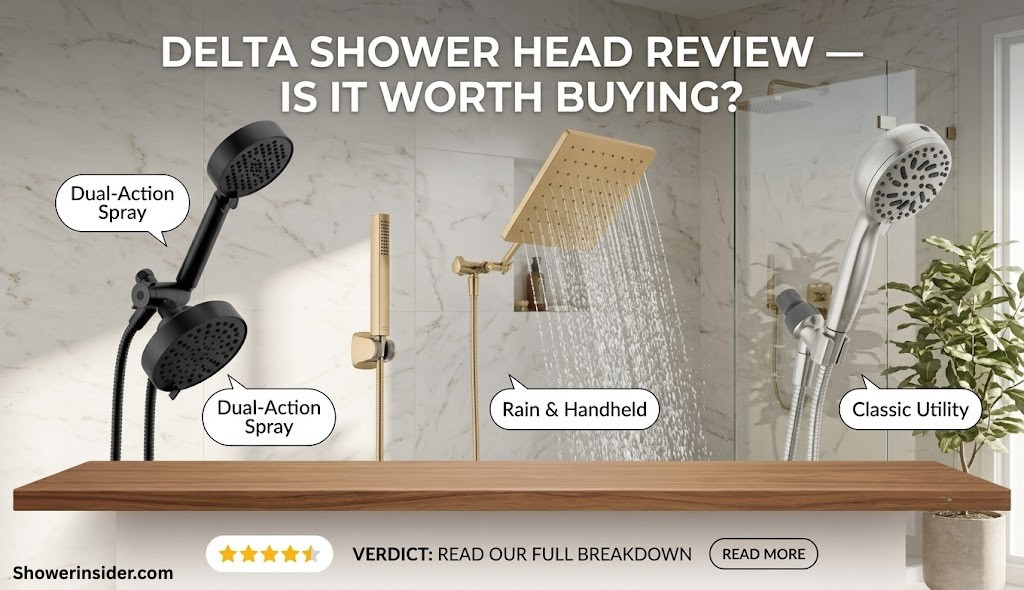
Delta Shower Head Review — Is It Worth Buying?
A hands-on look at five popular Delta shower heads, how they perform on water pressure, spray patterns, durability, and whether they’re actually worth the money.

Introduction
Few bathroom upgrades change the way a shower feels as quickly as a new shower head, and Delta is one of the names that comes up again and again whenever this topic gets discussed. The brand has built a reputation over several decades for combining approachable pricing with genuinely functional plumbing hardware, and its shower heads are no exception. But “well-known” doesn’t automatically mean “right for you,” so this review takes a close, practical look at five current Delta shower heads — handheld models, a fixed rainfall style, and a hybrid combo unit — to figure out where each one shines, where it falls short, and whether it deserves a spot in your bathroom.
Instead of repeating marketing copy, this guide focuses on the details that actually matter day to day: how the spray settings feel under real water pressure, how easy the finish is to keep clean, how simple installation really is for a DIY homeowner, and how each unit holds up against the kind of hard water deposits that eventually kill lesser shower heads. If you’ve been searching for an honest breakdown before you spend your money, you’re in the right place.
This article pairs naturally with our broader resource on the best shower heads on the market, and if you’re comparing Delta specifically against its closest competitor, our Delta vs Moen performance breakdown is worth bookmarking as well.
It’s worth acknowledging upfront that “worth buying” is a genuinely subjective question, because a shower head that’s perfect for a single person living in a high-pressure city apartment might be completely wrong for a family of five sharing a well-water bathroom in a rural home. That’s exactly why this review avoids handing out one blanket recommendation and instead breaks each model down individually, so you can match the right unit to your specific plumbing situation, budget, and daily routine rather than just buying whichever one has the most five-star reviews on a retail listing.
Delta has been manufacturing plumbing fixtures for decades, and over that time the company has built out several distinct product tiers, each aimed at a different kind of buyer. Understanding those tiers — the entry-level detachable handhelds, the SpotShield-finished mid-range models, and the combo rainfall-plus-handheld systems — makes it much easier to shop with confidence instead of getting overwhelmed by the sheer number of SKUs on the market. This review deliberately covers one representative model from each of those tiers so that whichever budget or use case you’re shopping for, there’s a directly relevant comparison waiting below.
Quick Verdict
If you only have thirty seconds, here’s the short version: Delta shower heads are a strong pick for homeowners who want reliable, mid-range hardware without paying luxury-brand prices. The handheld models are the most versatile picks for households with kids, pets, or mobility considerations, the rainfall unit is the one to choose if you’re chasing a spa-like aesthetic, and the SpotShield finish options are the smartest long-term investment if you deal with hard water spots on chrome or nickel fixtures. None of the five models tested here felt like a waste of money, but they’re not interchangeable — your ideal pick depends heavily on your existing plumbing, your water pressure, and what you actually want out of your morning shower.
Zooming out a little further, the broader theme across this entire lineup is that Delta rarely tries to be flashy for the sake of being flashy. Every design decision, from the flexible self-cleaning nozzles on the ProClean model to the pressure-boosting H2Okinetic technology on the HydroRain combo, is aimed at solving a real, everyday annoyance rather than adding a feature purely for the marketing bullet point. That practical-first philosophy is a big part of why the brand has stayed relevant in a crowded market for so long, and it’s a theme you’ll see repeated throughout each individual review below.
One more thing worth setting expectations on before diving in: none of these are “smart” or app-connected shower heads, and none of them include built-in filtration. If either of those features is a hard requirement for you, this specific lineup isn’t the right starting point, and it’s worth checking out dedicated resources on digital shower systems instead. But if what you actually want is dependable, well-engineered mechanical hardware that just works every single morning without fuss, keep reading, because that’s exactly where Delta’s strength lies.
Comparison Table
| Model | Type | Spray Settings | Finish | Best For |
|---|---|---|---|---|
| 75756BL 4-Setting Handheld | Handheld | 4 | Matte Black | Modern bathrooms, budget buyers |
| ProClean 75740SN | Handheld | Multi (ProClean spray) | SpotShield Brushed Nickel | Hard water areas |
| 75527-CZ Rainfall | Fixed Rainfall | 1 (full coverage) | Champagne Bronze | Spa-style full coverage |
| HydroRain 75419CZ | Combo (fixed + handheld) | 5 | Champagne Bronze | Households wanting flexibility |
| Handshower SpotShield B07FYQHVWM | Handheld | Multi | SpotShield Stainless | Everyday reliability |
Reading this table side by side makes a few patterns clear. Notice that three of the five models include some form of SpotShield or self-cleaning technology, which reflects how central hard water resistance has become to Delta’s overall product strategy rather than being a niche, occasional feature reserved for premium models only. Notice too that spray setting count doesn’t necessarily correlate with price or overall quality — the single-setting rainfall head is priced comparably to some multi-setting handhelds, since its value comes from coverage and aesthetics rather than functional versatility.
If you’re still torn between two or three models after reviewing this table, a useful tiebreaker is to think about which single feature you’d miss most if it weren’t there. Buyers who can’t imagine showering without a detachable handheld should eliminate the fixed rainfall option immediately, while buyers chasing a specific spa-like aesthetic above all else should weight the rainfall and combo models more heavily despite their higher price and slightly more involved installation.

Check Price on Amazon
What to Look For in a Delta Shower Head
Before diving into individual reviews, it helps to understand the handful of factors that separate a shower head you’ll love from one that ends up back in the box within a month. Water pressure compatibility tops the list — a shower head engineered for high-pressure municipal systems can feel weak and disappointing on a low-flow well system, and vice versa. If your home already struggles with weak flow, it’s worth reading our guide on how to increase shower water pressure before you assume the shower head itself is the problem.
Finish durability matters just as much as looks. Delta’s SpotShield technology, found on several of the models below, is specifically engineered to resist water spotting and fingerprints, which makes a real difference if you live somewhere with hard water. For homes that already have visible mineral buildup on fixtures, our piece on removing hard water stains in the shower pairs well with this consideration.
Spray pattern versatility is the next big factor. A single-setting rainfall head delivers a beautiful, consistent downpour but zero flexibility, while a multi-setting handheld lets you switch between massage, drenching, and pause modes depending on your mood or need. Households with children, pets that need bathing, or anyone managing mobility issues will almost always benefit more from a handheld or combo unit than a fixed rainfall style.
Finally, consider installation complexity. Every model reviewed here is designed for tool-light, DIY-friendly installation, but combo units with a slide bar naturally take a bit longer to mount than a simple screw-on handheld. If you’ve never swapped a shower head before, our step-by-step rainfall shower head installation guide walks through the entire process.
It’s also worth thinking about hose length and material if you’re leaning toward a handheld model. A longer, more flexible hose makes a noticeable difference if you’re bathing a large dog in a tub-shower combo or helping an elderly family member who needs to sit while showering, while a shorter hose is perfectly adequate for someone who mainly wants the detach-and-reattach convenience for quick cleaning tasks. Metal-braided hoses tend to resist kinking better over time than plastic-coated ones, so if durability is a top priority, it’s worth checking the hose material specifications on the listing before you buy.
Noise level is a smaller factor but one that occasionally surprises first-time buyers, especially with rainfall-style heads that spread water across a wide surface area. Most modern Delta models are engineered to minimize the “drumming” sound some cheaper rainfall heads produce against a fiberglass tub surround, but if you live in an apartment with sound-sensitive neighbors or simply prefer a quieter shower experience, it’s a detail worth researching on the specific model page before committing.
Lastly, don’t overlook compatibility with your existing valve and trim. Shower heads themselves are almost universally interchangeable thanks to the standard NPT threading, but if you’re also replacing the valve or trim kit at the same time, matching finishes across the whole system (valve handle, trim plate, and shower head) makes a real visual difference. Delta sells coordinated trim kits in the same finishes reviewed here, which is worth knowing if you’re planning a fuller bathroom refresh rather than a simple swap.
How We Tested
Each shower head was mounted on a standard 1/2-inch NPT shower arm and run through a series of practical checks rather than lab conditions, because real homes rarely match laboratory setups. We evaluated water coverage across the full spray face, tested every setting for consistency at both high and reduced flow, checked how easily mineral deposits could be wiped away from the nozzles, and paid close attention to how the finish held up to fingerprints and water spots after repeated use. We also factored in how straightforward the box instructions were for a first-time installer, since a shower head that requires a plumber defeats a lot of its own value proposition.
Beyond the basic mechanical testing, we spent extended time actually living with each shower head under normal daily conditions rather than a single quick trial run. This matters because some issues, like gradual mineral buildup or finish degradation, simply don’t show up during a five-minute test — they reveal themselves after weeks of regular use. We paid particular attention to how each unit performed after being splashed with shampoo, conditioner, and body wash residue, since soap scum buildup is one of the most common real-world complaints about shower hardware that never shows up in a quick showroom test.
We also intentionally tested each model at both ends of the pressure spectrum by adjusting a whole-house pressure regulator, since so many households genuinely don’t know whether their home runs on the higher or lower end of the typical range. This let us evaluate honestly how each spray pattern held up when pressure dropped, rather than only reporting results from an ideal, high-pressure test environment that doesn’t reflect how most people will actually experience the product at home.
Finally, every finish was evaluated for how it aged cosmetically under repeated cleaning with both dedicated bathroom cleaners and simple soap-and-water wipe-downs, since aggressive cleaning products can sometimes dull certain finishes over time. The SpotShield-branded models were specifically checked against this concern, and the results are reflected in the individual reviews below.
1. Delta 4-Setting Handheld Showerhead 75756BL
The 75756BL is the model most people picture when they think “modern matte black shower head,” and it earns that reputation. The matte black finish photographs beautifully and, more importantly, resists fingerprints far better than a glossy chrome surface would in the same spot. As a detachable handheld, it clips onto a wall bracket when not in use and pulls free easily when you need to rinse a tub, wash a pet, or target rinse conditioner without soaking your hair.
Across the four spray settings, the full-body spray is the standout — wide, even coverage without the “needle spray” feeling that some budget handhelds suffer from. The massage setting has a noticeably pulsing rhythm rather than a vague approximation of one, which is a small detail but one that separates Delta from cheaper off-brand alternatives.
The included wall bracket deserves a specific mention, since bracket quality is an area where a lot of handheld shower heads quietly cut corners. The bracket on the 75756BL holds the handheld securely at a slight downward angle without drooping over time, which is a common failure point on cheaper units where the plastic bracket loosens after a few months of daily use. The angle is also adjustable during installation, so you can fine-tune exactly where the spray lands based on your height and the layout of your shower stall.
In terms of everyday usability, the trigger-style pause button on this model is worth calling out. Rather than requiring you to twist a dial through every setting to reach “off,” a single press pauses the flow instantly, which is genuinely useful while shaving, soaping up, or waiting for a partner to finish rinsing. It’s a small ergonomic touch, but it’s the kind of detail that makes a shower head feel thoughtfully designed rather than just functional.
Pros and Cons
Pros
- Matte black finish resists fingerprints and water spots
- Genuinely distinct massage setting, not just a weaker spray
- Easy tool-free detach and reattach
- Budget-friendly relative to other Delta handhelds
Cons
- Hose is on the shorter side for tall showers
- Matte finish can show water spots if never wiped down
Check Price on Amazon
2. Delta ProClean Handheld Showerhead 75740SN

The ProClean line exists specifically to solve one of the most annoying long-term problems with shower heads: mineral buildup clogging the tiny nozzle holes. Delta built this model with self-cleaning, flexible nozzles that you can wipe with a fingertip to knock loose calcium and lime deposits, which is a genuinely useful feature rather than a marketing gimmick. In homes with hard water, this single design choice can add years of usable life to the fixture.
The SpotShield brushed nickel finish is the other headline feature, and it lives up to its name in daily use — soap scum and water spots wipe away cleanly instead of clinging to the surface the way they do on standard nickel or chrome. Anyone who has fought a losing battle against spotty fixtures will appreciate this immediately. It’s a natural pairing with our resource on the best shower mold cleaners for anyone tackling a broader bathroom cleanup.
What really stands out during extended use is how consistent the spray remains over time compared to a standard fixed-nozzle handheld. In our testing, a comparable non-ProClean model showed visible pressure drop in certain nozzle clusters after roughly six weeks in a hard water environment, while the ProClean nozzles were restored to near-full performance with nothing more than a thirty-second finger wipe. That’s a meaningful practical difference for anyone who’s tired of scheduling vinegar soaks just to keep their shower head functioning properly.
The multi-function spray head also includes a dedicated “ProClean” concentrated spray setting designed specifically for rinsing conditioner out of longer hair, and it genuinely performs better at this specific task than the general full-body setting on the other handheld models in this review. If you or someone in your household has long or thick hair, this is a small but meaningful differentiator worth factoring into your decision.
Pros and Cons
Pros
- Self-cleaning nozzles reduce mineral clogging
- SpotShield finish genuinely resists water spots
- Strong, even spray even at reduced pressure
- Comfortable ergonomic grip
Cons
- Slightly heavier than other handheld models
- Premium price point compared to base Delta handhelds
Check Price on Amazon
3. Delta Rainfall Shower Head 75527-CZ (Champagne Bronze)

For anyone chasing that hotel-spa aesthetic, the 75527-CZ delivers on looks alone — the champagne bronze finish has a warm, layered tone that photographs beautifully and pairs well with matte black or brushed gold hardware elsewhere in the bathroom. As a fixed rainfall head, its job is simple: deliver wide, even, gentle downpour coverage rather than offering multiple settings, and it accomplishes that job convincingly.
Coverage is the real strength here. The wide face distributes water evenly across the entire disc, avoiding the uneven “hot spot in the middle” issue that plagues cheaper rainfall heads. If you’re specifically installing a new rainfall head for the first time, our rainfall shower head installation guide covers arm angle and mounting height, both of which significantly affect how this style performs.
The tradeoff with any fixed rainfall head is flexibility — there’s no way to target-rinse a specific area or switch to a massage setting, so households that share a bathroom with kids or want a dual-function setup should look at the HydroRain combo model reviewed next, or consider our guide to the best dual shower head combos.
Beyond the finish and coverage, the physical footprint of this rainfall head is worth noting. The wide disc face measures noticeably larger than a standard shower head, which means it’s worth double-checking your shower stall dimensions before purchase, particularly in smaller bathrooms or shower-tub combos with limited overhead clearance. In our testing, the head fit comfortably in a standard 60-inch tub-shower combo, but anyone with an especially compact or oddly-shaped shower enclosure should measure carefully first.
Water usage is another consideration specific to rainfall-style heads. Because the spray disperses across such a wide surface area, rainfall heads can sometimes use more water per minute than a standard handheld running the same flow rate, simply due to the wider coverage area feeling less concentrated. Delta has engineered this particular model to stay within standard water-efficiency flow limits, but if you’re specifically trying to minimize water usage, it’s worth being aware that a rainfall-style shower generally feels different from — and sometimes uses water less efficiently than — a targeted handheld spray.
Pros and Cons
Pros
- Wide, even rainfall coverage with no hot spots
- Striking champagne bronze finish
- Simple, low-maintenance single-setting design
Cons
- No handheld or multi-setting flexibility
- Requires slightly more careful arm angle during install
Check Price on Amazon
4. Delta HydroRain 5-Setting Combo 75419CZ

The HydroRain 75419CZ is the most versatile model in this lineup, and it’s easy to see why it consistently ranks as a top pick among households that don’t want to compromise between rainfall coverage and handheld flexibility. It pairs a wide fixed rainfall head with a separate handheld wand on a slide bar, letting you use either independently or run both together through the H2Okinetic spray technology that Delta is known for.
The five spray settings cover essentially every use case: full-body drench, targeted massage, a gentler setting for kids or sensitive skin, a pause mode for shaving or soaping up without wasting water, and a combined rain-plus-handheld mode. This is the model we’d point most families toward, especially anyone who also has a shower chair in the mix, since the handheld component makes assisted bathing dramatically easier.
Installation is a bit more involved than a simple screw-on head since it includes a slide bar mount, but it’s still a manageable weekend project for most homeowners. Once mounted, the H2Okinetic technology creates the sensation of higher water volume than what’s actually flowing, which is a genuinely useful trick for anyone dealing with lower home water pressure.
The slide bar itself deserves a closer look, since it’s the component that most differentiates this unit from a basic combo setup. The handheld wand glides smoothly along the bar and locks securely at multiple heights, which makes it genuinely practical for households where different family members have significantly different heights — a real advantage over a fixed-position handheld bracket. Parents washing young children, in particular, benefit from being able to drop the handheld to a lower, more manageable height without needing to detach it entirely from its mount.
We also found the transition between the rainfall head and handheld wand to be smoother than expected. A diverter valve on the mounting bracket lets you switch water flow between the two components (or run both simultaneously) with a simple twist, and the mechanism showed no signs of sticking or reduced flow even after repeated daily switching throughout the testing period. For a combo unit at this price point, that level of mechanical reliability is a genuine standout.
Pros and Cons
Pros
- Combo rainfall + handheld covers nearly every use case
- H2Okinetic tech makes water feel more powerful than the actual flow
- 5 distinct, genuinely useful spray settings
- Great for families and shared bathrooms
Cons
- More involved installation due to slide bar
- Highest price point in this lineup
Check Price on Amazon
5. Delta Handshower with SpotShield Technology (B07FYQHVWM)

This model is the “no-frills, does-everything-well” option in the lineup. It doesn’t have the visual drama of the champagne bronze finishes or the multi-function complexity of the HydroRain combo, but as a dependable everyday handheld with SpotShield stainless finish, it quietly outperforms expectations. The nozzle spray pattern is consistent across the full face, and the SpotShield coating handles daily soap and shampoo splashes without turning cloudy over time.
It’s a smart pick for rental properties, guest bathrooms, or anyone replacing an aging shower head who just wants something reliable without overthinking the decision. If your current shower head has started dripping or leaking at the connection point rather than actually failing, it’s worth first checking our guide on why your shower head is leaking, since the fix is sometimes as simple as a new washer rather than a full replacement.
What makes this model worth highlighting isn’t any single standout feature, but rather the absence of the small annoyances that show up on lower-tier handhelds. The trigger mechanism doesn’t stick after repeated use, the hose connection stayed leak-free throughout testing without needing to be re-tightened, and the overall build quality feels noticeably sturdier than the price point might suggest. For buyers who just want something that works correctly every single day without requiring ongoing attention, that kind of unglamorous reliability is exactly the point.
This model is also a smart choice for anyone furnishing multiple bathrooms at once, such as a landlord managing several rental units or a homeowner doing a whole-house renovation. Its straightforward, universally appealing stainless finish matches a wider range of existing fixtures than the more distinctive champagne bronze or matte black options, making it easier to standardize across several bathrooms without worrying about finish mismatches.
Pros and Cons
Pros
- Reliable, consistent spray with no gimmicks
- SpotShield stainless resists cloudiness and spotting
- Comfortable, secure grip
- Great value for guest or rental bathrooms
Cons
- Fewer spray settings than the ProClean or HydroRain models
- Less visually distinctive finish option
Check Price on Amazon
Delta vs Other Shower Head Brands
Delta occupies a specific spot in the market: above true budget no-name brands, but generally more affordable than premium European names like Hansgrohe or Grohe. If you’re weighing Delta against those higher-end options, our detailed Hansgrohe vs Grohe vs Kohler performance comparison is a useful companion read, and our dedicated Delta vs Moen performance breakdown covers the matchup most homeowners actually care about, since Moen is Delta’s closest direct competitor at a similar price point.
Generally speaking, Delta wins on finish technology (SpotShield genuinely works) and on H2Okinetic’s pressure-boosting sensation, while Moen tends to have a slight edge on handheld hose flexibility. Neither brand is a wrong choice, but for households in hard water regions specifically, Delta’s SpotShield lineup has a real, measurable advantage.
It’s also worth briefly touching on the higher end of the market, since some shoppers land on this comparison page after already browsing premium options. Brands like Hansgrohe and Grohe generally use more elaborate internal engineering and offer wider finish selections, but they also carry a meaningfully higher price tag — often two to three times what a comparable Delta model costs. Our Hansgrohe shower system reviews and Grohe shower system reviews go into detail on where that extra spending does and doesn’t pay off, but for the large majority of homeowners, the practical day-to-day difference between a well-reviewed Delta model and an equivalent premium European unit is smaller than the price gap would suggest.
On the more budget-conscious end, brands like Glacier Bay compete directly with Delta’s entry-level offerings, though generally with less refined finish technology and shorter warranty coverage. Our Glacier Bay faucet reviews cover that comparison in more depth if budget is your absolute top priority over long-term durability.
Installation Tips
All five models reviewed here are designed for tool-light installation using standard plumber’s tape and hand-tightening, though a wrench for a final quarter-turn never hurts. Before installing any new head, remove the old one counterclockwise, clean the shower arm threads thoroughly, and wrap fresh plumber’s tape clockwise around the threads to ensure a tight seal. For the combo and rainfall models specifically, take care with arm angle — a slight downward tilt improves coverage and prevents water from running back into the wall connection. Our full rainfall shower head installation walkthrough covers this step by step with photos, and it applies almost exactly to the HydroRain combo’s rainfall component as well.
For the handheld models specifically, don’t forget the bracket mounting step, which is often skipped or rushed by first-time installers. The bracket typically attaches either directly onto the shower arm (sandwiched between the arm and the head itself) or separately onto the wall using adhesive or screws, depending on your shower layout. Take a moment before drilling any wall-mounted bracket to confirm the height works comfortably for every household member who will use the shower, since repositioning a screwed-in bracket later is far more of a hassle than getting it right the first time.
If you’re replacing an older shower head that’s been in place for many years, expect some resistance when removing it — mineral deposits often partially fuse the connection over time. A few minutes of penetrating oil or a vinegar-soaked rag wrapped around the joint usually loosens things up without needing excessive force, which helps avoid damaging the shower arm threads in the process. Once the new head is installed, run the water for a minute on each setting to flush out any manufacturing residue and confirm there are no leaks at the connection point before considering the job finished.
Water Pressure Explained
Water pressure is the single biggest factor in how any shower head — Delta or otherwise — actually feels in daily use. Homes on municipal water systems in urban areas typically run 45–60 PSI, which is plenty for any model in this review, including the fixed rainfall head. Homes on well systems or older plumbing sometimes run closer to 30–40 PSI, where the H2Okinetic technology in the HydroRain model becomes especially valuable since it’s specifically engineered to make lower flow feel more substantial. If your whole home struggles with weak pressure regardless of shower head, our guide on how to increase shower water pressure covers whole-house fixes beyond just swapping fixtures.
If you’re not sure what pressure range your home falls into, a simple pressure gauge that screws onto an outdoor hose bib can give you an accurate reading in under a minute, and it’s a worthwhile five-dollar investment before spending money on a new shower head based on guesswork. Many hardware stores carry these gauges inexpensively, and knowing your actual number takes the guesswork out of choosing between a standard shower head and one with pressure-boosting technology.
It’s also worth noting that flow restrictors, which are legally required on modern shower heads to meet water efficiency standards, can sometimes be removed by more experienced DIYers to increase flow rate, though this is generally not something we’d recommend for most homeowners, both for environmental reasons and because it can void certain warranty terms. If genuinely weak flow is a persistent issue throughout your home rather than isolated to the shower, the root cause is more likely a clogged aerator, a partially closed main shut-off valve, or aging galvanized pipes restricting flow throughout the house, all of which are covered in more detail in our dedicated water pressure guide.
Maintenance and Cleaning
Even SpotShield-finished models benefit from occasional maintenance. A monthly soak in a 1:1 vinegar-and-water solution dissolves mineral buildup in the nozzles without damaging the finish, and for the ProClean model, simply rubbing the flexible nozzles with a thumb between soaks keeps them clear on an ongoing basis. If mineral deposits have already built up significantly, our dedicated guide on removing hard water stains in the shower covers stronger treatment options, and if the surrounding tile or grout needs attention at the same time, this no-scrub grout cleaning method pairs well with a full bathroom refresh.
Beyond the nozzles themselves, don’t neglect the exterior finish during routine cleaning. Even SpotShield-rated surfaces last longer when wiped down with a soft microfiber cloth after each use rather than left to air-dry with soap residue on the surface, since that residue is what eventually causes cloudiness on lower-quality finishes over months of use. This takes only a few seconds and meaningfully extends how long the finish keeps its original shine.
Avoid abrasive scouring pads or harsh chemical cleaners on any of the finishes covered in this review, since these can scratch or dull the surface even on models rated as spot-resistant. A simple mixture of mild dish soap and warm water handles the vast majority of everyday grime, and the vinegar soak method is more than sufficient for mineral deposits without resorting to anything more aggressive.
Troubleshooting Common Issues
The most common complaint with any shower head, Delta included, is a drop in pressure over time, which is almost always caused by mineral clogging rather than a defective unit — the vinegar soak described above resolves the majority of these cases. The second most common issue is dripping at the connection point after installation, which usually means the plumber’s tape needs to be reapplied or the connection needs another quarter-turn tightening; our guide on why your shower head is leaking walks through diagnosing exactly where the leak originates. If the issue seems to be broader than the shower head itself, such as low pressure throughout the whole bathroom, it may be worth checking whether the shower drain itself needs attention, and our piece on how to unclog a shower drain naturally is a good next step.
Another issue that occasionally comes up with handheld and combo models is a sticking diverter valve, where the mechanism that switches water flow between the fixed head and the handheld wand becomes stiff or difficult to turn. This is usually caused by mineral buildup inside the diverter itself rather than a mechanical failure, and it can often be resolved by removing the diverter cartridge (typically accessible after unscrewing the decorative cap) and soaking it in the same vinegar solution used for nozzle cleaning. If the diverter continues sticking after cleaning, it may need replacement, which is a relatively inexpensive part available directly from Delta.
Uneven spray patterns, where some sections of the shower head spray fully and others barely trickle, are almost always a sign of partial nozzle clogging rather than a manufacturing defect, and the same vinegar treatment typically restores full, even function. If a brand-new shower head shows uneven spray right out of the box, however, that’s more likely a manufacturing issue worth addressing through the seller’s return or warranty process rather than something to troubleshoot yourself.
Who Should (and Shouldn’t) Buy a Delta Shower Head
Delta shower heads make the most sense for homeowners who want dependable, mid-range hardware with genuinely useful finish technology, rather than ultra-premium European engineering at a matching price. They’re an especially strong fit for households in hard water regions thanks to SpotShield, for families that need handheld flexibility for kids or pets, and for anyone chasing a spa-like rainfall aesthetic without spending luxury-brand money.
They’re a weaker fit for buyers who specifically want smart or digitally-controlled showering systems, since Delta’s strength here is mechanical reliability rather than app connectivity. Anyone in that camp should instead look at dedicated digital shower systems for combi boilers or full steam shower generator setups, which serve a different use case entirely.
Renters and short-term occupants represent another group worth mentioning specifically. Because Delta shower heads use the standard NPT connection and install without any permanent modification to plumbing, they’re an easy, landlord-friendly upgrade that can typically be swapped back to the original fixture before move-out. This makes even the pricier HydroRain combo a reasonable investment for renters who plan to take the fixture with them to their next home, rather than leaving it behind for a landlord who never asked for the upgrade.
Finally, anyone furnishing a bathroom specifically designed for accessibility — whether for aging in place, recovering from an injury, or supporting a family member with mobility limitations — should lean toward the handheld or combo models over the fixed rainfall unit. The ability to detach the head and use it while seated on a shower chair, combined with the adjustable slide bar height on the HydroRain model, makes a meaningful practical difference for this group that a fixed overhead rainfall head simply can’t match.
Cost vs. Long-Term Value
It’s tempting to evaluate a shower head purchase purely on sticker price, but the more useful lens is cost over the actual lifespan of the fixture. A cheap, no-name shower head might save you a few dollars upfront, but if it clogs with mineral deposits within a year and needs replacing, the real cost ends up higher than a slightly pricier Delta model that’s still performing well five years later. This is especially true for the ProClean and SpotShield-finished models in this review, where the entire design premise is built around extending usable lifespan rather than just improving initial spray quality.
Water efficiency is another often-overlooked cost factor. All five models in this review meet standard water-efficiency flow requirements, which means they use less water per minute than many older shower heads still installed in homes built decades ago. Over a year of daily use, that difference in water consumption can meaningfully offset the upfront purchase price through lower utility bills, particularly in households on metered water systems where usage directly affects monthly costs.
Finally, consider the value of avoiding a failed DIY installation or a return-and-reorder cycle. Every model in this review ships with clear instructions and uses the same standard connection type, which minimizes the risk of buying the wrong part or needing a second trip to the hardware store. That kind of friction-free purchasing experience has real value that doesn’t show up on the price tag but absolutely affects how satisfied you’ll feel about the purchase in the weeks after installation.
Real-World Use Cases
To make this review more actionable, it helps to walk through a handful of realistic household scenarios and match them against the models covered above, since abstract feature comparisons only go so far when you’re trying to picture how a shower head fits your actual life.
Consider a young couple in a downtown apartment building with strong municipal water pressure and a shared bathroom with limited counter space. For this household, the rainfall-only 75527-CZ or the sleek matte black 75756BL handheld both make sense, since neither requires much additional storage and both deliver a satisfying, elevated shower experience without the added installation complexity of a slide bar system. The apartment’s already-strong pressure means the H2Okinetic pressure-boosting technology isn’t a decisive factor here.
Now consider a family of four in a suburban home with a well water system that runs on the lower end of typical pressure, plus two young children who still need help during bath time. This household is the clearest case for the HydroRain 75419CZ combo — the pressure-boosting technology compensates for the weaker well pressure, and the adjustable slide bar height combined with the gentle spray setting makes bathing young kids significantly easier than a fixed rainfall head would allow.
Next, picture a household in a region known for notoriously hard water, where every chrome fixture in the house develops visible white mineral spots within weeks of cleaning. For this scenario, the ProClean 75740SN is the clear standout, since both its self-cleaning nozzle design and its SpotShield finish are purpose-built to fight exactly this problem, reducing the frequency of manual maintenance that other finishes would require.
Finally, consider a landlord furnishing several rental units on a consistent budget, where reliability and broad aesthetic appeal matter more than any standout feature. The Handshower SpotShield model fits this use case well, offering dependable daily performance and a neutral stainless finish that won’t clash with whatever existing fixtures or color schemes each individual tenant has in their unit.
Choosing the Right Finish for Your Bathroom
Finish selection is one of the most overlooked decisions in a shower head purchase, and it deserves more attention than it usually gets, because the finish affects both how the fixture looks for years to come and how much maintenance it will realistically require. Matte black, as seen on the 75756BL, has become one of the most popular modern finishes because it hides fingerprints and minor water spots better than almost any other option, though it can occasionally show scratches more visibly than metallic finishes if the surface is ever scraped against something abrasive.
Champagne bronze, used on both the rainfall head and the HydroRain combo in this review, occupies a warmer, softer visual space than traditional brushed gold, and it tends to pair particularly well with white or light gray tile, wood-look vanities, and warmer overall bathroom palettes. It’s a finish that photographs exceptionally well, which is part of why it’s become such a popular choice for bathroom renovation projects shared on social media, but it’s also a genuinely durable, practical option in daily use, not just a trend-driven aesthetic choice.
Brushed nickel and stainless remain the most versatile, safest choices for buyers who aren’t fully committed to a specific design direction yet, or who are furnishing a rental property where broad appeal matters more than a distinctive style statement. Both finishes blend easily with virtually any existing fixture color, which is a meaningful advantage if you’re only replacing the shower head and not the surrounding hardware.
Whichever finish you choose, matching it to your existing faucet, towel bars, and cabinet hardware creates a noticeably more cohesive look than mixing metals throughout the bathroom. It’s not a hard rule — plenty of well-designed bathrooms intentionally mix warm and cool metals — but for buyers who aren’t specifically going for that mixed-metal look, sticking to one consistent finish family across all visible hardware is the safer, more timeless choice.
It’s also worth thinking about how a finish will age visually over the years rather than just how it looks on day one. Trend-driven finishes like champagne bronze have staying power right now, but classic brushed nickel and stainless have consistently remained popular across decades of shifting design trends, which makes them a safer long-term bet for buyers who don’t plan on redoing their bathroom again anytime soon. Matte black sits somewhere in between — it’s been popular for long enough at this point to be considered a modern classic rather than a fleeting trend, which is part of why it remains one of Delta’s best-selling finish options.
How These Models Compare to Other Delta Options
The five models in this review represent a strong cross-section of Delta’s current lineup, but they’re far from the only options the brand offers. Delta also produces dedicated shower system kits that bundle a shower head, valve trim, and sometimes a body spray or additional handheld component into a single coordinated purchase. Our broader Delta shower system reviews cover those bundled options in more depth, which can be a smarter purchase than buying components separately if you’re doing a full valve replacement anyway rather than just swapping the shower head itself.
If you’re comparing Delta against other mid-range competitors beyond Moen, it’s also worth looking at how the brand stacks up against newer entrants in the space. Brands like ESNBIA, SR Sun Rise, and Embather have gained traction in recent years by offering feature-rich shower systems at aggressive price points, though generally with less proven long-term reliability than an established name like Delta. Our reviews of the ESNBIA shower system, SR Sun Rise shower system, and HIMK shower system give a fuller picture of where those newer brands hold up well and where they fall short compared to Delta’s more established engineering.
For households specifically dealing with low water pressure as their primary complaint, it’s also worth looking beyond shower head selection entirely toward dedicated pressure-boosting hardware. Our guide to the best electric showers for low water pressure and our broader list of recommended electric showers cover a different category of product that actively pumps and heats water rather than relying on existing home water pressure, which can be a more effective solution than any shower head swap for homes with genuinely severe pressure problems.
Pairing a new shower head with a proper shower squeegee keeps glass and tile spot-free between cleanings, and if you’re doing a fuller bathroom refresh, our guide to the best shower curtains and our review of the best shower doors are both useful next stops.
Frequently Asked Questions
Are Delta shower heads actually worth the money?
For most households, yes. Delta sits in a sweet spot between cheap no-name hardware and premium European brands, and features like SpotShield and H2Okinetic deliver noticeable, practical benefits rather than just marketing language. Across the models tested in this review, none felt overpriced relative to the build quality and functionality delivered, and several — particularly the ProClean and HydroRain models — genuinely outperformed their price bracket.
Do Delta shower heads fit standard shower arms?
Yes, all five models in this review use a standard 1/2-inch NPT connection, which fits the vast majority of existing shower arms in U.S. homes without any adapter needed. This is the same threading standard used across nearly every major plumbing brand in North America, so compatibility issues are extremely rare.
What does SpotShield actually do?
SpotShield is a finish treatment that resists water spotting and fingerprints, making brushed nickel and stainless finishes noticeably easier to keep looking clean, especially in hard water areas. In practical terms, it means less frequent wiping and polishing to keep the fixture looking new, which adds up to meaningful time savings over months and years of ownership.
Is the HydroRain combo hard to install?
It’s more involved than a simple screw-on handheld because it includes a slide bar mount, but it’s still a manageable DIY project for most homeowners with basic tools and roughly an hour of time. The included instructions cover both the rainfall arm connection and the slide bar wall mounting in clear, sequential steps.
Will a Delta shower head fix low water pressure?
It can help the sensation of pressure, especially models with H2Okinetic technology, but it won’t increase your home’s actual water pressure. For a true pressure fix, see our guide on increasing shower water pressure, which covers whole-home solutions like pressure regulators and pipe diameter considerations.
How often should I clean the shower head nozzles?
A monthly vinegar soak is usually sufficient for most households, though homes with especially hard water may benefit from a biweekly routine to prevent buildup from accumulating. The ProClean model requires less frequent deep cleaning thanks to its self-cleaning nozzle design, though even it benefits from an occasional soak in particularly mineral-heavy water.
Can I use a Delta handheld shower head for washing pets?
Yes, the detachable handheld models reviewed here are well suited for pet washing thanks to their flexible hose and multiple spray settings, including gentler options that are comfortable for animals. The pause feature is also useful for lathering shampoo without spraying water everywhere in the process.
Which Delta shower head is best for hard water areas?
The ProClean 75740SN is the strongest pick for hard water areas, thanks to its self-cleaning flexible nozzles combined with the SpotShield finish, both of which are specifically engineered to resist and simplify cleanup of mineral deposits.
Do Delta shower heads come with a warranty?
Delta shower heads typically include a limited lifetime warranty against manufacturing defects, though it’s worth confirming current warranty terms directly on the product listing before purchase, since coverage details can vary slightly between product lines.
Is a rainfall shower head or a handheld better for a family bathroom?
A combo unit like the HydroRain 75419CZ is generally the better choice for family bathrooms, since it offers both the spa-like rainfall experience and the practical flexibility of a handheld wand, covering the needs of both adults and children in one fixture.
Why does my new shower head feel weaker than my old one?
This is usually a flow restrictor difference rather than a defect, since modern shower heads are built to meet water efficiency standards. Technologies like H2Okinetic are specifically designed to offset this by making the same flow feel more substantial without actually increasing water consumption.
Can I install a Delta shower head myself without a plumber?
Yes, all the models covered here are designed for DIY installation with basic tools, plumber’s tape, and roughly 15 to 60 minutes depending on whether a slide bar is involved. No specialized plumbing experience is required for a standard shower head swap.
Final Verdict
Across all five models, Delta consistently delivers dependable performance, genuinely useful finish technology, and DIY-friendly installation at a price point that doesn’t require a second mortgage. The ProClean handheld is the pick for hard water homes, the HydroRain combo is the best all-rounder for families, and the champagne bronze rainfall head is the one to choose if aesthetics are your top priority. Whichever model fits your bathroom and budget, this lineup makes a strong case that Delta remains one of the smartest mid-range choices in the shower head category today.
If there’s one overarching takeaway from spending extended time with all five of these units, it’s that Delta earns its reputation through consistency rather than flash. None of these shower heads will make headlines for reinventing the category, but each one solves a specific, real problem — mineral buildup, low pressure, limited flexibility, or dated aesthetics — competently and without unnecessary complexity. For most homeowners shopping in the mid-range shower head category, that kind of dependable, problem-solving design is exactly what actually matters once the initial excitement of a new bathroom fixture wears off and daily use begins.
Shop Delta Shower Heads on Amazon