
How Long Does a Shower Steamer Last Per Shower?
A single shower steamer typically lasts 1–4 showers depending on its size, formulation, and how you place it. In ideal placement (away from direct spray, activated slowly by steam and splashes), a large steamer can last 2–4 sessions. Under direct spray, the same steamer dissolves in under 5 minutes — one shower, barely.
The per-session lifespan of a shower steamer is the question that surprises most new users — because the answer is not “one tablet = one shower” the way the packaging might imply. The actual lifespan depends almost entirely on one variable: how much direct water contact the steamer receives. Shower steamers react with water — the more aggressively water hits them, the faster they dissolve. This is physics, not product quality.
Understanding this is the key to getting dramatically more value from every steamer you buy. A steamer placed directly under your shower head dissolves completely in 3–8 minutes — one very intense, brief aromatherapy burst. The same steamer placed in a corner of the shower floor, away from the direct spray, activated only by steam and incidental water splashes, can last 20–30 minutes of sustained fragrance — and may have fizzing material remaining for a second or third shower session if you break off the session before it’s fully dissolved.
🔬 Why Direct Spray Destroys Steamers So Quickly
Shower steamers contain citric acid and baking soda (sodium bicarbonate) as their base — the same reactive pair in bath bombs. When water contacts them, the acid and base react to produce carbon dioxide bubbles (the fizzing), which simultaneously disperses the essential oils into the air. Under direct spray, this reaction happens at maximum rate all at once, like dropping an entire effervescent tablet into a glass of water versus letting it sit in humid air. The CO₂ releases all at once, takes the essential oils with it in a short burst, and the steamer is spent in minutes. Steam and humidity trigger the same reaction at a slow, controlled rate — producing sustained aromatherapy rather than one intense burst.
Shower Steamer Shelf Life: How Long Do They Last Stored?
Properly stored shower steamers last 6–12 months with full fizzing potency. In ideal conditions (airtight container, cool and dry location, away from bathroom humidity), some formulations maintain quality for up to 2 years. Improperly stored — left on a bathroom shelf in an open bag — they can lose 30–50% of their fizzing power within weeks.
The shelf life of shower steamers is almost entirely a function of storage conditions. The citric acid and baking soda in every steamer begin reacting the moment they contact any moisture — including ambient humidity in the air. This is a slow reaction in dry conditions (taking months to significantly deplete the reactants) but a fast one in a humid bathroom (detectable degradation within days of being left open).
A steamer that has “gone flat” from humidity exposure before use isn’t dangerous or unhealthy — it just won’t produce the satisfying fizz and sustained fragrance release of a fresh steamer. The essential oils may still be present, but without the vigorous CO₂ release to propel them into the air, the aromatherapy effect is dramatically reduced. You’ll know a steamer has pre-reacted when it feels slightly powdery, crumbly, or lighter than expected — the CO₂ has already escaped.
How Shower Steamers Work (and Why It Matters for Longevity)
Shower steamers are not bath bombs for the shower — they are specifically formulated for airborne aromatherapy delivery through steam, not skin contact. Understanding this distinction explains everything about how to use them correctly and why they last longer in some shower setups than others.
The key difference from bath bombs is fragrance concentration: shower steamers contain 3–5 times more essential oil per gram than bath bombs, calibrated for the dilution that occurs when fragrance disperses through an entire steam-filled shower space. This high concentration is why they deliver such powerful aromatherapy — and why they should never be dissolved in bathwater for soaking (the skin-contact concentration would be uncomfortably high, particularly menthol and eucalyptus varieties).
The fizzing reaction serves a mechanical purpose beyond just the visual effect: the CO₂ bubbles propel microscopic droplets of essential oil into the steam air as they escape. Without this propulsion, the oils would sit on the surface of the dissolving tablet and evaporate slowly rather than dispersing through the shower space. This is why a pre-reacted “flat” steamer that still smells strongly when held to your nose doesn’t produce the same shower experience — the delivery mechanism is gone even if the fragrance is still present.
For those interested in the next level of shower aromatherapy — beyond steamers — a steam shower generator with a dedicated aromatherapy injector delivers continuous, consistent essential oil mist throughout the entire session. Our best steam shower generator guide covers the full range of options for transforming your shower into a true wellness space.
What’s Actually Inside a Shower Steamer
Opening up the formulation of a shower steamer explains a lot about why longevity varies so much from brand to brand, and why two tablets that look nearly identical on a shelf can behave completely differently once they hit water. Every shower steamer, regardless of price point, is built from the same handful of core ingredient categories, but the ratios and quality within each category are what separate a tablet that fizzes gently for half an hour from one that dissolves into a puddle in ninety seconds.
The base of every steamer is the effervescent pair: citric acid and sodium bicarbonate (baking soda). These two powders are inert on their own, but the moment they’re exposed to water they begin an acid-base reaction that produces carbon dioxide gas — the fizz you see and hear. The ratio between these two ingredients is the single biggest lever a manufacturer has over how a steamer performs. A formulation weighted more heavily toward baking soda tends to fizz slower and more gently, which is exactly the behavior you want for a long, sustained aromatherapy session. A formulation weighted toward citric acid fizzes faster and more aggressively, producing a shorter, more intense burst — sometimes intentional for “quick hit” travel-size products, sometimes just a sign of a cheaper, less considered recipe.
Layered on top of the effervescent base is the fragrance system, almost always built from essential oils rather than synthetic fragrance oils in higher-quality products (though many budget and mid-range brands blend in fragrance oils to cut cost). Eucalyptus, peppermint, lavender, and citrus oils are the most common because they hold up well to heat and humidity without breaking down into unpleasant notes. The concentration of oil per gram of tablet is the second major lever on performance — more oil means a stronger, longer-lasting scent throw, but oil is also the most expensive ingredient in the formula, which is exactly why budget steamers tend to smell faint even when fully fizzing.
A binder is usually included to hold the powder together in tablet form — often a small amount of water, witch hazel, or a mild oil that’s sprayed into the powder mixture before it’s pressed into a mold. The binder ratio affects hardness: a steamer pressed too loosely crumbles in transit and starts reacting prematurely from ambient humidity, while one pressed too hard can be so dense that it barely fizzes even under direct water contact. Getting this balance right is part of what separates a well-engineered commercial product from a rushed private-label knockoff.
Finally, many steamers include a small percentage of coloring (usually mica or a cosmetic-grade dye) purely for visual appeal, and some include a light dusting of Epsom salt or dead sea salt for texture and a marketing tie-in to “spa” language, even though salt has essentially no functional benefit once the tablet is placed away from direct water in a shower rather than dissolved in a soaking bath.
💡 Reading an Ingredient List Before You Buy
If you want to predict how long a steamer will last before you ever get it wet, scan the ingredient list. Baking soda listed first (before citric acid) generally signals a slower, gentler fizz. “Essential oil” listed rather than “fragrance oil” or “parfum” generally signals a stronger, more natural scent that holds up over a longer session. And a short ingredient list with no unnecessary fillers is usually a sign of a more concentrated, better-performing tablet than one padded with cheap bulking agents.
Scent Guide: Which Fragrance Does What
Longevity isn’t only about how long a steamer physically lasts — it’s also about how long the experience feels worthwhile, and that comes down to choosing the right scent for the right moment. Different essential oils behave differently once dispersed into hot, humid air, and matching the fragrance to your intended use dramatically changes how satisfying the session feels, independent of the tablet’s actual dissolve time.
🌿 Eucalyptus
The most popular shower steamer scent by a wide margin, and for good reason — its sharp, medicinal aroma cuts through steam more effectively than almost any other oil, so it “reads” as strong even at lower concentrations. Best for morning showers, sinus congestion, and anyone who wants a steamer that feels noticeable within the first thirty seconds.
💜 Lavender
A softer, rounder scent that disperses more slowly through steam than eucalyptus, which makes it a better match for evening and pre-sleep showers where a sustained, gentle aroma is preferable to an intense burst. Lavender-based steamers tend to feel like they last longer per session simply because the fragrance builds gradually rather than hitting all at once.
🍊 Citrus (Orange, Lemon, Grapefruit)
Bright and energizing, but citrus oils are among the most volatile and degrade fastest once a tablet is opened or exposed to air, which means citrus steamers generally have the shortest effective shelf life of any common scent family and benefit the most from strict airtight storage.
🌲 Peppermint
Extremely potent per drop, which means peppermint steamers can be formulated with less total oil and still deliver a strong scent throw — often translating into a slightly longer-lasting fragrance experience per gram of tablet compared to milder oils.
🌸 Rose & Floral Blends
Delicate and easily overwhelmed by steam saturation, floral blends tend to feel like they fade fastest of any category, even when the tablet itself hasn’t finished dissolving — a cosmetic rather than chemical limitation worth knowing about before you judge a floral steamer as “weak.”
🌰 Woodsy & Spice Blends (Cedar, Sandalwood, Clove)
Heavier, less volatile oils that tend to linger in the bathroom air well after the shower has ended, making them a good choice if you want the aromatherapy effect to persist into the rest of your morning or evening routine rather than dissipating the moment you step out.
If you regularly find yourself disappointed that a steamer “didn’t last,” it’s worth experimenting with a different scent family before assuming the product itself is defective — the perceived duration of a shower steamer’s fragrance is as much about the volatility of its essential oil as it is about the tablet’s physical dissolve rate.
Health & Wellness Benefits of Shower Steamers
While shower steamers are primarily a sensory and relaxation product rather than a medical treatment, the aromatherapy they deliver does have some well-documented, modest benefits worth understanding — both to set realistic expectations and to choose the right scent for the effect you’re after.
Sinus and Congestion Relief
Menthol-forward oils like eucalyptus and peppermint, combined with the warm steam of the shower itself, can provide temporary relief from nasal congestion and a stuffy feeling associated with colds or seasonal allergies. The warm, humid air is doing much of the physical work here, with the essential oil adding a perceived cooling and opening sensation.
Stress Reduction and Relaxation
Lavender and other calming florals are widely used in aromatherapy research for their association with reduced perceived stress and improved mood. Combined with the already-relaxing ritual of a warm shower, a lavender steamer can meaningfully enhance an evening wind-down routine.
Mental Clarity and Energy
Citrus and peppermint scents are commonly associated with alertness and a mood lift, making them a popular choice for morning showers when the goal is to wake up and feel energized rather than to relax.
Muscle Relaxation (Perceived)
Some steamers include eucalyptus or menthol specifically marketed toward post-workout recovery. While the tablet itself doesn’t penetrate muscle tissue, the combination of warm steam and a cooling menthol scent can create a genuinely pleasant, relaxing sensory experience after exercise.
Sleep Support
An evening shower with a lavender or chamomile steamer, paired with dimmed lighting, is a popular addition to wind-down routines aimed at improving sleep onset — more from the ritual and relaxation response than any pharmacological effect of the oil itself.
It’s worth being clear-eyed about the limits here: shower steamers are a pleasant sensory enhancement to an existing shower routine, not a substitute for medical treatment of respiratory conditions, chronic stress, or sleep disorders. Anyone with asthma, severe allergies, or a diagnosed respiratory condition should introduce a new steamer scent cautiously and discontinue use if it causes any irritation, coughing, or breathing discomfort.
Why Shower Steamers Go Flat Before You Use Them
💧 Bathroom Humidity (Most Common)
Leaving steamers on the bathroom shelf — even in their packaging — exposes them to the high humidity of a bathroom that’s used daily. Shower steam fills the air after every use and slowly activates the citric acid-baking soda reaction in any unsealed steamers nearby. A package opened and left on a shelf in an active bathroom will be noticeably less potent within 2–3 weeks.
🌡️ Heat and Temperature Swings
Heat accelerates chemical reactions. Storing steamers in a warm bathroom, near a radiator, or in a car during summer causes the reactive components to break down faster even in the absence of moisture. Ideal storage temperature is 60–75°F (15–24°C) — cool, stable, and consistently dry.
📦 Poor Original Packaging
Budget steamers often come in thin plastic bags with inadequate sealing. Even factory-sealed, cheap packaging can admit enough ambient moisture to pre-activate the steamer during shipping and retail storage. If a steamer arrives feeling gritty, powdery, or shows visible white crystalline deposits, it has already partially reacted in transit.
✋ Handling and Skin Contact
The moisture on your hands is enough to begin activating a shower steamer’s surface when you handle it. This is why quality steamers often come individually wrapped — to prevent the moisture from skin contact during packaging and retail handling. If your steamers feel slightly tacky or show surface fizzing when you pick them up, handle them more briefly and transfer directly to the shower.
Placement for Maximum Duration: The Single Most Important Factor
The difference between a steamer that lasts 5 minutes and one that lasts through multiple showers is entirely placement. This is not an exaggeration — optimal placement can multiply a steamer’s effective lifespan by 4–6 times compared to poor placement.
Corner of Shower Floor
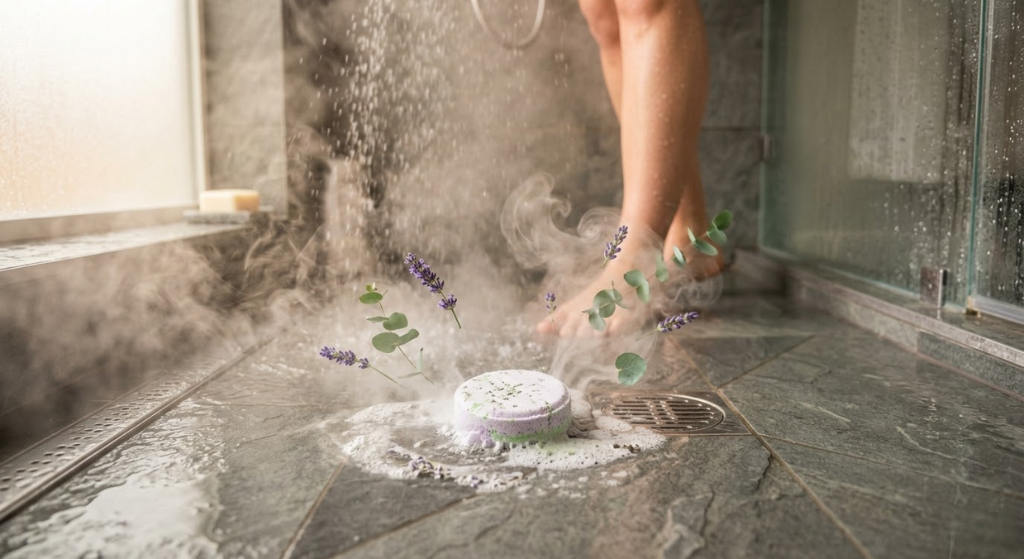
Best placement. Away from direct spray, reached only by steam and incidental splashes. Activates gradually over 20–30 minutes. Provides sustained, consistent aromatherapy through the full shower session. May have material remaining for a second session.
Shower Shelf / Caddy
Good if positioned away from direct spray. Activates primarily from steam, lasting longer than floor placement near the drain. Easier to use partial steamer and save the rest. Less intense activation than floor placement but more controllable duration.
Under Direct Spray
Worst placement. Dissolves completely in 3–8 minutes. You get an intense burst of fragrance for the first few minutes, then nothing. Also washes most of the essential oil straight down the drain before it can disperse into the air.
💡 The Multi-Session Steamer Technique
Place the steamer on a small shower shelf or soap dish away from direct spray. At the end of your shower, remove it from the wet environment and set it somewhere dry (outside the shower) to stop the reaction. When dry, the remaining material retains its fizzing capacity for the next session. With this technique, a large steamer (30–40g) can last 3–4 showers. The key is stopping the reaction between uses by removing it from the humid shower environment.
The right shower environment also affects how well steamers perform. If your shower has poor ventilation or is not enclosed enough to hold steam, steamers will underperform — the steam that activates them and carries the fragrance dissipates too quickly. If you’ve noticed that your shower has persistent smell issues, that’s a sign of ventilation and moisture management worth addressing separately — a well-ventilated shower is actually better for steamer performance because steam stays in the space longer before exhausting out.
The Critical Storage Guide: How to Keep Steamers Fresh for Months
Proper storage is the second most important factor in shower steamer longevity — after placement during use. A steamer that arrives in peak condition can be rendered nearly useless in two weeks by poor storage, or maintained at near-full potency for 12+ months by correct storage.
| Storage Method | Expected Shelf Life | Best For |
|---|---|---|
| Airtight glass jar with lid | 12–18 months | Bulk purchases, gift sets — best long-term option |
| Zip-lock bag (double-sealed) | 6–12 months | Individual steamers between uses, travel |
| Original packaging (sealed) | 3–6 months | Depends on packaging quality — budget brands shorter |
| Open container or basket | 2–4 weeks in bathroom | Not recommended — humidity degrades rapidly |
| Shower shelf (exposed) | Days to 1 week | Never store this way — direct humidity exposure |
⚠️ The Bathroom Storage Trap
The most common shower steamer storage mistake: keeping the whole pack in the bathroom where they’ll be used. It feels convenient — but the ambient humidity from daily showers silently activates and depletes the remaining steamers between uses. Store your stock of steamers in a bedroom, linen closet, or any room that isn’t regularly exposed to shower humidity. Take out one or two at a time and keep only those in the bathroom, each in its own sealed zip-lock bag until the moment of use.
Storage Location Matters Too
- Best locations: A dry bedroom dresser drawer, linen closet shelf, or cool pantry — anywhere with stable, low humidity and moderate temperature
- Acceptable: A bathroom cabinet that’s closed and not directly over the shower — ambient humidity is lower in closed storage
- Avoid: Open bathroom shelves, near the shower or tub, in any container that traps steam from the shower, or in direct sunlight (UV degrades essential oils over time)
6 Tips to Get More Out of Every Shower Steamer
1. Place in a Corner — Not Under Spray
The single most impactful change. Move the steamer from under the spray to a back corner of the shower floor. The fizzing slows from intense to gentle and sustained, making the aromatherapy experience last the full shower rather than the first 5 minutes.
2. Use Only Half Per Session
Break larger steamers in half before use. Half a large steamer used optimally produces a better shower experience than a whole one under direct spray — and you get twice the sessions per pack. Wrap the unused half in cling film and seal in a zip-lock bag immediately.
3. Keep the Shower Enclosed
An open shower curtain or partially open glass door lets steam escape faster, reducing how long the aromatherapy stays in your breathing zone. Keep the shower closed for the full session with a steamer to maximize the steam-concentration effect.
4. Run Slightly Hotter Water
Steam activates steamers, not just water. Running the shower slightly hotter than usual (while keeping the direct spray off the steamer) produces more steam, which both activates the steamer more effectively and carries the essential oil through the air more efficiently. Ideal water temperature for steamer use: 105–115°F (40–46°C). Consistent with hot vs cold shower benefits.
5. Remove Between Sessions
If you plan to use a steamer across multiple sessions, remove it from the shower at the end of each use while material remains. Pat it gently dry with a cloth or tissue and place it in a sealed bag. The reaction stops when dry, and the remaining material stays potent for the next shower.
6. Don’t Touch the Steamer With Wet Hands
Even brief contact with wet skin begins activating the surface. If you’re placing the steamer partway through a shower (or moving one mid-session), dry your hands on a towel first and handle the steamer quickly. The less moisture on your hands when you touch it, the less activation happens outside the intended placement.

Shower Steamer Lifespan by Brand and Formulation
| Category | Tablet Weight | Sessions per Tablet | Shelf Life | Notes |
|---|---|---|---|---|
| Premium artisan brands | 40–80g | 3–5 sessions | 9–12 months | Higher essential oil %, airtight individual wrapping |
| Mid-range retail brands | 25–45g | 2–3 sessions | 6–9 months | Consistent quality; packaging varies |
| Budget / value packs | 10–25g | 1–2 sessions | 3–6 months | Lower essential oil concentration; thinner packaging |
| Individually wrapped sets | 20–40g | 1–3 sessions | 12+ months | Wrapping dramatically extends shelf life of each tablet |
| DIY / homemade | Variable | 1–3 sessions | 2–4 months | Shorter shelf life unless individually wrapped immediately after curing |
💡 The Weight-to-Sessions Formula
A rough rule of thumb that works across most brands: divide the tablet weight in grams by 15 to estimate maximum sessions in ideal placement conditions. A 30g tablet = approximately 2 sessions max. A 60g tablet = approximately 4 sessions. Budget tablets tend to be lighter (10–15g) and provide 1 reliable session. This formula assumes optimal placement away from direct spray — under direct water, every size is effectively a 1-session tablet.
DIY Shower Steamers: Do Homemade Ones Last as Long?
DIY shower steamers — made from citric acid, baking soda, essential oils, and a binder — are a popular project and can produce excellent results. They also have specific longevity characteristics that differ from commercial products.
Per-session lifespan: Comparable to commercial steamers of the same size and weight. The citric acid / baking soda ratio determines fizzing duration, not the source. DIY steamers with a higher baking soda ratio (2:1 baking soda to citric acid) fizz more slowly and last longer per session than the reverse ratio.
Shelf life: Generally shorter than commercial steamers because they lack the preservative compounds and vacuum-tight individual packaging that commercial products use. A well-made DIY steamer stored in an airtight container will last 2–4 months at acceptable potency. The essential oils degrade faster without commercial stabilizers, and the fizzing reaction is more sensitive to ambient humidity in homemade batches that haven’t been precision-formulated for shelf stability.
💡 DIY Shelf Life Extension
The single biggest improvement to DIY shower steamer shelf life is individual wrapping. Wrap each steamer in cling film immediately after the curing period (24–48 hours), then place in a sealed bag or container. This creates a moisture barrier that dramatically extends the effective shelf life from 6–8 weeks to 3–5 months. Add a small food-safe silica gel packet to your storage container for further humidity control.
Shower Steamers vs Steam Shower Generator: Which Is Right for You?
Shower steamers are the convenient, no-installation way to get aromatherapy in the shower. A steam shower generator is the permanent, whole-body therapeutic upgrade. If you’ve found yourself going through steamers quickly and wanting more, it’s worth understanding what the next level looks like.
| Shower Steamers | Steam Shower Generator | |
|---|---|---|
| Cost | $1–$5 per session | $300–$2,000+ installed |
| Installation | None — drop and go | Requires licensed electrician and plumber |
| Aromatherapy quality | Good — varies by steamer | Excellent — continuous, consistent, controllable |
| Steam volume | Minimal — fragrance in existing steam | Full spa-level steam filling the enclosure |
| Health benefits | Aromatherapy only | Aromatherapy + respiratory + muscle + circulation |
| Ongoing cost | $30–$100/month for daily users | $7–$15/month in electricity |
| Best for | Occasional aromatherapy, rental properties, gift | Daily wellness routine, health benefits at scale |
If you use shower steamers daily or near-daily and find the cost adding up — at $2–3 per session, daily use costs $60–$90/month — a steam shower generator becomes financially competitive within 12–18 months and delivers a dramatically superior experience. Our best steam shower generator guide covers the full range from entry-level to professional-grade systems, including the key sizing and installation factors that determine whether a generator works correctly for your specific shower enclosure.
Frequently Asked Questions
1–4 showers per tablet, entirely dependent on placement. Under direct spray: 3–8 minutes (one very short session). In a corner away from spray, activated by steam: 20–30 minutes per session with material potentially remaining for a second use. Optimal placement away from direct water is the single most important factor in per-session longevity.
Almost certainly placement. If the steamer was on the shower floor under or near the shower head’s direct spray, it dissolved at maximum rate — water drives the citric acid + baking soda reaction as fast as possible. Move the steamer to a back corner, shelf, or soap dish away from direct water flow. The same steamer will last 4–6× longer in optimal placement.
With proper storage (airtight container, away from bathroom humidity): 6–12 months at full potency, sometimes up to 18 months for individually-wrapped quality brands. Stored improperly (open bag on bathroom shelf): 2–4 weeks before noticeable potency loss. The enemy is ambient humidity from daily showers slowly activating the reactive ingredients.
Yes — this is actually recommended for large steamers. Break larger tablets in half before placing in the shower. After the session, wrap the unused half in cling film, seal in a zip-lock bag, and store away from the bathroom’s ambient humidity. Use within 2–4 weeks for best results. This extends the value of premium steamers significantly.
Yes — gradually. Two things degrade: the fizzing capacity (as citric acid and baking soda slowly react with trace moisture in the air) and the essential oil potency (as oils oxidize over time). A steamer stored for 18 months will still work but may produce 60–70% of the fizzing and scent intensity of a fresh one. Individual wrapping dramatically slows both forms of degradation.
Three possible causes: the steamer has lost potency from poor storage; the shower space isn’t enclosed enough to concentrate the steam (open curtain, poor seal on glass door); or the steamer is dissolving too slowly from not enough water contact — a very occasional splash to restart the fizzing helps. In an enclosed shower with a fresh, well-stored steamer in a corner placement, the scent should be immediately and strongly noticeable. If showering at night, the relaxing effects of a warm shower combined with lavender aromatherapy from a steamer create an excellent pre-sleep routine.
At $1–3 per session with optimal use, shower steamers are excellent value for occasional aromatherapy enhancement. For daily users, the cost adds up quickly — daily use at $2/session = $730/year — at which point a steam shower generator ($400–$2,000 installed, $7–15/month running costs) becomes more economical within 12–18 months while providing a dramatically more therapeutic experience. For occasional use or renting, steamers are unbeatable in convenience and cost.
Getting the Most From Every Shower Steamer You Buy
A shower steamer that lasts 3 minutes and a shower steamer that lasts 30 minutes can be the exact same product — the difference is entirely placement and storage. Move yours away from direct spray, keep the shower enclosed, store the rest in an airtight container outside the bathroom, and you’ll get 3–4× the sessions per pack you’re currently getting.
For daily wellness users who want to take aromatherapy further, a steam shower generator delivers continuous, consistent steam and fragrance that transforms the shower into a genuine therapeutic experience. But for occasional indulgence and targeted aromatherapy, a well-placed shower steamer remains one of the most effortless upgrades available to any shower.
Explore Steam Shower Generators →