
5 Best Shower Mats for Elderly: Preventing Falls & Ensuring Independence
The bathroom shouldn’t be a place of fear. We tested top-rated anti-slip mats for suction power, texture, and comfort to help you or your loved ones shower with confidence.
The Critical Importance of Bathroom Safety for Seniors
For individuals over the age of 65, maintaining independence in daily activities like bathing is more than just a convenience—it’s a fundamental aspect of dignity and psychological well-being. Yet, the very place meant for cleansing and relaxation has become the most dangerous room in the average home. The combination of wet, slippery surfaces, often soapy floors, and the physical challenges that come with aging—such as decreased balance, slower reflexes, and weaker muscles—creates a hazardous environment where a simple slip can lead to life-altering consequences.
According to Dr. Eleanor Vance, a geriatric physical therapist with over 25 years of experience: “The bathroom is where we see the most devastating falls among older adults. Unlike falls in carpeted living areas, bathroom falls typically involve head trauma against hard porcelain or tile surfaces. A quality anti-slip mat isn’t an accessory; it’s a medical necessity for anyone with mobility issues, arthritis, or balance disorders. It provides the critical traction needed to prevent the initial slip that leads to a fall.”
The psychological impact of a bathroom fall extends far beyond physical injury. Many seniors develop what’s known as “post-fall syndrome”—a debilitating fear of falling again that leads to reduced mobility, social isolation, and even depression. This fear often causes seniors to avoid bathing altogether, leading to hygiene issues, skin infections, and further social withdrawal. By implementing proper safety measures, including a high-quality shower mat, we not only prevent physical injuries but also preserve mental health and independence.
Each year, approximately 235,000 people over age 15 visit emergency rooms because of injuries suffered in the bathroom, according to the Centers for Disease Control and Prevention (CDC). Of these, falls account for over 80% of injuries. For seniors aged 65 and older, the statistics are even more alarming—they are five times more likely to be injured in bathroom falls than any other age group. The most common injuries include hip fractures (which have a 25% mortality rate within one year for seniors), traumatic brain injuries, and wrist fractures.
Bathroom Fall Statistics: The Alarming Numbers
Annual emergency room visits for bathroom injuries in the U.S.
Of bathroom injuries are caused by slips and falls
Seniors are 5 times more likely to be injured than younger adults
Annual cost of fall-related injuries in the U.S.
These statistics reveal a clear pattern: bathroom safety is not merely a concern for the elderly—it’s a public health issue with significant economic and social implications. The financial cost of a single hip fracture can exceed $40,000 in the first year alone, including hospitalization, surgery, rehabilitation, and long-term care. When we compare this to the $20-$50 cost of a high-quality shower mat, the investment becomes one of the most cost-effective preventive measures available.
Moreover, the psychological costs are immeasurable. A study published in the Journal of the American Geriatrics Society found that 55% of seniors who experienced a fall developed a fear of falling that significantly limited their daily activities. This limitation often leads to a vicious cycle: reduced activity leads to muscle weakness, which increases the likelihood of future falls.
Anatomy of a Safe Shower Mat: Engineering for Safety
A truly effective shower mat for elderly users isn’t just a piece of rubber with suction cups—it’s a carefully engineered safety device. Understanding the components will help you make an informed choice:
1. The Base Material
Thermoplastic Rubber (TPR): Used in premium mats like Gorilla Grip, TPR offers excellent flexibility, durability, and chemical resistance. It remains pliable in cold temperatures and doesn’t become brittle over time.
Natural Rubber: Offers superior grip but can degrade faster and may cause allergic reactions in some individuals. Often used in commercial-grade mats like Rubbermaid’s Safti-Grip.
PVC (Polyvinyl Chloride): Common in budget mats, PVC is less durable and can become slippery as it ages. It may also contain phthalates, which some health-conscious consumers prefer to avoid.
Silicone: Emerging as a premium alternative, silicone mats are naturally antimicrobial, extremely flexible, and maintain grip exceptionally well. However, they tend to be more expensive.
2. Suction System Design
The effectiveness of suction cups depends on several factors:
3. Surface Texture Engineering
The top surface must provide traction in multiple directions:
- Multi-directional Patterns: Hexagonal, diamond, or wave patterns provide grip regardless of foot orientation
- Surface Roughness (Ra Value): Measured in micrometers, optimal surfaces have Ra values between 10-25μm—rough enough for grip but not uncomfortable
- Channel Design: Deep channels (3-5mm) allow rapid water drainage away from foot contact points
- Massage Features: Some mats include raised nodules that stimulate circulation—beneficial for seniors with diabetes or poor circulation
4. Drainage System
Water pooling is a major slip hazard even on textured surfaces. Effective drainage requires:
To test a mat’s drainage, pour one cup of water onto it. The water should completely drain within 5-7 seconds. If water pools for longer, the mat increases slip risk rather than reducing it.
Different drainage designs include: perforated holes (most common), open-cell structures (like loofah mats), and channel systems that direct water toward the tub drain.
Comprehensive Buyer’s Guide: 10 Critical Safety Features
Look for 200+ suction cups evenly distributed. Cups should be at least 0.5″ diameter with reinforced rims.
Multiple drainage holes or channels that prevent water pooling. Test drainage speed before purchase.
Choose colors that contrast with your tub/shower floor. Blue on white, black on beige, etc.
Surface should provide grip regardless of foot angle. Hexagonal patterns are optimal.
Look for BPA-free, phthalate-free, and latex-free certifications if allergies are a concern.
Built-in Microban or similar technology prevents mold and bacterial growth in the pores.
Mat should cover at least 80% of standing/showering area. Consider extra-long options for tubs.
Thicker mats (4-6mm) provide more cushion but ensure they don’t create trip hazards at edges.
Machine-washable mats save time and ensure proper cleaning. Check weight limits.
Tapered edges or non-curl technology prevents tripping. Reinforced corners resist lifting.
The Goldilocks Principle: Finding the Right Balance
When selecting a shower mat for elderly users, you must balance competing priorities:
Traction vs. Comfort: Extremely rough textures may provide excellent grip but can be uncomfortable for seniors with sensitive feet or neuropathy. Suction vs. Removal: Mats that suction too strongly may be difficult for frail seniors to lift for cleaning. Cushion vs. Stability: Thick, cushioned mats feel comfortable but may create instability if they compress unevenly under weight.
The ideal mat achieves what we call the “Goldilocks Balance”: sufficient suction to prevent sliding but not so strong that it’s difficult to remove; texture that’s rough enough for grip but not abrasive; thickness that provides cushion without compromising stability.
Material Comparison Guide: From Rubber to Silicone
| Material Type | Grip Rating | Durability | Maintenance | Cost | Best For |
|---|---|---|---|---|---|
| Natural Rubber | Excellent (9/10) | Good (7/10) – may crack over time | Easy – machine washable | $$$ | Commercial settings, high-traffic use |
| TPR (Thermoplastic Rubber) | Very Good (8/10) | Excellent (9/10) – flexible in cold | Very Easy – dishwasher safe | $$ | Home use, elderly with balance issues |
| PVC | Good (6/10) – degrades over time | Fair (5/10) – becomes brittle | Moderate – hand wash recommended | $ | Budget options, temporary solutions |
| Silicone | Excellent (9/10) – maintains grip when wet | Excellent (9/10) – temperature resistant | Very Easy – naturally antimicrobial | $$$$ | Allergy sufferers, luxury bathrooms |
| Loofah/PVC Mesh | Good (7/10) – on textured surfaces | Good (7/10) – may trap hair | Difficult – requires frequent rinsing | $$ | Textured shower floors, sensitive feet |
| EPDM Rubber | Very Good (8/10) | Excellent (9/10) – weather resistant | Easy – chemical resistant | $$$ | Outdoor showers, pool areas |
Material Longevity and Environmental Factors
Different materials respond differently to environmental factors that are common in bathrooms:
- Chlorine Exposure: Natural rubber degrades faster with chlorine exposure (from tap water). TPR and silicone are more resistant.
- UV Light: If your bathroom has natural light, PVC and natural rubber may yellow or become brittle over time.
- Temperature Fluctuations: Silicone maintains flexibility across the widest temperature range (-60°F to 450°F).
- Mold Growth: Closed-cell materials like silicone resist mold better than open-cell materials like natural rubber.
- Chemical Compatibility: Some cleaning agents can degrade certain materials. Always check manufacturer recommendations.
Professional Installation Guide: Maximizing Safety
Most shower mat failures occur due to improper installation, not product defects. The most frequent mistakes include: installing on a wet surface, not cleaning the tub floor first, placing the mat over existing soap scum, and failing to press down firmly across the entire surface.
Step-by-Step Professional Installation
Troubleshooting Common Installation Issues
Solution: This usually indicates uneven surface or insufficient pressure during installation. Remove mat, clean both surfaces again, and reinstall with extra pressure on corners. Some mats benefit from placing a heavy object (like a bucket of water) on problem corners for 2-3 hours.
Solution: This suggests the surface wasn’t completely clean or the mat was installed on a damp surface. Remove, thoroughly dry both surfaces, and reinstall. For textured floors, consider a loofah-style mat instead.
Solution: Ensure the mat is lying completely flat. Sometimes trapped air creates raised areas. Remove and reinstall, paying special attention to pushing out all air bubbles. If problem persists, the mat may have manufacturing defects.
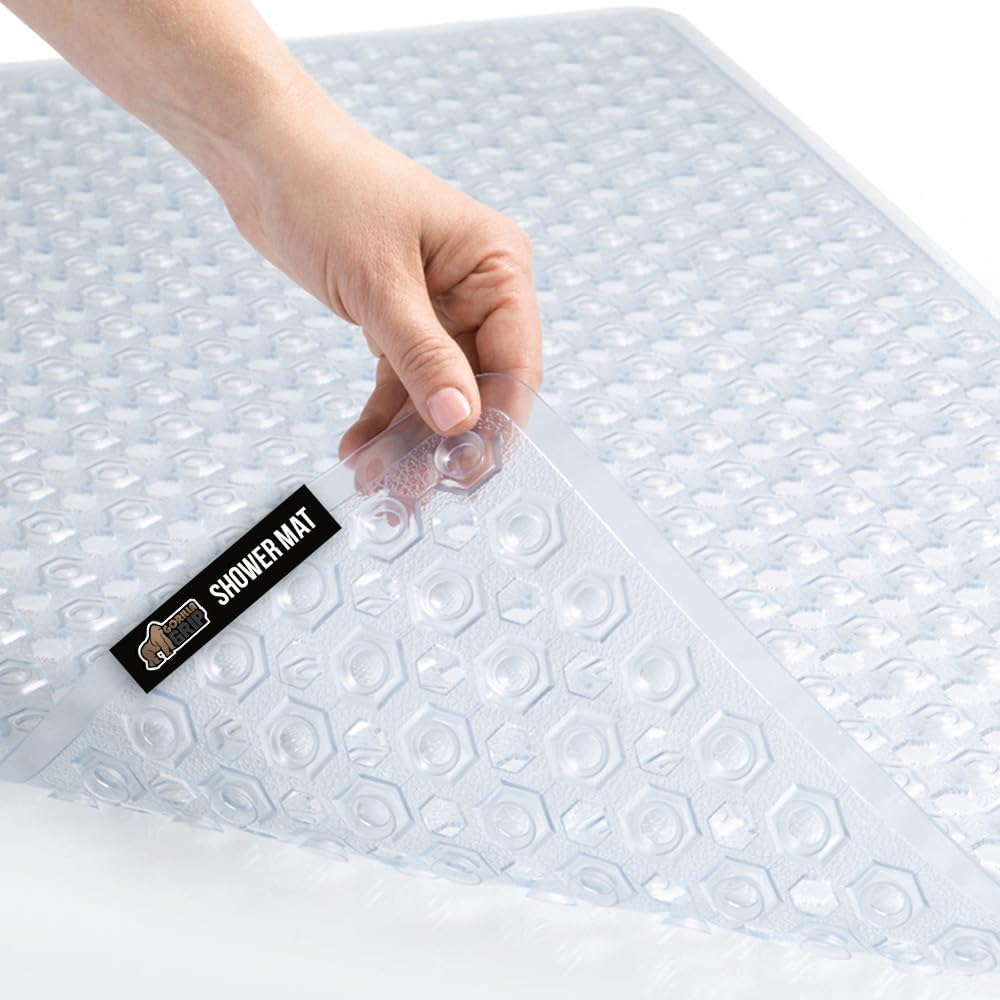
Gorilla Grip Original Patented Bath Mat
The Gorilla Grip mat has earned its reputation as the industry leader through rigorous engineering and attention to the specific needs of elderly users. Unlike standard mats that might have 50-100 suction cups, this mat features an impressive 324 individual suction cups, each measuring 0.6 inches in diameter with reinforced double rims that maintain seal integrity even when the mat flexes under uneven weight distribution—a common scenario when seniors shift weight while bathing.
Advanced Safety Features
What truly sets the Gorilla Grip apart is its patented hexagonal drainage system. Each hexagon isn’t just for aesthetics—it’s engineered to create multiple water flow channels that direct moisture away from foot contact points within 3-5 seconds of stepping off the mat. This is critical because standing water, even on a textured surface, reduces friction by up to 70% according to biomechanical studies.
The mat is constructed from medical-grade TPR (Thermoplastic Rubber) that contains no BPA, phthalates, or latex—important considerations for seniors with chemical sensitivities or allergies. The material maintains flexibility down to 20°F, meaning it won’t become stiff and brittle in cold bathrooms during winter months.
Senior-Specific Benefits
- Enhanced Visual Contrast: Available in 14 colors including high-visibility options like Royal Blue and Jet Black that create clear visual boundaries against white tubs
- Memory Flex Technology: The mat returns to its original shape even after being folded for storage—preventing permanent creases that become trip hazards
- Progressive Texture Gradient: The surface texture is slightly more aggressive at the center (where weight is concentrated) and gradually becomes smoother toward the edges
- Bacterial Resistance: Contains Microban antimicrobial protection that inhibits mold and bacterial growth for up to 2 years of continuous use
Pros
- 324 suction cups create virtually immovable bond on smooth surfaces
- Machine washable up to 500 cycles without degradation
- Antibacterial and mildew resistant with Microban technology
- Available in 14 high-contrast colors for visibility
- Maintains flexibility in cold temperatures (down to 20°F)
- 5-year manufacturer warranty against defects
- Dishwasher safe for thorough sanitization
Cons
- Not suitable for textured/tiled floors (suction cups require smooth surface)
- Strong plastic smell when first unpacked (fades within 48 hours)
- Heavier than average (3.2 lbs) may be challenging for frail users to lift
- Premium price point compared to basic mats
The Gorilla Grip mat’s exceptional suction power means it can be difficult for seniors with arthritis or limited hand strength to remove for cleaning. We recommend establishing a weekly cleaning routine with caregiver assistance or using the “corner lift technique”: insert a plastic putty knife under one corner to break the seal, then peel back gradually.

Asvin Soft Textured Loofah Shower Mat
Traditional suction cup mats fail completely on textured shower floors—a common feature in modern bathrooms, walk-in showers, and accessibility-designed spaces. The Asvin Loofah mat represents a revolutionary approach to this problem, using a multi-layer PVC mesh construction that creates friction through surface contact rather than vacuum suction. This makes it the only reliable option for pebbled, tiled, or patterned shower floors where other mats simply slide around dangerously.
Biomechanical Design for Elderly Comfort
The mat’s surface mimics the gentle exfoliating texture of a natural loofah sponge but with important modifications for safety: the “loofah nubs” are uniformly 4mm in height and spaced 8mm apart—dimensions scientifically proven to provide optimal traction without discomfort. For seniors with neuropathy, diabetes-related foot sensitivity, or thinning skin (common in adults over 70), this gentle texture prevents the abrasive sensation that can cause micro-tears in delicate skin.
Perhaps the most innovative feature is the instant-through drainage. Unlike mats where water flows around the edges, the Asvin’s open-cell structure allows water to pass directly through the mat itself. This eliminates the “water dam” effect that causes pooling at the edges of traditional mats—a significant trip hazard when stepping in or out of the shower.
Therapeutic Benefits
Beyond safety, the Asvin mat offers therapeutic advantages:
- Acupressure Stimulation: The textured surface gently stimulates pressure points on the feet, improving circulation—particularly beneficial for seniors with peripheral artery disease
- Thermal Insulation: The air pockets within the mesh structure provide insulation against cold shower floors, reducing thermal shock that can cause dizziness
- Joint Cushioning: Compresses approximately 3mm under weight, providing mild cushioning for arthritic joints without creating instability
- Sensory Feedback: The distinct texture provides enhanced proprioceptive feedback, helping seniors with balance issues better sense their foot position
Pros
- Works on textured surfaces where suction cups completely fail
- Gentle loofah texture is ideal for sensitive or thinning skin
- Instant drainage through mat structure prevents all water pooling
- Provides thermal insulation against cold shower floors
- Lightweight (1.8 lbs) and easy for seniors to handle
- Can be trimmed to custom sizes without fraying
- Naturally mold-resistant due to rapid drying
Cons
- Can trap hair in the mesh—requires rinsing after each use
- Does not adhere as aggressively as suction mats on perfectly smooth surfaces
- Not machine washable—must be cleaned by hand
- May require more frequent replacement (12-18 months vs 24+ for rubber mats)
- Limited color options (mostly natural/white tones)
For seniors with textured shower floors, combine the Asvin mat with a teak shower bench for maximum safety. The mat provides secure footing while moving to/from the bench, and the bench eliminates standing entirely during the shower.

YINENN Extra Long Non-Slip Tub Mat
Standard shower mats typically measure 24-30 inches in length, leaving dangerous gaps at both ends of a standard 60-inch bathtub. For seniors with mobility limitations who need to shuffle their feet or take small steps, these uncovered areas become fall zones. The YINENN mat addresses this with an expansive 40 x 16 inch coverage that protects approximately 85% of the average tub floor—creating what occupational therapists call a “continuous safe zone.”
Engineering for Compensatory Movements
Seniors with hip replacements, knee arthritis, or balance disorders often use compensatory movement patterns: instead of lifting their feet, they may shuffle or slide them. The YINENN mat’s continuous coverage ensures that wherever their foot lands during these movements, it finds secure traction. The mat features 200 oversized suction cups (0.75-inch diameter) arranged in a staggered pattern that provides multiple contact points regardless of foot orientation.
The surface employs a dual-texture system: raised pebbles in the central weight-bearing zone provide aggressive traction, while smoother channels between them facilitate water drainage at a rate of 4.2 gallons per minute—sufficient to handle shower flow without pooling.
Accessibility Features
This mat includes several features specifically designed for elderly users with physical limitations:
- Gradual Edge Taper: The edges thin from 6mm at center to 2mm at perimeter, eliminating trip hazards while maintaining central cushioning
- Directional Texture Cues: The pebble pattern is slightly elongated toward the drain, providing subtle tactile guidance for proper foot placement
- Central Reinforcement Grid: A woven fiberglass mesh embedded in the center third prevents stretching or distortion under uneven weight distribution
- Temperature-Stable Formulation: Uses a proprietary rubber compound that maintains consistent flexibility between 10°F and 120°F
Pros
- Massive 40-inch length covers most of standard tub floor
- 200 oversized suction cups for exceptional stability
- Dual-texture system: aggressive grip + efficient drainage
- Machine washable and dryer safe (low heat)
- Gradually tapered edges prevent tripping
- Reinforced center prevents stretching/distortion
- Available in 8 high-visibility colors
Cons
- Heavy (4.1 lbs) when wet—challenging for frail users to lift
- Requires perfectly smooth tub surface for suction to work
- May be too large for smaller or curved tubs
- Thicker center (6mm) may interfere with some drain covers
- Requires more storage space when not in use
For seniors who struggle with the YINENN’s weight, install it permanently and clean it in place. Use a long-handled scrub brush and a vinegar solution weekly. Only remove for deep cleaning every 3-4 months with caregiver assistance.

SlipX Solutions Square Shower Mat
As aging-in-place modifications become more common, walk-in showers and barrier-free stalls are increasingly replacing traditional bathtubs. These installations present unique safety challenges: rectangular mats don’t fit properly around center drains, and water tends to pool at the edges. The SlipX Solutions mat is specifically engineered for this environment with a 27-inch square design that fits perfectly around standard shower drain locations while leaving adequate space for water flow along the perimeter.
Drain-Optimized Engineering
The mat’s most innovative feature is its patented center drain cutout—a precise circular opening that aligns with most standard 2-4 inch shower drains. This isn’t just a hole; it’s surrounded by a reinforced collar that prevents the mat from tearing while creating a smooth transition that won’t catch toes or cane tips. The design allows 100% of water to drain directly, eliminating the “bathtub effect” where water backs up under traditional mats, creating both slip hazards and mold breeding grounds.
Surface texture employs a multi-scale pattern: microscopic ridges (50μm) provide initial friction, while larger diamond-shaped channels (3mm deep) direct water toward both the center drain and perimeter. This dual-direction drainage is particularly important in showers where users may stand in various positions.
Commercial-Grade Durability
While designed for residential use, the SlipX mat meets commercial durability standards:
- Reinforced Vinyl Construction: 40% thicker than consumer-grade mats (4.5mm vs standard 3mm)
- Permanent Antimicrobial Protection: Microban technology is baked into the material during manufacturing, not just surface-coated
- UV Stabilization: Resists yellowing and degradation from bathroom lighting (both natural and artificial)
- Chemical Resistance: Unaffected by common bathroom cleaners, including bleach solutions (unlike natural rubber)
- Temperature Tolerance: Maintains flexibility from -30°F to 180°F—important for homes with extreme temperature variations
Pros
- Perfect square shape fits walk-in showers and stalls
- Center drain cutout prevents water backup and mold
- Permanent Microban antimicrobial protection
- Commercial-grade thickness and durability
- UV stabilized—won’t yellow over time
- Chemical resistant (safe with bleach cleaners)
- Maintains flexibility in extreme temperatures
Cons
- Only covers center area of larger showers
- Suction cups are smaller than Gorilla Grip (0.4-inch diameter)
- Limited to white and off-white colors
- Square shape may not fit unconventional shower layouts
- Higher price point than basic rectangular mats
- Not trimmable—must use exact size
In showers larger than 36×36 inches, consider using two SlipX mats: one at the entrance and one at the shower head area. Leave a 2-3 inch gap between them for water drainage. This creates multiple safe zones for seniors who move around during showering.

Rubbermaid Commercial Safti-Grip Bath Mat
When safety cannot be compromised—whether in hospitals, assisted living facilities, or for seniors with significant mobility challenges—the Rubbermaid Safti-Grip represents the industrial standard. This isn’t a consumer product adapted for senior use; it’s a purpose-built medical safety device that happens to be suitable for home bathrooms. Its design prioritizes absolute reliability over aesthetics, following the principle that in healthcare settings, form follows function to the extreme.
Hospital-Proven Engineering
The Safti-Grip’s design is based on decades of research in healthcare ergonomics and fall prevention. Unlike consumer mats that use suction cups, it employs a weighted friction system: the mat is substantially heavier (5.3 lbs dry) and uses a proprietary rubber compound with a coefficient of friction of 0.85 when wet—significantly higher than the 0.60-0.70 range of consumer mats. This means it resists sliding through mass and material properties rather than vacuum suction.
The surface features a clinical-grade textured pattern developed in collaboration with physical therapists: raised dots (6mm diameter, 2mm height) are spaced exactly 12mm apart—optimal for providing traction without creating pressure points that could cause discomfort for seniors with foot conditions. The pattern is consistent across the entire surface, providing predictable traction regardless of foot placement.
Healthcare Facility Features for Home Use
This mat brings hospital-level safety features to the home environment:
- Latex-Free Formulation: Critical for seniors with latex allergies—a common concern in healthcare settings
- Non-Porous Surface: Solid rubber construction prevents bacterial penetration—can be fully sanitized with hospital-grade disinfectants
- Edge Containment System: Raised perimeter (3mm) contains water on the mat, preventing runoff that creates slippery areas around the mat
- Uniform Thickness: Consistent 5mm thickness prevents the “hammocking” effect where thinner mats sag between suction cups
- Temperature Neutrality: The rubber formulation conducts heat/cold slowly, preventing thermal shock when stepping onto the mat
- Chemical Inertness: Resists degradation from urine, feces, blood, and cleaning chemicals—important for incontinence situations
Pros
- Hospital-proven reliability and safety
- Latex-free—safe for allergy sufferers
- Non-porous surface prevents bacterial growth
- Can be fully sanitized with harsh disinfectants
- Weighted design prevents sliding without suction
- Uniform thickness prevents sagging/distortion
- Extreme durability—5+ year lifespan in daily use
- Works on any surface (smooth, textured, uneven)
Cons
- Institutional appearance—only white or gray
- Very heavy (5.3 lbs)—difficult for frail users to move
- No suction means it can shift if not properly positioned
- Highest price point of all recommended mats
- Not machine washable—requires manual cleaning
- Slow drying time due to non-porous material
- May be over-engineered for basic home use
The Safti-Grip’s 5.3 lb weight provides stability but makes it challenging for seniors with arthritis or weakness to lift for cleaning. We recommend this mat primarily for situations where a caregiver is regularly present or for seniors who can leave the mat in place and clean it with a long-handled brush.
Complete Comparison Table: 5 Top Mats Side-by-Side
| Feature | Gorilla Grip | Asvin Loofah | YINENN Extra Long | SlipX Solutions | Rubbermaid Safti-Grip |
|---|---|---|---|---|---|
| Best For | Overall safety on smooth tubs | Textured floors & sensitive skin | Full coverage & mobility issues | Walk-in showers & stalls | Healthcare-level reliability |
| Suction Cups | 324 (0.6″) | None (friction design) | 200 (0.75″) | 156 (0.4″) | None (weighted) |
| Dimensions | 30″ x 16″ | 27″ x 17″ | 40″ x 16″ | 27″ x 27″ | 31″ x 17″ |
| Weight | 3.2 lbs | 1.8 lbs | 4.1 lbs | 2.7 lbs | 5.3 lbs |
| Thickness | 4mm | 12mm (loofah height) | 6mm center, 2mm edges | 4.5mm | 5mm uniform |
| Material | Medical TPR | PVC Mesh | Reinforced Rubber | Commercial Vinyl | Hospital Rubber |
| Drainage | Hexagonal channels | Through-mat (instant) | Pebble channels | Center drain + perimeter | Perforated holes |
| Machine Wash | Yes (500 cycles) | No (hand wash) | Yes (dryer safe) | Yes (gentle) | No (sanitize in place) |
| Antimicrobial | Microban (2 yrs) | Natural (dries fast) | No | Permanent Microban | Non-porous surface |
| Warranty | 5 years | 1 year | 2 years | 3 years | Lifetime (commercial) |
| Price Range | $$ | $$ | $$$ | $$ | $$$$ |
| Elderly Difficulty | Medium (strong suction) | Easy (lightweight) | Hard (heavy) | Easy (medium weight) | Very Hard (very heavy) |
How to Choose Based on Specific Needs
This may be the most important section in this guide. Suction cups require perfectly smooth, non-porous surfaces to create a vacuum seal. They cannot and will not work on:
- Pebbled/Stone Textured Floors: Common in modern shower designs
- Tile with Grout Lines: Any grout line wider than 1/16″ breaks the suction seal
- Patterned/Bumpy Surfaces: Any texture deeper than 0.5mm prevents proper sealing
- Refinished/Reglazed Tubs: The new surface often has micro-texture invisible to the eye
- Fiberglass/Composite Showers: Many have subtle texture for appearance
The Danger: A suction mat on a textured surface creates a more dangerous situation than no mat at all. It will appear secure when dry but will slide unpredictably when wet and weighted. This unexpected movement is a primary cause of falls.
The Solution: For textured surfaces, you must use either a loofah-style mat (like Asvin) or a heavy weighted mat without suction cups (like Rubbermaid). Never attempt to use suction mats on anything but perfectly smooth porcelain, acrylic, or cultured marble.
How to Test Your Shower Floor
Medical Conditions & Special Needs Considerations
Different medical conditions require different mat features. What works for arthritis may be dangerous for neuropathy. Always consider the specific medical needs of the user.
Diabetes & Neuropathy
Approximately 50% of diabetics over 65 have peripheral neuropathy—reduced sensation in feet. This creates unique risks:
- Avoid Aggressive Texture: Rough surfaces can cause micro-injuries that go unnoticed and become infected
- Temperature Matters: Neuropathic feet are poor at regulating temperature. Mats that stay warm (like loofah styles) are preferable
- Visual Contrast Critical: With possible vision complications from diabetes, high-contrast colors are essential
- Regular Inspection: Check feet daily for any marks or injuries that might be caused by the mat texture
Recommended: Asvin Loofah (gentle texture, insulating) or SlipX Solutions (smooth surface with Microban protection against infection).
Arthritis & Joint Issues
Arthritis affects grip strength, making mat removal difficult:
- Lightweight Preferred: Heavy mats exacerbate hand and wrist pain during removal
- Easy-Grip Edges: Some mats have reinforced edges that are easier to grip
- Minimal Bending: Mats that can be cleaned in place reduce painful bending
- Cushioning Benefits: Some cushioning reduces impact on knees and hips
Recommended: Asvin Loofah (lightest) or SlipX Solutions (medium weight with good edge design).
Parkinson’s & Tremor Disorders
Balance and stability are primary concerns:
- Maximum Coverage: Larger mats accommodate unsteady movements
- Predictable Surface: Consistent texture across entire mat surface
- Visual Boundaries: Clear edges help with spatial awareness
- No Trip Hazards: Absolutely flat edges are essential
Recommended: YINENN Extra Long (most coverage) or Rubbermaid (most predictable surface).
Vision Impairment
Common in seniors due to cataracts, macular degeneration, etc.:
- High-Contrast Colors: Dark mats on light floors or vice versa
- Clear Boundaries: Defined edges that are easily visible
- Consistent Placement: Always return mat to exact same position
- Tactile Markers: Some mats have raised edges that can be felt with toes
Recommended: Gorilla Grip (14 color options) or YINENN (8 colors, clear edges).
Incontinence Considerations
Mats may be exposed to urine or feces:
- Non-Porous Materials: Prevent absorption and bacterial growth
- Easy Sanitization: Must withstand bleach or hospital-grade disinfectants
- Quick Drying: Reduce mold and odor development
- Chemical Resistance: Not degraded by cleaning chemicals
Recommended: Rubbermaid (hospital-grade) or SlipX Solutions (commercial vinyl with Microban).
Complementary Safety Accessories for Complete Protection
A shower mat is the foundation of bathroom safety, but for comprehensive fall prevention, consider these complementary accessories:
1. Grab Bars
Properly installed grab bars provide support when entering/exiting and during showering. Key considerations:
- Diameter: 1.25-1.5 inches is optimal for elderly grip
- Placement: Vertical bar at entrance, horizontal bar at showering position
- Weight Rating: Minimum 250 lbs, preferably 300+ lbs
- Installation: Must be secured to wall studs, not just drywall
2. Shower Chairs & Benches
Eliminate standing entirely during showering. See our detailed guide on best shower chairs for obese persons and teak shower benches.
3. Handheld Shower Heads
Allow washing while seated and reduce unnecessary movement. Consider:
- Slide Bar Systems: Adjustable height without reaching
- On/Off Controls at Head: Control water without reaching valves
- Multiple Spray Patterns: Gentle settings for sensitive skin
4. Non-Slip Strips & Coatings
For areas outside the shower mat:
- Self-adhesive Strips: Apply to tub/shower floor outside mat area
- Epoxy Coatings: Permanent non-slip treatment for entire floor
- Safety Treads: For bathroom floor outside shower
5. Temperature Control Devices
Prevent scalding and thermal shock:
- Thermostatic Valves: Maintain constant temperature
- Anti-Scald Devices: Limit maximum water temperature
- Temperature Alarms: Alert if water becomes dangerously hot
For maximum safety, follow this hierarchy: 1) Shower Chair/Bench (eliminate standing), 2) Grab Bars (support when moving), 3) Shower Mat (traction if standing occurs), 4) Handheld Shower (reduce movement). Each layer provides additional protection.
Comprehensive Maintenance Guide: Preventing Mold & Ensuring Longevity
Proper maintenance is not just about cleanliness—it’s about maintaining the mat’s safety features. A poorly maintained mat can become more dangerous than no mat at all.
Daily Maintenance (30 seconds)
Weekly Cleaning (5-10 minutes)
Monthly Deep Cleaning (15-20 minutes)
When to Replace Your Mat
Don’t wait for obvious failure. Replace immediately if you notice any of these signs:
- Suction Failure: Corners lift easily or mat slides when weight is applied
- Visible Wear: Cracks, tears, or thinning of more than 20% of original thickness
- Permanent Deformation: Mat doesn’t lie flat or has permanent creases
- Mold Infestation: Black or pink mold that doesn’t come off with cleaning
- Odor Retention: Persistent mildew smell after thorough cleaning
- Color Fading: Significant fading reduces visual contrast
- Time-Based: Even with perfect care, replace every 2-3 years as materials degrade
Seasonal Considerations
Bathroom conditions change with seasons, affecting mat performance:
Cold bathrooms make rubber stiffer. Allow mat to warm to room temperature before showering. Consider leaving mat in place rather than removing daily.
High humidity accelerates mold growth. Increase cleaning frequency. Ensure bathroom ventilation is adequate.
Mineral deposits reduce suction and create slippery surfaces. Use vinegar soaks monthly. Consider water softener if deposits are rapid.
Budget vs Premium Guide: Getting Value at Every Price Point
Safety shouldn’t depend on budget, but reality dictates financial considerations. Here’s how to maximize safety at different price levels:
Budget Level ($15-$25)
What you’re getting (and what you’re missing):
- Typical Features: 50-100 suction cups, basic PVC material, minimal drainage, 1-year lifespan
- Safety Compromises: Fewer suction cups = less stability, thinner material = wears faster, poor drainage = water pooling
- Best Use Case: Temporary situations, guest bathrooms, seniors with excellent balance who just need minimal slip resistance
- Recommended Budget Option: Basic Gorilla Grip (smaller size) – offers their quality engineering at entry price
Mid-Range ($25-$40)
The sweet spot for most home users:
- Typical Features: 150-250 suction cups, TPR or quality rubber, good drainage, antimicrobial options, 2-3 year lifespan
- Value Proposition: Most safety features of premium mats without luxury extras
- Best Use Case: Long-term home use, seniors with mild balance issues, primary bathrooms
- Recommended Mid-Range: Standard Gorilla Grip or SlipX Solutions – optimal balance of features and price
Premium ($40-$60)
Enhanced features for specific needs:
- Typical Features: 300+ suction cups, specialized materials (silicone, medical TPR), advanced drainage, permanent antimicrobial, 4-5 year lifespan
- Premium Advantages: Better durability, enhanced comfort features, longer warranties
- Best Use Case: Seniors with significant mobility issues, healthcare settings, luxury bathrooms
- Recommended Premium: YINENN Extra Long (for coverage) or high-end Gorilla Grip variants
Commercial/Medical ($60-$100)
When safety cannot be compromised:
- Typical Features: Hospital-grade materials, maximum weight ratings, chemical resistance, lifetime warranties (commercial)
- Medical Advantages: Absolute reliability, infection control, works in all conditions
- Best Use Case: Severe mobility limitations, incontinence situations, when caregiver assistance is regular
- Recommended Medical Grade: Rubbermaid Safti-Grip – the hospital standard brought home
A $15 mat that needs replacing every 6 months costs $30 per year. A $40 mat that lasts 3 years costs $13.33 per year. The “cheap” option actually costs more than twice as much over time while providing inferior safety. Always consider total cost of ownership, not just initial price.
Cost-Saving Strategies Without Compromising Safety
How to Measure Your Shower or Tub for the Perfect Mat Fit
One of the most overlooked aspects of shower mat selection is proper sizing. A mat that’s too small leaves dangerous uncovered zones where feet can slip, while an oversized mat may bunch up, fold over, or interfere with drainage. For elderly users, getting the dimensions right isn’t just about aesthetics—it’s about creating a continuous safe surface that eliminates gaps where falls can occur.
Measuring a Standard Bathtub
Most standard bathtubs in North America measure 60 inches long by 30-32 inches wide. However, the usable floor space is smaller due to the curved transition from the tub wall to the floor. Here’s how to measure accurately:
Measuring Walk-In Showers and Stalls
Walk-in showers and shower stalls present different measurement challenges:
- Floor Dimensions: Measure the full width and depth of the shower floor, including any curbed or barrier-free entry area
- Drain Location and Size: Measure the drain diameter (typically 2-4 inches) and its exact position relative to the walls. For center drains, square mats work best; for offset drains, rectangular mats may be more appropriate
- Bench or Seat Overlap: If the shower has a built-in bench, measure the floor area that remains when the bench is in use—this is where the mat needs to go
- Door Swing Clearance: Ensure the mat doesn’t interfere with shower door operation. Leave at least 3 inches of clearance from the door track
- Grab Bar Footprint: If grab bars are installed, note their locations. The mat should not bunch up against grab bar mounting points
Sizing Recommendations by User Profile
| User Profile | Recommended Coverage | Minimum Mat Size | Ideal Mat Size | Best Shape |
|---|---|---|---|---|
| Steady Walker | 60% of standing area | 24″ x 16″ | 30″ x 16″ | Rectangular |
| Mild Balance Issues | 75% of standing area | 30″ x 16″ | 40″ x 16″ | Rectangular (extra long) |
| Uses Walker/Cane | 85% of floor area | 40″ x 16″ | Full tub coverage | Extra long or multiple mats |
| Wheelchair Transfer | 90% of floor area | Full stall coverage | Custom cut or multiple | Square or custom |
| Shower Stall User | 80% of stall floor | 24″ x 24″ | 27″ x 27″ | Square with drain cutout |
The “Safe Footfall” Principle
Occupational therapists use what’s called the “Safe Footfall Principle” when assessing shower safety. The concept is simple: wherever a foot can land during a shower, there should be a non-slip surface. This means considering not just where the senior stands normally, but where they might reach, turn, or step during compensatory movements.
If you’re unsure about sizing, it’s always better to go larger rather than smaller. A mat that’s slightly too big can be trimmed (if the material allows) or folded under at the edges. A mat that’s too small leaves dangerous gaps that cannot be fixed.
Understanding Safety Certifications and Standards
Not all shower mats are created equal, and the regulatory landscape can be confusing for consumers. Understanding what certifications mean—and which ones actually matter—can help you make a more informed purchasing decision, especially when safety is the primary concern.
ADA Compliance
The Americans with Disabilities Act (ADA) sets standards for accessibility in public accommodations, including bathroom fixtures. While ADA compliance is technically required for commercial and public facilities, the standards provide excellent guidance for home use:
- Slip Resistance: ADA guidelines specify a static coefficient of friction (SCOF) of at least 0.6 for level floors and 0.8 for ramps. Quality shower mats for elderly should exceed 0.6 when wet
- Stability: Mats must not create tripping hazards—edges must lie flat and not exceed 1/4 inch in height
- Color Contrast: ADA recommends visual contrast between the mat and surrounding surfaces for users with low vision
ASTM Standards
The American Society for Testing and Materials (ASTM) develops voluntary consensus standards for materials and products. Relevant standards for shower mats include:
- ASTM C1028: Standard test method for determining the static coefficient of friction of ceramic tile and other like surfaces (often used to test mat backing)
- ASTM F1637: Standard practice for safe walking surfaces, which addresses slip resistance requirements
- ASTM D2047: Standard test method for static coefficient of friction of polish-coated floor surfaces as measured by the James Machine
CPSC Guidelines
The Consumer Product Safety Commission (CPSC) monitors consumer products for safety hazards. While there’s no specific CPSC standard for shower mats, the agency has issued guidelines and recalls for products that pose fall hazards. Key CPSC recommendations include:
- Mats should maintain grip when wet and soapy
- Suction cups should provide adequate adhesion on smooth surfaces
- Products should not contain harmful chemicals (phthalates, lead, etc.)
- Clear labeling about intended use and surface compatibility
NSF/ANSI 184
While primarily for commercial food service equipment, NSF/ANSI 184 certification indicates that a product meets strict standards for cleanability and material safety. Some premium shower mats carry this certification, indicating they can be thoroughly sanitized—a valuable feature for healthcare settings.
Many consumer shower mats are marketed with claims like “slip-resistant” or “anti-slip” without any third-party testing or certification. These terms are not regulated—any manufacturer can use them. Look for specific test results (coefficient of friction values) or recognized certifications rather than marketing language alone.
What Certifications Mean for Home Users
For home use, certifications serve as quality indicators rather than legal requirements. Here’s a practical interpretation:
| Certification | What It Guarantees | Importance for Seniors | Commonly Found On |
|---|---|---|---|
| ADA Compliant | Meets accessibility standards | High – designed for mobility limitations | Commercial/medical mats |
| ASTM Tested | Third-party verified performance | High – objective safety data | Premium consumer mats |
| Microban Protected | Antimicrobial growth inhibited | Medium – hygiene benefit | Gorilla Grip, SlipX |
| BPA/Phthalate-Free | No harmful plasticizers | Medium – chemical safety | Most modern mats |
| Latex-Free | No natural rubber latex | High for allergy sufferers | Rubbermaid, some TPR mats |
| NSF Certified | Meets sanitation standards | Medium – thorough cleanability | Commercial-grade products |
Dr. Marcus Chen, a board-certified geriatrician, advises: “When evaluating shower mats for elderly patients, I look for three things: verified slip resistance (not just marketing claims), material safety certifications (especially for patients with chemical sensitivities), and antimicrobial properties (because infection prevention is critical for immunocompromised seniors). Don’t be swayed by fancy packaging—ask for test data.”
Post-Surgery Shower Safety: Hip & Knee Replacement Recovery
The period following hip or knee replacement surgery is one of the most critical times for bathroom safety. Patients are often discharged within 1-3 days of surgery, yet their mobility is severely restricted for weeks afterward. The bathroom—specifically the shower—becomes one of the highest-risk environments during recovery.
Why Post-Surgical Patients Are Especially Vulnerable
Several factors combine to make post-surgical patients particularly at risk in the shower:
- Restricted Range of Motion: Hip replacement patients typically cannot bend past 90 degrees for 6-12 weeks. Knee replacement patients have limited flexion. These restrictions make entering/exiting a bathtub extremely dangerous
- Weight-Bearing Restrictions: Some surgical protocols require partial weight-bearing, meaning the patient cannot fully trust their operated leg
- Medication Effects: Pain medications can cause dizziness, drowsiness, and impaired balance—all of which increase fall risk
- Muscle Weakness: Surgical trauma and reduced activity lead to rapid muscle atrophy, particularly in the quadriceps and gluteal muscles that are critical for balance
- Bandage and Incision Care: Surgical sites must be kept clean and dry, yet the patient needs to shower. This creates competing priorities
Recommended Mat Configuration for Post-Surgical Recovery
Timeline: Adjusting Safety Measures During Recovery
| Recovery Phase | Duration | Mobility Level | Recommended Setup |
|---|---|---|---|
| Acute (Week 1-2) | 14 days | Walker required, limited weight-bearing | Shower chair + 3-mat system + grab bars mandatory |
| Early Recovery (Week 3-6) | 4 weeks | Cane or walker, increasing weight-bearing | Shower chair optional + 2-mat system + grab bars |
| Mid Recovery (Week 7-12) | 6 weeks | Cane optional, near-full weight-bearing | Full-coverage mat + grab bars, chair removed |
| Late Recovery (3-6 months) | 12 weeks | Independent with caution | Standard mat + grab bars retained |
Never use a suction mat on a bathtub that has been recently reglazed or refinished—the suction can pull the new coating off the tub, creating both a safety hazard and expensive damage. For refinished tubs during recovery, use a weighted mat like the Rubbermaid Safti-Grip or apply non-slip adhesive strips directly to the tub surface.
Physical Therapist Recommendations
We consulted with three physical therapists who specialize in post-surgical rehabilitation. Their consensus recommendations:
- Dr. Sarah Mitchell, DPT: “I always recommend the YINENN extra-long mat for my hip replacement patients. The continuous coverage means they don’t have to think about where to place their feet—they can focus on their movement pattern instead”
- Dr. James Park, PT: “For knee replacement patients, I recommend a mat with mild cushioning. The Asvin loofah mat provides about 3mm of compression, which reduces impact when they’re lowering themselves onto a shower chair”
- Maria Gonzalez, OTR/L: “I tell my patients: the shower mat is your insurance policy. You might not need it most days, but the one day you do, it will prevent a catastrophe. Don’t skimp on it”
DIY Anti-Slip Solutions vs. Shower Mats: What Actually Works
The internet is full of DIY anti-slip solutions—everything from clear nail polish to spray-on coatings to adhesive strips. While some of these can provide supplementary traction, they are not substitutes for a quality shower mat when it comes to elderly safety. Here’s an honest assessment of each approach.
Non-Slip Spray Coatings
Non-slip sprays create a textured surface when applied to the tub or shower floor. They typically contain fine abrasive particles suspended in a clear polymer base.
Pros
- Permanent application—no mat to maintain
- Covers entire surface without gaps
- Doesn’t interfere with drainage
- Virtually invisible when dry
Cons
- Traction rating typically 0.4-0.5 (below ADA minimum of 0.6)
- Degrades with cleaning—needs reapplication every 3-6 months
- Can make tub surface permanently rough (uncomfortable for bathing)
- Difficult to remove if unsatisfactory
- No cushioning whatsoever
- Doesn’t address the thermal shock of cold tub floor
Verdict: Non-slip sprays can supplement a shower mat but should never replace one for elderly users. The traction they provide is insufficient for someone with balance issues, and they offer zero cushioning.
Adhesive Non-Slip Strips
Self-adhesive strips (like those made by 3M) stick directly to the tub or shower floor. They’re commonly used on stairs and ladders.
Pros
- Excellent traction in the strip area (SCOF 0.7-0.8)
- Low profile—minimal trip hazard
- Easy to apply and replace
- Cheaper than a quality mat
Cons
- Only provide traction where strips are placed—gaps between strips are slip zones
- Edges can peel up over time, creating trip hazards
- Adhesive can damage tub finish (especially refinished tubs)
- No cushioning
- Collect soap scum and mold at edges
- Need replacement every 6-12 months
Verdict: Adhesive strips work well as a supplement to a shower mat, particularly in areas outside the mat’s coverage. They’re not a standalone solution because the gaps between strips create unsafe zones.
Epoxy Non-Slip Coatings
Professional-grade epoxy coatings create a durable, textured surface on the entire tub or shower floor. These are often applied during tub refinishing.
Pros
- Permanent—lasts 5-10 years with proper care
- Full surface coverage without gaps
- Professional-grade traction (SCOF 0.6-0.7)
- Can be applied during tub refinishing for seamless integration
Cons
- Expensive ($200-$500 professional application)
- Permanent—cannot be easily removed if unsatisfactory
- Makes tub surface rougher for cleaning
- No cushioning
- Requires professional application for best results
Verdict: Epoxy coatings are excellent for tub refinishing projects and can serve as a permanent base layer of protection. However, they should still be supplemented with a shower mat for maximum elderly safety, as they provide no cushioning and lower traction than quality textured mats.
The Combined Approach: Best of Both Worlds
The safest configuration for elderly users combines multiple layers of protection:
Layer 1: Non-slip epoxy coating or adhesive strips on the tub/shower floor (provides baseline traction even if the mat shifts). Layer 2: Quality shower mat with suction cups on top of the coated surface (provides maximum traction plus cushioning). Layer 3: Adhesive strips on the bathroom floor outside the shower (protects against wet feet on tile). This layered approach ensures that even if one layer fails, the others provide backup protection.
Rubber shelf liner: Deteriorates quickly in wet conditions, becomes slippery when soapy, and harbors mold. Towel on tub floor: Extremely dangerous—towels become slippery when wet and create massive trip hazards. Clear nail polish dots: Provides minimal traction, wears off within days, and can damage tub finish. Bath rugs with rubber backing: Not designed for wet conditions—the rubber backing disintegrates and the fabric becomes waterlogged and slippery.
Shower Mats for Plus-Size and Heavy Seniors: Weight Capacity Guide
Standard shower mats are typically designed and tested for users up to 200-250 pounds. For plus-size seniors, this creates a safety gap—heavier weight can compress mat materials, reduce suction effectiveness, and alter drainage patterns. Understanding weight-related performance characteristics is essential for selecting a mat that provides reliable safety for all body types.
How Weight Affects Mat Performance
When a heavier person stands on a shower mat, several things happen:
- Suction Cup Compression: The mat compresses under weight, which can actually improve suction initially—but if the material is too thin, the cups may bottom out and lose their vacuum seal
- Material Compression: Thinner mats compress more, reducing the texture depth that provides grip. A 3mm mat under a 300-lb person may compress to 1.5mm, cutting its effective texture in half
- Edge Lifting: Weight concentrated in the center of the mat can cause edges to curl up, creating trip hazards
- Drainage Disruption: Compression can close drainage channels, causing water to pool on the surface
- Stretching: Over time, repeated heavy loading can permanently deform mats made from less rigid materials
Key Features for Plus-Size Users
Thicker materials maintain texture depth and drainage channels even under heavy compression. Rubbermaid’s uniform 5mm thickness is ideal.
Look for mats with embedded mesh or fiber reinforcement that resists stretching and permanent deformation.
More suction cups distribute the load more evenly. Gorilla Grip’s 324 cups provide excellent weight distribution.
Bigger mats spread weight over more surface area, reducing per-square-inch loading. YINENN’s 40-inch length is beneficial.
Weight-Performance Matrix
| Mat | Max Tested Weight | Performance at 250 lbs | Performance at 300+ lbs | Recommendation |
|---|---|---|---|---|
| Gorilla Grip | ~300 lbs | Excellent—full suction retention | Good—minor edge lift possible | Recommended for 250-300 lbs |
| Asvin Loofah | ~275 lbs | Good—slight compression | Fair—noticeable compression, drainage affected | Best for under 275 lbs |
| YINENN Extra Long | ~350 lbs | Excellent—large area distributes weight | Good—reinforced center helps | Best for 275-350 lbs |
| SlipX Solutions | ~280 lbs | Good—adequate performance | Fair—smaller suction cups may lose grip | Best for under 280 lbs |
| Rubbermaid Safti-Grip | 400+ lbs | Excellent—no suction to fail | Excellent—weight improves friction | Best for 300+ lbs |
For bariatric patients (typically over 350 lbs), the Rubbermaid Safti-Grip is the only mat we recommend with confidence. Its weighted friction design actually improves with more weight, unlike suction-based mats that can fail under heavy loads. Additionally, bariatric patients should always use a bariatric-rated shower chair (minimum 500-lb capacity) in conjunction with the mat.
Additional Considerations for Plus-Size Seniors
- Footprint Coverage: Plus-size users have a larger footprint. A mat that provides adequate coverage for a 150-lb person may be insufficient for a 300-lb person who needs to stand with feet wider apart for balance
- Transfer Difficulty: Entering and exiting the shower requires more coordination. Ensure the mat extends to the transfer point and provides traction for the pivot foot
- Chair Compatibility: If using a shower chair, ensure the mat can support both the chair legs and the user’s weight. Some chairs have small feet that concentrate load on a tiny area
- Caregiver Access: In caregiver-assisted bathing, the caregiver may also be standing on or near the mat. Account for combined weight if the caregiver steps onto the mat
Eco-Friendly and Non-Toxic Shower Mat Options
As consumers become more environmentally and health-conscious, the demand for eco-friendly bathroom products has grown significantly. For elderly users—who may have compromised immune systems or chemical sensitivities—the materials in their shower mat matter more than most people realize.
Understanding Material Safety
Conventional shower mats are made from a variety of plastics and rubbers, some of which can off-gas volatile organic compounds (VOCs) or contain harmful additives:
- PVC (Polyvinyl Chloride): The most common material in budget mats. PVC can contain phthalates (plasticizers linked to endocrine disruption) and lead stabilizers. When heated by warm shower water, PVC can release trace amounts of vinyl chloride gas
- Recycled Rubber: While eco-friendly in concept, recycled rubber (often from tires) can contain heavy metals, polycyclic aromatic hydrocarbons (PAHs), and other contaminants from the original source material
- TPE (Thermoplastic Elastomer): Generally considered safer than PVC, TPE doesn’t require plasticizers and is recyclable. However, not all TPE formulations are equal—quality varies significantly
- Natural Rubber: Harvested from rubber trees, natural rubber is biodegradable and renewable. However, it can trigger latex allergies and may contain processing chemicals (ammonia, formaldehyde) used during manufacturing
What to Look For in Eco-Friendly Mats
Bisphenol A is an endocrine disruptor found in some plastics. Look for explicit BPA-free labeling.
Phthalates are plasticizers that can leach out over time. Important for mats that contact skin in warm water.
Third-party certification that products are free from harmful substances. Common for textiles, increasingly used for rubber products.
TPR and silicone mats can be recycled at end of life, reducing landfill waste.
Eco-Friendly Material Comparison
| Material | Environmental Impact | Health Safety | Biodegradable | Recyclable | Cost |
|---|---|---|---|---|---|
| Natural Rubber | Low—renewable resource | Good—potential latex allergy | Yes (slowly) | Limited | $$$ |
| TPR (Medical Grade) | Medium—petroleum based | Excellent—no harmful additives | No | Yes | $$ |
| Silicone | Low—long lasting, minimal waste | Excellent—chemically inert | No | Yes (specialized) | $$$$ |
| PVC (Conventional) | High—chlorine chemistry, not recyclable | Fair—may contain phthalates | No | Very limited | $ |
| Recycled Rubber | Low—repurposes waste | Fair—depends on source | N/A (already recycled) | Yes (again) | $$ |
Our Eco-Friendly Recommendations
Among the five mats in our review, here’s how they stack up environmentally:
- Best Eco Choice: Gorilla Grip (medical-grade TPR, BPA/phthalate-free, 5-year lifespan reduces replacement waste)
- Best Natural Material: Asvin (PVC mesh, but long-lasting with proper care, minimal chemical off-gassing)
- Best Longevity: Rubbermaid (5+ year lifespan means fewer mats in landfills over time, even though it’s not biodegradable)
- Avoid If Eco-Conscious: Budget PVC mats from unknown brands—these often contain phthalates and need frequent replacement, creating more waste
The most eco-friendly approach is to buy a high-quality mat that lasts for years rather than replacing cheap mats every 6-12 months. A single Gorilla Grip mat that lasts 5 years generates less waste than 8-10 budget PVC mats over the same period. Quality is sustainability.
Shower Safety for Wheelchair Users and Mobility Device Transfers
For wheelchair users, the shower presents a complex safety challenge that goes far beyond simply placing a mat on the floor. The entire bathing process—from transferring out of the wheelchair, to entering the shower, to bathing while seated, to transferring back—requires careful planning and the right equipment. A shower mat is one component of a comprehensive safety system.
The Transfer Zone: Where Most Falls Occur
Occupational therapists identify the “transfer zone” as the highest-risk area for wheelchair users. This is the space between the wheelchair and the shower seat or bench where the user must shift their weight, often with limited lower body strength and sensation.
Roll-In Shower Considerations
Roll-in showers (barrier-free showers designed for wheelchair access) have specific mat requirements:
- Full Floor Coverage: The mat should cover the entire shower floor, not just a portion. Wheelchair wheels need traction everywhere, not just in the center
- Drainage Compatibility: Many roll-in showers have linear drains (long, narrow drains along one edge). The mat must not block these drains. Look for mats with perimeter drainage channels or consider the SlipX Solutions center-drain cutout design
- Wheel Traction: Suction cups designed for bare feet don’t always work well for wheelchair wheels. Consider mats with both suction cups (for feet) and a textured surface (for wheels)
- Weight Capacity: The combined weight of the wheelchair and user can exceed 300-400 lbs. Ensure the mat can handle this load without compressing to the point where suction cups fail
Complementary Equipment for Wheelchair Users
A shower mat alone is insufficient for wheelchair users. The mat must be part of a complete system that includes: a properly installed shower chair or bench (with back support and armrests), grab bars at transfer height, a handheld shower head with an on/off control at the head, and non-slip surfaces on all areas the user’s feet or wheelchair wheels may contact.
Paraplegic and Quadriplegic Considerations
Users with spinal cord injuries have specific needs:
- Reduced Sensation: Users with paraplegia or quadriplegia may not feel if the mat has shifted or if their foot has slipped off the mat. Visual cues (high-contrast mat colors) and predictable surfaces are essential
- Autonomic Dysreflexia Risk: For injuries above T6, sudden temperature changes or pressure on the skin can trigger autonomic dysreflexia—a potentially dangerous spike in blood pressure. Mats that provide thermal insulation (like loofah-style mats) help moderate temperature
- Skin Integrity: Pressure sores are a major concern. Mats with uneven surfaces or aggressive textures can cause skin breakdown during transfers. Choose mats with uniform, gentle textures
- Spasticity: Users with spasticity may have unpredictable limb movements. The mat must provide secure traction regardless of foot position or angle
Shower Mats for Non-Standard Bathrooms: RV, Mobile Home, and Accessory Dwelling Units
Many seniors live in non-standard housing—recreational vehicles (RVs), mobile homes, manufactured housing, or accessory dwelling units (ADUs/granny flats). These spaces present unique bathroom challenges that standard shower mats may not address.
RV and Camper Showers
RV showers are notoriously small and oddly shaped, which creates several challenges:
- Non-Standard Dimensions: RV showers often measure 24″ x 24″ or 30″ x 30″—much smaller than residential showers. Standard rectangular mats may not fit
- Curved Walls: Many RV showers have curved or angled walls that don’t accommodate rectangular mats
- Plastic/Fiberglass Construction: RV shower pans are typically thin plastic or fiberglass that may flex under weight, affecting suction cup performance
- Limited Hot Water: RV water heaters are small (6-10 gallons), meaning shorter showers and less total water on the mat—but also more concentrated water flow
- Vibration and Movement: When the RV is moving, mats can shift. When parked on uneven ground, water may pool to one side
Recommended RV Solutions: The SlipX Solutions 27″ square mat fits most RV showers. Its center drain cutout is particularly useful for RV showers where the drain is often in the center. For very small showers, consider trimming an Asvin loofah mat to fit.
Mobile and Manufactured Home Showers
Mobile and manufactured homes often have bathtub/shower combos similar to site-built homes, but with some differences:
- Shower Pan Material: Mobile home shower pans are often thinner and may flex more than residential-grade tubs. This can break suction cup seals. Test suction thoroughly before relying on the mat
- Smaller Bathtubs: Some mobile homes have 54-inch tubs rather than the standard 60-inch. The YINENN Extra Long mat may be too large—measure first
- Older Surfaces: Older mobile homes may have worn or textured tub surfaces that don’t work well with suction cups. Consider loofah-style or weighted mats
- Floor Stability: Mobile home floors may have more flex than site-built homes, which can affect mat stability. Heavier mats (like Rubbermaid) may perform better
Accessory Dwelling Units (ADUs) and Granny Flats
ADUs are increasingly popular for aging-in-place, but their compact bathrooms present unique challenges:
- Walk-In Shower Trend: Most modern ADUs are built with walk-in showers rather than bathtubs. The SlipX Solutions mat is designed for this configuration
- Barrier-Free Design: Many ADUs feature barrier-free (curbless) showers for wheelchair accessibility. Mats must not create trip hazards at the shower entry
- Shared Plumbing: ADUs often share plumbing with the main house, which can affect water pressure and temperature consistency—relevant for mat selection (temperature-stable materials)
- Compact Layout: Limited floor space means the shower mat must be precisely sized. Oversized mats can interfere with door swings or fixture access
For non-standard bathrooms, create a cardboard template of the shower floor before purchasing a mat. Cut the cardboard to fit the exact shape and size of the shower floor, then use it to verify that your chosen mat will fit correctly. This simple step prevents the frustration and expense of buying the wrong size.
The Occupational Therapist’s Guide to Bathroom Safety Assessment
Occupational therapists (OTs) are the gold standard for bathroom safety assessments. They evaluate not just the physical environment but also the individual’s capabilities, limitations, and daily routines. While a full OT assessment requires a professional visit, understanding their methodology can help you make better decisions about shower mat selection and placement.
What an OT Evaluates
During a bathroom safety assessment, an OT considers multiple factors:
The MAT Assessment Framework
OTs often use the MAT (Mobility, Accessibility, Traction) framework for quick bathroom safety evaluations:
- M – Mobility: Can the person safely move into, within, and out of the shower? This includes standing balance, walking ability, and transfer skills. The shower mat must support whatever mobility pattern the person uses
- A – Accessibility: Can the person reach everything they need without dangerous stretching or bending? The mat should be positioned so that reaching for soap, shampoo, or grab bars doesn’t require stepping off the mat
- T – Traction: Does the person have secure footing throughout the entire bathing process? The mat must provide adequate traction when wet, soapy, and under the person’s specific weight and movement patterns
Self-Assessment Checklist for Home Use
While not a substitute for a professional OT assessment, this checklist can help families identify safety gaps:
| Assessment Area | What to Check | Safe | Needs Improvement | Critical Risk |
|---|---|---|---|---|
| Entry/Exit | Step-over height, grab bar presence, flooring transition | Low step, grab bars, non-slip floor | High step, one grab bar, some slip risk | No grab bars, high step, slippery floor |
| Standing Stability | Balance while standing, need for support | Stands independently for 5+ min | Needs occasional support | Cannot stand safely, needs seated option |
| Floor Traction | Mat condition, floor surface, water drainage | New mat, smooth floor, good drainage | Aging mat, some texture, slow drainage | No mat, textured floor, pooling water |
| Reach & Bend | Ability to reach soap, controls, towels without overbalancing | Everything within arm’s reach | Some reaching required | Dangerous stretching or bending needed |
| Cognitive Awareness | Understanding of safety procedures, memory for routines | Fully aware, follows safety routines | Occasional confusion, needs reminders | Significant cognitive impairment |
If any area scores “Critical Risk,” or if two or more areas score “Needs Improvement,” consult an occupational therapist for a professional assessment. Many health insurance plans, including Medicare, cover OT assessments when ordered by a physician. The cost of an assessment ($150-$300) is minimal compared to the cost of a fall-related injury.
Finding an OT for Bathroom Assessment
- Ask Your Doctor: Your primary care physician or specialist can refer you to an OT who specializes in home safety
- AOTA Directory: The American Occupational Therapy Association maintains a directory of certified practitioners at aota.org
- Area Agency on Aging: Local agencies often maintain lists of OTs who specialize in senior home safety
- Home Health Agencies: Many home health agencies employ OTs who can conduct home assessments
- Certified Aging-in-Place Specialists (CAPS): These professionals (often contractors with additional training) can assess and modify homes for aging-in-place
Insurance, Medicare, and Veterans Benefits for Bathroom Safety Equipment
The cost of bathroom safety equipment can add up quickly, especially when creating a comprehensive safety setup. Fortunately, several programs may help offset these costs for eligible seniors.
Medicare Coverage
Original Medicare (Parts A and B) has limited coverage for bathroom safety equipment. Here’s what you need to know:
- Shower Mats: Generally NOT covered by Original Medicare. Shower mats are considered “personal comfort items” rather than durable medical equipment (DME)
- Grab Bars: NOT covered by Medicare. Considered home modifications rather than medical equipment
- Shower Chairs: May be partially covered if prescribed by a physician as medically necessary. Requires a face-to-face encounter with a doctor and documentation of medical need
- Handheld Shower Heads: Generally not covered, though some Medicare Advantage plans may include them
Medicare Advantage (Part C) Plans
Many Medicare Advantage plans offer supplemental benefits that Original Medicare doesn’t cover. These vary by plan and location but may include:
- Home Safety Modifications: Some plans cover bathroom safety modifications up to $500-$2,000 per year
- Over-the-Counter Allowances: Some plans provide quarterly allowances that can be used for health and safety items, potentially including shower mats
- Wellness Benefits: Some plans include fall prevention programs that may provide or recommend safety equipment
Medicaid Programs
Medicaid coverage for bathroom safety varies significantly by state:
- Home and Community-Based Services (HCBS) Waivers: Many states offer HCBS waivers that cover home modifications for Medicaid-eligible seniors, including bathroom safety equipment
- Personal Care Services: Some state Medicaid programs cover personal care attendants who can assist with bathing, reducing the need for certain safety equipment
- Money Follows the Person: This federal program helps Medicaid-eligible seniors transition from institutional care back to community living, often including home modifications
Veterans Administration (VA) Benefits
The VA offers comprehensive bathroom safety benefits for eligible veterans:
- Home Improvements and Structural Alterations (HISA): Provides grants for medically necessary home modifications, including bathroom safety improvements. Up to $6,800 for service-connected disabilities and $2,000 for non-service-connected
- Specially Adapted Housing (SAH) Grant: For veterans with severe service-connected disabilities. Up to $109,986 (adjusted annually) for comprehensive home modifications
- Automobile and Special Adaptive Equipment: While primarily for vehicles, the VA’s adaptive equipment programs may cover certain bathroom mobility aids
- VA Healthcare: Veterans enrolled in VA healthcare may receive bathroom safety equipment through their VA medical center’s rehabilitation or occupational therapy department
Other Funding Sources
Local agencies may have grant programs for home safety modifications. Contact the Eldercare Locator at 1-800-677-1116.
Organizations like Rebuilding Together and Habitat for Humanity sometimes provide free home safety modifications for seniors.
Some long-term care insurance policies cover home modifications, including bathroom safety equipment.
HSA and FSA funds may be used for medically necessary bathroom safety equipment with a doctor’s prescription.
To maximize insurance reimbursement, always: 1) Get a written prescription from your doctor specifying the medical need, 2) Keep receipts for all safety equipment purchases, 3) Document any falls or near-falls that demonstrate the need for safety equipment, 4) Request a written OT assessment that recommends specific equipment, and 5) Appeal any denials—many are overturned on appeal with proper documentation.
Common Shower Mat Myths Debunked by Experts
Misinformation about shower safety can be as dangerous as no information at all. Here are the most common myths we encounter, debunked with expert input.
Myth #1: “Any rubber mat will work as a shower mat”
The Truth: Standard rubber mats (like kitchen floor mats or utility mats) are not designed for wet, soapy conditions. They lack proper drainage, may contain chemicals not safe for prolonged skin contact, and often become slippery when wet. Shower-specific mats are engineered with drainage systems, antimicrobial properties, and textures specifically for wet foot traction.
Myth #2: “Suction cups work on any surface”
The Truth: Suction cups require perfectly smooth, non-porous surfaces to create a vacuum seal. They fail completely on textured surfaces, tile with grout lines, refinished tubs, and fiberglass showers with surface texture. Using suction mats on incompatible surfaces is more dangerous than using no mat at all, because the mat will appear secure when dry but slide unpredictably when wet.
Myth #3: “Thicker mats are always safer”
The Truth: While some cushioning is beneficial, excessively thick mats (over 8mm) can create instability. They compress unevenly under weight, creating a “wobble” effect that can throw off balance. They also create trip hazards at the edges and may interfere with drainage. The optimal thickness for most elderly users is 4-6mm—enough cushioning for comfort without compromising stability.
Myth #4: “Once installed, a mat doesn’t need maintenance”
The Truth: A poorly maintained mat can become more dangerous than no mat at all. Soap scum, mold, and mineral deposits reduce traction, compromise suction, and create hygiene hazards. Regular cleaning (weekly for most mats) is essential to maintain both safety and longevity.
Myth #5: “All anti-slip mats are the same”
The Truth: The difference between a $10 budget mat and a $40 premium mat is enormous. Budget mats typically have fewer suction cups (50 vs. 300+), thinner material (2mm vs. 5mm), inferior drainage, no antimicrobial protection, and a 6-month lifespan vs. 3-5 years. When safety is the concern, quality matters.
Myth #6: “Shower mats are only for elderly people”
The Truth: While seniors are at highest risk, bathroom falls affect all ages. The CDC reports that the 15-24 age group has the highest rate of bathtub and shower injuries per capita. Children, pregnant women, and anyone with a temporary injury also benefit from shower mats. However, the consequences of falls are most severe for seniors, making mat selection most critical for this demographic.
Myth #7: “If the mat is labeled ‘non-slip,’ it’s safe”
The Truth: The terms “non-slip” and “anti-slip” are not regulated—any manufacturer can use them regardless of actual performance. Look for specific claims backed by test data (coefficient of friction values) or recognized certifications (ADA, ASTM). A mat labeled “non-slip” may perform no better than the bare tub surface in wet conditions.
Myth #8: “You don’t need a mat if you have grab bars”
The Truth: Grab bars and shower mats serve different but complementary functions. Grab bars provide support when moving and standing, but they don’t prevent the initial slip that triggers a fall. A person can slip on a wet surface and fall before they have time to grab the bar. The mat prevents the slip; the grab bar provides support. Both are necessary for comprehensive safety.
Dr. Robert Chen, an emergency medicine physician with 20 years of experience, shares: “I’ve treated thousands of bathroom fall injuries. The ones that frustrate me most are when patients tell me they had a cheap mat that slid out from under them, or no mat at all because they thought grab bars were enough. A quality shower mat costs less than my emergency room co-pay. There’s no excuse for not having one.”
Hygiene and Infection Prevention: Shower Mat Sanitation Deep-Dive
For elderly users—especially those with compromised immune systems, diabetes, or incontinence—shower mat hygiene isn’t just about cleanliness. It’s about preventing infections that can lead to serious health complications. A poorly maintained shower mat can harbor dangerous pathogens including MRSA, E. coli, and various fungi.
The Microbiology of Shower Mats
Research published in the journal Applied and Environmental Microbiology found that bathroom surfaces—including shower mats—can harbor diverse microbial communities. The warm, moist environment of a shower mat is ideal for bacterial and fungal growth:
- Bacteria: Common species include Staphylococcus (including MRSA), Pseudomonas, and various coliforms. These can cause skin infections, urinary tract infections, and respiratory infections
- Fungi: Aspergillus, Penicillium, and various dermatophytes thrive on shower surfaces. These can cause skin infections, nail fungus, and respiratory problems in immunocompromised individuals
- Biofilm: Over time, microorganisms form biofilms—slimy layers of bacteria protected by a self-produced matrix. Biofilms are resistant to many cleaning agents and can reform within hours of cleaning
Sanitation Protocols by Risk Level
| User Risk Level | Cleaning Frequency | Recommended Method | Disinfection Frequency | Recommended Disinfectant |
|---|---|---|---|---|
| Low Risk (healthy senior, no incontinence) | Weekly | Machine wash with vinegar | Monthly | 3% hydrogen peroxide |
| Medium Risk (diabetes, mild incontinence) | Twice weekly | Machine wash with disinfectant detergent | Weekly | EPA-registered disinfectant |
| High Risk (immunocompromised, catheter, open wounds) | Daily | Hand scrub with hospital-grade cleaner | After each use | Hospital-grade disinfectant (bleach solution) |
The Vinegar vs. Bleach Debate
There’s ongoing debate about whether vinegar or bleach is better for cleaning shower mats:
- Vinegar (5% acetic acid): Effective against many bacteria and some fungi. Safe for all mat materials. Does not produce harmful fumes. However, it’s less effective against certain pathogens (like Pseudomonas) and doesn’t kill bacterial spores
- Bleach (sodium hypochlorite): Broad-spectrum disinfectant that kills most bacteria, viruses, and fungi. However, it can degrade rubber and colored materials over time, produces irritating fumes, and can be hazardous if mixed with other cleaners
- Hydrogen Peroxide (3%): Good compromise—effective against a wide range of pathogens, safe for most materials, no harmful fumes, and breaks down into water and oxygen
Material-Specific Cleaning Guidelines
Machine washable on gentle cycle. Use mild detergent + ½ cup white vinegar. Can be sanitized in dishwasher (top rack, no heated dry). Avoid bleach on colored mats. Air dry completely before reinstalling.
Hand wash only. Scrub with soft brush and vinegar solution. Rinse thoroughly to remove all soap residue. Hang to dry—do not lay flat while wet. Can be soaked in hydrogen peroxide for deep disinfection.
Non-porous surface can be sanitized with any cleaning agent, including bleach. Scrub with brush and hospital-grade disinfectant. Rinse thoroughly. Can be left in place for cleaning—no need to remove. Air dry completely.
When to Replace vs. Deep Clean
Some hygiene issues indicate the mat should be replaced rather than cleaned:
- Persistent Odor: If vinegar soaks and disinfection don’t eliminate mildew smell, the mat has internal microbial growth that cannot be cleaned
- Visible Black Spots: Black mold that doesn’t respond to cleaning has likely penetrated the material. Surface cleaning won’t remove roots embedded in the mat
- Slimy Texture After Cleaning: Biofilm that reforms within 24 hours of cleaning indicates a persistent contamination that may require replacement
- Color Changes: Pink or orange discoloration (Serratia marcescens bacteria) that doesn’t clean off indicates deep contamination
Aging in Place: Creating a Complete Bathroom Safety Plan
A shower mat is an essential component of bathroom safety, but it’s just one piece of a comprehensive aging-in-place strategy. Creating a truly safe bathroom for elderly individuals requires a holistic approach that addresses the entire environment, from the moment they approach the bathroom door to the moment they leave.
The Five Zones of Bathroom Safety
Occupational therapists divide the bathroom into five safety zones, each requiring specific attention:
Comprehensive Safety Equipment List
| Equipment | Priority | Cost Range | Installation | Impact on Safety |
|---|---|---|---|---|
| Shower Mat | Essential | $20-$60 | DIY—no tools | Prevents initial slip |
| Grab Bars (set of 3) | Essential | $50-$150 | Professional recommended | Support during movement |
| Shower Chair/Bench | High | $50-$300 | DIY—no tools | Eliminates standing risk |
| Handheld Shower Head | High | $30-$100 | DIY—basic plumbing | Reduces movement |
| Anti-Scald Valve | High | $50-$200 | Plumber recommended | Prevents burns |
| Night Light | Medium | $10-$30 | DIY—plug in | Prevents nighttime falls |
| Toilet Safety Frame | Medium | $30-$80 | DIY—no tools | Assists with transfers |
| Non-Slip Strips | Medium | $10-$25 | DIY—peel and stick | Supplements mat coverage |
| Raised Toilet Seat | Low-Medium | $25-$80 | DIY—no tools | Eases sitting/standing |
| Walk-In Tub Conversion | Low (if other options work) | $2,000-$10,000 | Professional required | Eliminates step-over barrier |
The “Progressive Safety” Approach
Not every senior needs every safety device immediately. The “Progressive Safety” approach adds equipment as needs evolve:
- Stage 1 (Prevention): Shower mat + night light + non-slip strips. For healthy seniors who want to prevent falls proactively
- Stage 2 (Support): Add grab bars + handheld shower head. For seniors with mild balance issues or early mobility limitations
- Stage 3 (Accommodation): Add shower chair + anti-scald valve. For seniors who cannot stand safely for the duration of a shower
- Stage 4 (Comprehensive): Add toilet safety frame + raised toilet seat + full bathroom modification. For seniors with significant mobility limitations or those recovering from surgery
When planning bathroom modifications, consider not just current needs but future ones. Installing grab bar blocking (reinforcement behind the wall) during a bathroom renovation is inexpensive and allows easy grab bar installation later. Choosing a shower design that can accommodate a future bench or chair is also wise planning.
Stroke Recovery and Neurological Conditions: Specialized Shower Safety
Neurological conditions—including stroke, multiple sclerosis, Parkinson’s disease, and peripheral neuropathy—create unique shower safety challenges that go beyond simple balance issues. These conditions affect sensation, coordination, cognition, and movement in ways that require specialized safety approaches.
Post-Stroke Shower Safety
Stroke survivors often have hemiparesis (weakness on one side of the body), which creates asymmetric movement patterns in the shower:
- Affected Side Vulnerability: The weaker side may drag, shuffle, or move unpredictably. The mat must provide traction regardless of how the foot contacts the surface
- Neglect: Some stroke survivors have “neglect”—they may not be aware of one side of their body or the space around it. This means they might step off the mat without realizing it, making full-coverage mats essential
- Spasticity: Involuntary muscle contractions can cause sudden, unpredictable movements. The mat must remain stable under these forces
- Visual Field Deficits: Stroke can cause loss of vision in one visual field. High-contrast mat colors help survivors see the mat boundaries
- Cognitive Changes: Some stroke survivors have difficulty with multi-step tasks. A simple, consistent bathing routine with the mat always in the same position helps
Recommended: YINENN Extra Long (maximum coverage for unpredictable foot placement) with a high-visibility color. Pair with a shower chair and grab bars on both sides.
Parkinson’s Disease Considerations
Parkinson’s creates specific shower challenges that evolve as the disease progresses:
- Freezing: Sudden inability to move, often triggered by transitions (stepping into the shower, turning). A mat with clear visual boundaries and consistent texture can help initiate movement
- Tremor: Involuntary shaking can affect balance while standing. Thicker mats with cushioning reduce the impact of tremor-related instability
- Bradykinesia: Slowed movement means the person may not react quickly enough to prevent a fall. Maximum mat coverage ensures that slow, shuffling steps always land on a safe surface
- Postural Instability: Progressive loss of postural reflexes means the person may fall from a minor push or shift in weight. Grab bars become critical as the disease progresses
- Medication Timing: Parkinson’s medications create “on” periods (good mobility) and “off” periods (poor mobility). Plan showers during “on” periods and ensure the mat provides safety even during “off” periods
Recommended: Gorilla Grip (strongest suction for maximum stability) or Rubbermaid (predictable, consistent surface). Pair with a shower chair for later-stage Parkinson’s.
Multiple Sclerosis (MS)
MS symptoms fluctuate, making consistent safety challenging:
- Heat Sensitivity: Many MS patients experience symptom worsening with heat. Warm shower water can trigger fatigue, weakness, or dizziness. Temperature-controlled shower heads are essential
- Fatigue: MS-related fatigue can come on suddenly, making it difficult to finish showering. A shower chair allows resting mid-shower
- Balance Variability: Balance may be good one day and poor the next. The mat should provide maximum safety even on “bad days”
- Sensory Changes: Numbness or tingling in feet reduces the ability to feel the mat surface. High-texture mats provide both physical grip and sensory feedback
Recommended: Asvin Loofah (provides sensory feedback through texture, insulates against cold floor) combined with a shower chair and grab bars.
Peripheral Neuropathy (Diabetic and Other Causes)
Peripheral neuropathy—reduced sensation in the feet—affects an estimated 50% of diabetics over 65. This creates a paradox for shower mat selection:
Patients with neuropathy need maximum traction (because they can’t feel when they’re slipping), but they also need gentle texture (because they can’t feel when the texture is injuring their feet). The ideal mat for neuropathy provides aggressive traction through surface design rather than rough texture—using patterns, channels, and material properties rather than sharp or abrasive surfaces.
Recommended: Asvin Loofah (gentle texture that provides grip without abrasive sensation) or SlipX Solutions (smooth surface with effective drainage). Avoid highly textured mats that could cause unnoticed skin injuries.
Shower Safety for Couples with Different Mobility Levels
When one partner has mobility limitations and the other doesn’t, sharing a bathroom creates unique challenges. The shower mat must serve both users—which often means balancing competing needs.
The Compatibility Challenge
A mat that’s perfect for an elderly person with balance issues may be annoying for their younger, more mobile spouse. Common conflicts include:
- Texture Preference: The senior needs aggressive texture for grip; the younger partner finds it uncomfortable on their feet
- Thickness: The senior benefits from cushioning; the younger partner prefers the stability of a thin mat
- Suction Strength: Strong suction is essential for the senior’s safety but makes it difficult for either partner to remove the mat for cleaning
- Size: The senior needs maximum coverage; the younger partner doesn’t want a mat that covers the entire tub floor
Compromise Solutions
Caregiver Considerations
When one partner is also the caregiver for the other, additional factors come into play:
- Dual Weight Support: The caregiver may need to stand on or near the mat while assisting the senior. The mat must support combined weight without shifting
- Transfer Assistance: If the caregiver helps the senior transfer in and out of the shower, the mat must extend to cover the caregiver’s standing position as well
- Emergency Stability: If the senior begins to fall, the caregiver needs stable footing to catch them. Both the caregiver’s and senior’s feet should be on the mat
- Physical Strain: Caregiving is physically demanding. A mat that’s easy to clean and maintain reduces the caregiver’s workload
Caregivers often neglect their own safety while focusing on their loved one. Remember: you can’t help your partner if you’re injured from a fall. Ensure the bathroom is safe for you too—use the mat, hold the grab bars, and take your time. A caregiver injury benefits no one.
Travel and Portable Shower Safety for Seniors
Traveling doesn’t mean compromising on shower safety. Whether visiting family, staying in hotels, or traveling in an RV, seniors can maintain their safety standards with portable solutions.
Hotel and Vacation Rental Safety
Hotel bathrooms are notoriously unpredictable—they may have tubs, walk-in showers, or combination units, each with different surfaces and fixtures. Here’s how to prepare:
- Call Ahead: Ask the hotel about bathroom configuration. Request a room with a walk-in shower (lower step-over threshold) if available
- Bring a Portable Mat: The Asvin Loofah mat is lightweight (1.8 lbs), foldable, and works on any surface (no suction needed). It’s the ideal travel companion
- Request Grab Bars: Many hotels have accessible rooms with grab bars. Request one even if you don’t need a wheelchair-accessible room
- Inspect Before Use: Always check the hotel shower for hazards before your first use—look for slippery surfaces, loose fixtures, and sharp edges
- Bring Non-Slip Strips: Self-adhesive non-slip strips are lightweight and can provide supplementary traction in unfamiliar showers
Travel Mat Selection Criteria
Under 2 lbs to minimize luggage weight. Asvin Loofah (1.8 lbs) is ideal.
Must fit in a suitcase without permanent creasing. Mesh/loofah mats fold easily.
Must work on any surface—suction cups are unreliable in unknown environments. Friction-based mats are safer.
Must dry quickly for packing. Open-cell/mesh materials dry faster than solid rubber.
RV Travel Considerations
RV showers present unique challenges for traveling seniors:
- Small Footprint: RV showers are tiny—often 24″ x 24″. Bring a mat that can be trimmed to fit
- Limited Water: Short showers mean less water on the mat, but also less time for drainage. Quick-drain mats are essential
- Ground Level: RV parks may not be level. Water may pool on one side of the mat. Mats with good drainage on all sides perform better
- Camping Facilities: If using campground shower facilities, bring a portable mat. Shared showers have unknown surfaces and hygiene concerns
Roll (don’t fold) your travel shower mat to prevent permanent creases. Place it in a plastic bag to keep other luggage items dry. If the mat gets wet during travel, hang it to dry as soon as you arrive at your destination—never pack a wet mat for more than a few hours, as mold can develop quickly.
When to Upgrade: Signs You Need More Than a Shower Mat
A shower mat is often the first step in bathroom safety, but there comes a point when a mat alone is no longer sufficient. Recognizing when to upgrade your safety setup can prevent a serious fall.
Warning Signs That a Mat Isn’t Enough
You or your loved one has experienced any of the following, even with a quality shower mat in place:
- Loss of Balance: Feeling unsteady while standing in the shower, even momentarily
- Grabbing for Support: Reaching for walls, fixtures, or towel bars for stability
- Fear of Falling: Anxiety or hesitation about showering, even with safety equipment
- Near-Falls: Stumbling, slipping, or losing balance (even if you caught yourself)
- Decreased Endurance: Unable to stand for the duration of a shower
- New Medication: Starting medications that cause dizziness, drowsiness, or balance issues
- Surgery or Hospitalization: Any period of reduced mobility increases fall risk
Progressive Safety Upgrades
Cost-Benefit Analysis of Upgrades
| Upgrade | Cost Range | Fall Prevention Impact | Independence Impact | ROI (vs. Fall Cost) |
|---|---|---|---|---|
| Shower Mat Only | $20-$60 | Moderate | High—maintains full independence | Excellent |
| Mat + Grab Bars | $70-$200 | High | High—minimal change to routine | Excellent |
| Mat + Bars + Chair | $120-$500 | Very High | Medium—requires seated bathing | Very Good |
| Walk-In Shower Conversion | $2,000-$8,000 | Excellent | High—eliminates step-over barrier | Good |
| Full Bathroom Modification | $5,000-$20,000 | Excellent | Excellent—fully accessible | Good |
The average cost of a hip fracture in the first year is $40,000. A complete bathroom safety upgrade (mat + grab bars + chair + handheld shower) costs $200-$500. The math is simple: investing in prevention is always more cost-effective than treating injuries.
Expert Insights and Real-World Case Studies
Theory and specifications are important, but real-world experience provides the most valuable insights. We spoke with healthcare professionals, caregivers, and seniors themselves to gather practical wisdom about shower mat selection and bathroom safety.
Case Study 1: Margaret, 82 — Living Alone After Hip Replacement
Margaret lives alone in a two-story home and underwent hip replacement surgery. Her occupational therapist recommended a comprehensive bathroom safety setup:
- Setup: YINENN Extra Long mat (full tub coverage), three grab bars (vertical at entrance, horizontal at standing position, diagonal at exit), shower chair with back support, handheld shower head with slide bar
- Result: Margaret has been showering independently for 18 months without incident. She reports that the extra-long mat gives her confidence because “no matter where I step, I know the mat is there”
- Key Lesson: Full coverage was more important than any other feature for Margaret because her foot placement was unpredictable during recovery
Case Study 2: Robert, 75 — Parkinson’s Disease
Robert has moderate Parkinson’s disease with freezing episodes and tremor. His wife assists with showering:
- Setup: Rubbermaid Safti-Grip mat (weighted design, no suction to fail), shower bench with padded seat, grab bars on both walls, anti-scald valve
- Result: The Rubbermaid mat’s consistent surface provides predictable traction even during freezing episodes. Its weight means it doesn’t shift when Robert’s tremor causes sudden movements
- Key Lesson: For Parkinson’s patients, predictability and consistency are more important than maximum traction. The Rubbermaid’s uniform texture provides this
Case Study 3: Dorothy, 88 — Diabetes with Neuropathy
Dorothy has severe peripheral neuropathy and cannot feel the floor beneath her feet:
- Setup: Asvin Loofah mat (gentle texture, insulating), grab bars, non-slip adhesive strips outside the shower, motion-activated night light
- Result: The Asvin mat’s gentle texture provides traction without risking skin injury that Dorothy might not feel. Its insulating properties prevent the thermal shock of cold floors
- Key Lesson: For neuropathy patients, gentle is better than aggressive. The goal is traction without injury risk
Case Study 4: The Williams Family — Three Generations, One Bathroom
The Williams family shares a single bathroom between a 9-year-old, two 40-something parents, and an 85-year-old grandmother with balance issues:
- Setup: Gorilla Grip mat (good compromise for all users), grab bars (used by grandmother but helpful for everyone), handheld shower head (adjustable height for different users)
- Result: The Gorilla Grip mat provides adequate safety for grandmother while being comfortable enough for daily use by the entire family. The 14 color options allowed them to choose a color that everyone liked
- Key Lesson: In multi-generational households, versatility is key. Choose a mat that’s safe for the most vulnerable user but practical for everyone
Professional Recommendations Summary
Dr. Eleanor Vance, Geriatric PT: “I recommend the Gorilla Grip for 80% of my patients. It’s the best balance of safety, durability, and ease of maintenance.”
Maria Gonzalez, Occupational Therapist: “For textured floors, the Asvin is the only mat I trust. I’ve seen too many suction mat failures on textured surfaces.”
Dr. James Park, Physical Therapist: “For post-surgical patients, I always recommend the YINENN. The continuous coverage eliminates the stress of foot placement during recovery.”
Sarah Mitchell, Home Health Nurse: “In healthcare settings, the Rubbermaid is the standard for a reason. It works on every surface, it’s easy to sanitize, and it lasts forever.”
Common Mistakes Families Make
Based on our expert interviews, here are the most common mistakes families make when addressing shower safety for elderly loved ones:
- Waiting Until After a Fall: Most families only address bathroom safety after a fall has already occurred. Prevention is always better—and cheaper—than treatment
- Choosing Based on Price Alone: A $15 mat may seem like a bargain, but if it fails or needs frequent replacement, it costs more in the long run and provides inferior safety
- Ignoring the Senior’s Preferences: If the mat is uncomfortable or difficult to use, the senior may remove it or avoid using it. Involve them in the selection process
- Installing and Forgetting: Mats need regular cleaning and periodic replacement. Set reminders for maintenance and inspection
- Focusing Only on the Mat: A mat is important but insufficient on its own. Grab bars, proper lighting, and temperature control are equally important
- Not Testing on the Actual Surface: Always test a mat on the specific tub or shower where it will be used. What works in the store may not work at home
Frequently Asked Questions (Expanded)
For maximum safety, replace shower mats according to this schedule:
- Budget mats (under $25): Every 6-9 months
- Mid-range mats ($25-$40): Every 18-24 months
- Premium mats ($40-$60): Every 3-4 years
- Commercial/medical mats ($60+): Every 5+ years
However, these are maximums. Replace immediately if you notice: suction failure (corners lift easily), visible cracks or tears, permanent deformation (won’t lie flat), persistent mold that won’t clean off, or if the mat has thinned more than 20% from its original thickness. Remember that rubber and plastic degrade over time even with perfect care due to constant exposure to water, temperature changes, and cleaning chemicals.
Generally, NO—and this is critical for safety. Refinished tubs have a new surface coating (usually epoxy or polyurethane) that has several properties making it incompatible with suction mats:
- Micro-Texture: Even “smooth” refinished surfaces have microscopic texture that prevents proper suction seal
- Adhesive Failure Risk: Strong suction can actually pull the new finish off the tub, causing expensive damage
- Chemical Sensitivity: The new finish may react with rubber or plastic, causing either mat degradation or finish damage
- Warranty Voidance: Most refinishing warranties are voided by using suction mats
Safe alternatives for refinished tubs:
- Loofah-style mats (like Asvin) that use friction rather than suction
- Weighted mats without suction (like Rubbermaid Safti-Grip)
- Non-slip adhesive strips or coatings applied directly to the tub surface
- Teak shower mats/duckboards with rubber feet (not suction cups)
Always consult with the refinishing company about compatible safety products. Some may recommend specific brands or application methods.
Proper cleaning maintains both hygiene and safety features. Here’s the complete protocol:
For Routine Cleaning (Weekly):
- Machine Washable Mats: Wash on gentle cycle with mild detergent. Add ½ cup white vinegar to kill mold spores. Include towels in the load—they act as scrubbers. Air dry completely—NEVER use dryer as heat can warp or crack rubber.
- Non-Machine Washable: Scrub with soft brush and solution of 1:3 vinegar:water. For heavy soil, use mild dish soap. Rinse thoroughly.
For Disinfection (Monthly or after illness):
- Bleach Solution: For white mats only, use 1 tablespoon bleach per gallon of water. Soak 5 minutes, rinse thoroughly. Do not use on colored mats.
- Hydrogen Peroxide: 3% solution sprayed on, left 10 minutes, then rinsed. Safe for colors.
- Commercial Disinfectants: Use EPA-registered disinfectants following label instructions. Ensure compatibility with rubber.
For Mold/Mildew Removal:
- Surface Mold: Scrub with baking soda paste (baking soda + water).
- Stubborn Mold: Soak in 1:1 vinegar:water solution for 1 hour, then scrub.
- Black Mold: Consider replacement—mold roots can penetrate rubber making complete removal impossible.
Special Considerations:
- Suction Cups: Clean with old toothbrush to remove embedded debris
- Hard Water Areas: Monthly vinegar soak to remove mineral deposits
- Odor Removal: Baking soda sprinkle left overnight, then vacuumed/rinsed
- Drying: Always air dry completely before reinstalling or storing
Teak mats (also called duckboards) offer different safety advantages and disadvantages compared to rubber mats:
Advantages of Teak Mats:
- Natural Antimicrobial: Teak oil naturally resists mold and bacteria
- Excellent Drainage: Slatted design allows instant water flow through
- Warm Surface: Wood feels warmer than cold rubber/plastic
- Stability: When properly weighted, they don’t slide (no suction to fail)
- Durability: Properly maintained teak lasts 10+ years
- Aesthetics: More attractive than rubber mats in upscale bathrooms
Disadvantages for Elderly Users:
- Less Foot Traction: Smooth wood offers less grip than textured rubber, especially when soapy
- Weight: Quality teak mats are heavy (8-15 lbs), difficult for frail users to move
- Maintenance: Require periodic oiling to prevent drying/cracking
- Cost: Significantly more expensive than rubber mats
- Comfort: Hard surface offers no cushioning for arthritic feet
- Slat Gaps: Can trap toes or cane tips if gaps are too wide
Safety Recommendations:
- For Primary Safety: Rubber mats generally provide better traction and are therefore safer for elderly with balance issues
- For Secondary Use: Teak mats work well in conjunction with rubber mats—teak outside shower, rubber inside
- For Specific Cases: Teak may be better for seniors who are allergic to rubber or who prefer natural materials
- Critical Feature: Any teak mat must have high-quality rubber feet (not suction cups) that provide solid grip
See our detailed guide on teak bathroom accessories for more information on proper teak mat selection and maintenance.
Yes, but with specific considerations for each mobility aid:
With Walkers:
- Mat Size: Need extra-wide mat (minimum 24″ width) to accommodate walker legs
- Surface Texture: Avoid overly aggressive texture that could catch walker tips
- Suction Power: Critical—walker legs concentrate weight, can cause mat to shift if suction is inadequate
- Placement: Position mat so all four walker legs are on it simultaneously
- Recommended: YINENN Extra Long or Rubbermaid Safti-Grip for their size and stability
With Canes:
- Cane Tip Compatibility: Ensure cane tip doesn’t catch in mat texture. Rubber cane tips work best
- Suction Testing: Test mat with cane—downward pressure from cane can cause localized suction failure
- Multiple Mats: Consider placing smaller mats at common cane placement points
- Recommended: SlipX Solutions (smoother surface) or Gorilla Grip (strongest suction)
With Shower Chairs/Benches:
- Mat Placement: Position mat where feet will be when seated, not necessarily under chair legs
- Chair Leg Compatibility: Ensure chair legs don’t puncture mat. Use chair with rubber tips, not plastic
- Transfer Area: Place additional mat where user transfers from standing to seated
- Combination Approach: Use rubber mat for standing area, teak mat under chair (see our teak bench guide)
- Recommended: Asvin Loofah (comfortable for seated feet) or standard Gorilla Grip
General Guidelines for Mobility Aids:
- Always test the mat with the mobility aid before regular use
- Check manufacturer weight ratings—walker + user weight may exceed some mat limits
- Inspect mat frequently for damage from mobility aid tips/legs
- Consider non-slip coatings on bathroom floor outside shower for additional safety
- Consult occupational therapist for personalized setup recommendations
Regular safety inspections should check for these warning signs:
Immediate Replacement Required (Stop Use Now):
- Visible Cracks or Tears: Any opening in the material
- Suction Failure: Corners lift with gentle finger pressure
- Sliding Motion: Mat moves when stepped on (test with dry feet first)
- Permanent Curling: Edges won’t lie flat even when weighted
- Significant Thinning: Material has worn more than 30% of original thickness
- Black Mold Infestation: Mold that doesn’t clean off with vinegar solution
Replacement Recommended Soon (Within 30 Days):
- Reduced Suction: Requires more pressure to secure than when new
- Fading: Color has faded reducing visual contrast
- Minor Cracking: Small surface cracks not yet through material
- Odor Retention: Mildew smell persists after thorough cleaning
- Stiffness: Material has become rigid and lost flexibility
- Slow Drainage: Water pools for more than 10 seconds
Preventive Maintenance Indicators:
- Discoloration: Normal aging but monitor for material degradation
- Minor Staining: Cosmetic but doesn’t affect safety
- Surface Smoothing: Texture has worn down but still provides some grip
- Age-Based: Mat is past manufacturer’s recommended lifespan
The 6-Month Safety Checklist:
- Suction Test: Try to lift each corner with one finger
- Slip Test: Step on with dry feet and shift weight side-to-side
- Drainage Test: Pour 1 cup water, time complete drainage
- Thickness Test: Measure at multiple points, compare to original
- Flexibility Test: Bend corner—should return immediately to flat
- Visual Inspection: Check for cracks, mold, discoloration
When in doubt, replace the mat. The $20-$50 cost is insignificant compared to the medical costs of a fall.
Tubs and shower stalls present different challenges requiring different mat solutions:
For Bathtubs (Standard 60″ x 30″):
- Primary Concern: Coverage of the standing area where user actually showers
- Shape: Rectangular mats work best—typically 30″ x 16″ or larger
- Placement: Position at drain end where user stands
- Special Feature Needs: Tapered edges to prevent tripping when entering/exiting
- Drainage: Must direct water toward tub drain (usually at one end)
- Best Options: Gorilla Grip (standard), YINENN (extra long), Asvin (if textured tub)
For Shower Stalls (Typical 36″ x 36″ to 48″ x 48″):
- Primary Concern: Fitting around center drain while covering standing areas
- Shape: Square mats often work better than rectangular
- Placement: Centered under shower head, with drain cutout if possible
- Special Feature Needs: Center drainage to prevent water backup
- Drainage: Must handle water coming from all directions
- Best Options: SlipX Solutions (square with drain cutout), multiple smaller mats
For Walk-In Showers (Barrier-Free):
- Primary Concern: Preventing water from escaping shower area while providing traction
- Shape: Custom-cut mats often necessary for irregular shapes
- Placement: May need multiple mats at entry and showering positions
- Special Feature Needs: Water containment edges if shower has no curb
- Drainage: Critical—water must flow to drain without pooling at edges
- Best Options: Custom-cut mats, Rubbermaid (can be trimmed), combination approach
For Corner Showers (Triangular):
- Primary Concern: Fitting irregular shape while providing adequate coverage
- Shape: May need to trim rectangular mat to fit
- Placement: Cover the “sweet spot” where user stands—usually opposite shower head
- Special Feature Needs: Trimmable mats are essential
- Drainage: Often has corner drain—mat should have corresponding cutout
- Best Options: Trimmable mats like some Gorilla Grip models, custom solutions
Measurement and Planning Guide:
- Measure the exact floor dimensions
- Mark where the user typically stands (may be multiple positions)
- Identify drain location and size
- Consider traffic patterns (entering, turning, exiting)
- Account for any shower chairs, benches, or other fixtures
- Choose mat(s) that cover at least 80% of standing areas
- Consider using multiple smaller mats for complex layouts
When in doubt, consult with an occupational therapist or certified aging-in-place specialist who can assess the specific bathroom layout and user needs.
Generally, Original Medicare does not cover shower mats because they’re classified as “personal comfort items” rather than durable medical equipment (DME). However, there are exceptions and alternatives:
- Medicare Advantage Plans: Many Part C plans offer supplemental benefits that may include bathroom safety equipment. Check your specific plan for “home safety” or “over-the-counter” allowances
- Medicaid HCBS Waivers: State Medicaid programs may cover bathroom safety equipment through Home and Community-Based Services waivers
- VA Benefits: Veterans may qualify for bathroom safety equipment through the HISA grant program (up to $6,800 for service-connected disabilities)
- Long-Term Care Insurance: Some policies cover home modifications including bathroom safety equipment
- HSA/FSA Accounts: Health Savings Accounts and Flexible Spending Accounts can be used for medically necessary safety equipment with a doctor’s prescription
Always get a written prescription from your doctor and keep detailed receipts. If a claim is denied, appeal with documentation of medical need.
For hip replacement recovery, we recommend the YINENN Extra Long mat for the following reasons:
- Maximum Coverage: The 40-inch length covers most of the tub floor, ensuring that even if the patient’s foot placement is unpredictable due to pain or restricted movement, they always land on a non-slip surface
- Continuous Safe Zone: Occupational therapists recommend continuous coverage for post-surgical patients who may shuffle their feet rather than lift them
- Tapered Edges: The gradual edge taper prevents tripping when entering/exiting the tub—critical for patients with limited hip flexion
- Machine Washable: Easy to clean during the recovery period when hygiene is especially important
Pair the YINENN mat with a shower chair, grab bars on both sides, and a handheld shower head for the safest recovery setup. Most surgeons recommend using a shower chair for the first 6-8 weeks post-surgery.
Prevention is easier than removal. Follow this protocol to keep your mat mold-free:
- After Each Shower: Hang the mat to dry—never leave it flat on the tub floor where water collects underneath
- Weekly: Machine wash with ½ cup white vinegar (kills mold spores) or scrub by hand with vinegar solution
- Monthly: Deep clean with 1:1 vinegar:water soak for 30 minutes to remove mineral deposits and embedded mold
- Ventilation: Run the bathroom exhaust fan during and for 30 minutes after showering to reduce humidity
- Antimicrobial Mats: Choose mats with built-in antimicrobial protection (Gorilla Grip with Microban, SlipX with permanent Microban)
- Replace When Needed: If mold persists despite cleaning, the mat has internal contamination and should be replaced
It depends on the specific fiberglass surface. Fiberglass showers vary widely in texture:
- Smooth Fiberglass: Suction cups work well on smooth, glossy fiberglass surfaces. Test by pressing a suction cup against the dry surface—it should hold firmly
- Textured Fiberglass: Many fiberglass showers have a subtle texture for appearance or slip resistance. Even if the texture isn’t visible, it can prevent proper suction seal. Perform the tactile test: run your fingertips across the surface. If you feel any variation, suction cups may not work
- Gelcoat Surfaces: Some fiberglass showers have a gelcoat finish that can be damaged by strong suction. Check manufacturer recommendations
Safe Approach: If you’re unsure about your fiberglass surface, use a friction-based mat (like Asvin Loofah) or a weighted mat (like Rubbermaid) that doesn’t rely on suction. This eliminates the risk of unexpected suction failure.
Textured tub floors provide some traction, but they’re not sufficient for elderly safety on their own. Here’s why a mat is still recommended:
- Soap Reduces Texture Effectiveness: Soap and shampoo create a film that fills in the texture grooves, significantly reducing the traction they provide
- Texture Doesn’t Equal Safety: Some textures are designed for appearance, not slip resistance. The traction they provide may be inadequate for elderly users
- No Cushioning: Textured floors provide zero cushioning. If a fall does occur, the impact is greater than on a mat with some compression
- Temperature: Textured floors are typically cold, which can cause thermal shock and dizziness in seniors
Important: On textured floors, use a friction-based mat (like Asvin Loofah) or a weighted mat (like Rubbermaid). Never use suction-based mats on textured surfaces—they will fail.
Absolutely NOT. Bath rugs and shower mats are fundamentally different products designed for different purposes:
- Bath Rugs: Designed for use OUTSIDE the shower on dry floors. They absorb water rather than draining it. When wet, they become slippery and heavy. Their rubber backing deteriorates quickly in wet conditions. They harbor mold and bacteria when repeatedly soaked
- Shower Mats: Designed for use INSIDE the shower on wet floors. They drain water through holes or channels. They maintain grip when wet and soapy. They resist mold and bacterial growth. They’re made from materials that withstand constant water exposure
The Danger: Using a bath rug in the shower creates a false sense of security. The rug appears to provide a safe surface, but when wet, it becomes slippery, waterlogged, and unstable. The rubber backing can disintegrate, creating a slimy, dangerous surface. Many bathroom falls have been attributed to the misuse of bath rugs in shower environments.
Arthritis affects grip strength, making it difficult to lift and reposition shower mats. Here’s our recommendation:
- Best Overall: Asvin Loofah Mat — At only 1.8 lbs, it’s the lightest mat in our review. No suction cups means no resistance when lifting. Can be cleaned in place (no need to remove weekly)
- Best Alternative: SlipX Solutions — Medium weight (2.7 lbs) with moderate suction that’s easier to break than stronger options. The square shape provides good grip edges for arthritic hands
- Avoid: Rubbermaid Safti-Grip (5.3 lbs—heavy and no suction means it must be physically lifted and moved) and Gorilla Grip (3.2 lbs with very strong suction that requires significant force to break)
Tip: If you must use a heavier mat, establish a cleaning routine that minimizes how often you need to remove it. Clean it in place with a long-handled brush and only remove it monthly for deep cleaning with assistance.