
5 Best Teak Shower Benches: The Ultimate Bathroom Upgrade
Bring the elegance of a luxury spa into your own home. We reviewed the most durable, Grade-A teak benches that withstand water and elevate your daily routine.
The Transformative Power of Teak in Your Bathroom
There is something undeniably luxurious about stepping into a shower that features a teak bench. It transforms a sterile, tiled cubicle into a warm, inviting spa. But a teak bench isn’t just about aesthetics; it’s about functionality, safety, and comfort that elevates your daily routine from mundane to magnificent.
For centuries, teak wood has been the preferred material for shipbuilders, outdoor furniture makers, and luxury designers who understand its unique properties. The natural oils and rubber content that make it resistant to water damage are the same characteristics that create that warm, smooth surface perfect for bathroom environments.
Beyond practicality, incorporating a teak bench represents a commitment to self-care. The simple act of having a place to sit transforms your shower from a quick cleaning task to a restorative ritual. Whether you’re shaving your legs, exfoliating your feet, or simply enjoying the steam, a teak bench provides both physical support and psychological permission to slow down and pamper yourself.
Teak is the gold standard for wet environments because it is naturally high in rubber and oils, making it impervious to water, rot, and insects. However, not all wood labeled “teak” is created equal. In this comprehensive guide, we have curated the 5 best teak shower benches that use sustainably sourced, high-quality timber designed to last a lifetime.
Note: If you require a seat for medical reasons or heavier weight capacity, you might also want to consult our guide on the best shower chair for obese persons for medical-grade alternatives.
Why Teak Dominates Wet Environments
Understanding why teak outperforms every other wood species in shower conditions requires a brief look at its evolutionary biology. Teak trees (Tectona grandis) evolved in the monsoon climates of Southeast Asia, where they endure months of torrential rainfall followed by intense dry seasons. This environmental pressure produced a wood with extraordinary dimensional stability, meaning it expands and contracts minimally despite repeated wetting and drying cycles. For a shower bench that gets soaked daily, this property alone eliminates the cracking and warping that plague other wood species within months of bathroom installation.
The cellular structure of teak is another marvel of natural engineering. Unlike porous woods that absorb water like a sponge, teak’s cell walls are lined with hydrophobic compounds that actively repel moisture. When water contacts the surface, it beads up and rolls off rather than penetrating into the grain. This is why experienced boat builders have relied on teak for deck planking for over two thousand years, and why the same properties that protect a sailing vessel in the open ocean make it the ideal material for your home shower.
Beyond water resistance, teak possesses natural antimicrobial properties that are particularly valuable in bathroom environments. The silica and oil compounds in the wood create an inhospitable surface for bacteria, mold, and mildew. While other materials require constant chemical treatment to remain hygienic, teak naturally inhibits microbial growth. This is not merely a marketing claim; peer-reviewed research published in wood science journals has documented teak’s resistance to over 40 species of wood-rotting fungi, making it one of the most biologically durable timbers on the planet.
The Science Behind Teak’s Superiority
Chemical Composition: Nature’s Perfect Waterproofing
Teak (Tectona grandis) contains three key components that make it ideal for shower environments:
- Natural Oils (8-10% by weight): These hydrophobic oils permeate the wood cells, creating an internal waterproofing system that repels moisture penetration.
- Rubber Content (2-4%): This gives teak its characteristic flexibility and resilience, preventing cracking in humid environments.
- Silica Crystals (0.5-1.5%): Microscopic silica deposits create a natural abrasive resistance, making teak surfaces durable against daily wear.
Teak has a specific gravity of 0.55-0.70 (water = 1.0), making it dense enough to feel substantial but light enough to float. This density comes from tightly packed growth rings – approximately 20-30 rings per inch in premium Grade A teak, compared to 5-10 in lower grades.
Heartwood vs. Sapwood: Understanding the Difference
The center of the teak tree (heartwood) contains the highest concentration of protective oils. As the tree matures (minimum 25 years for quality teak), these oils migrate inward, creating the rich golden-brown color prized by craftsmen.
Sapwood (the outer layers) is lighter in color and contains fewer natural oils. While some manufacturers mix heartwood and sapwood to reduce costs, premium benches use 100% heartwood. This distinction affects not just appearance but longevity:
| Characteristic | Grade A Heartwood | Grade B/C Mixed Wood |
|---|---|---|
| Natural Oil Content | 8-10% | 2-4% |
| Color | Rich golden-brown | Pale yellow to uneven brown |
| Water Resistance | Excellent (impervious) | Good to Fair |
| Expected Lifespan in Shower | 25+ years | 5-10 years |
| Price per board foot | $18-$25 | $8-$12 |
How Teak Oil Chemistry Works
The protective oils in teak are not a single compound but a complex mixture of quinones, flavonoids, and terpenes that work synergistically to protect the wood. These compounds are produced by the living tree as a defense mechanism against insect attack and fungal infection, and they remain active in the harvested wood for decades. When you apply commercial teak oil to a bench, you are essentially supplementing the wood’s natural defense system, replenishing surface oils that gradually leach out through repeated water exposure.
The quinone compounds in teak are particularly interesting from a material science perspective. These molecules form cross-linked polymers within the wood cell walls, creating a molecular structure that is both hydrophobic (water-repelling) and thermally stable. This is why teak benches remain comfortable to the touch in steam showers where temperatures can exceed 110 degrees Fahrenheit. The wood absorbs heat slowly and does not conduct it aggressively to your skin, unlike metal or stone surfaces that can cause burns at similar temperatures.
Teak’s rubber content, while only 2-4% by weight, plays a disproportionately important role in the wood’s durability. The rubber molecules fill the microscopic gaps between cellulose fibers, creating a flexible matrix that absorbs impact and resists cracking. This is why a teak bench can withstand the daily stress of a person sitting down and standing up thousands of times per year without developing the hairline cracks that appear in harder, more brittle woods. The rubber content also contributes to teak’s characteristic warm feel, as it dampens the thermal conductivity of the wood and creates a surface that feels comfortable against bare skin even before the shower water warms it up.
Silica’s Role in Surface Durability
The microscopic silica crystals distributed throughout teak’s cellular structure act as natural abrasion-resistant particles. These crystals are harder than the surrounding wood fibers, creating a surface that resists scratching and wear from daily use. Over time, as the softer wood fibers around the silica crystals gradually wear away, the crystals become more exposed, actually making the surface slightly more textured and slip-resistant. This self-renewing surface quality is unique among hardwoods and is one reason why teak shower floors in commercial spas can withstand decades of heavy foot traffic without becoming dangerously smooth.
Understanding the Teak Grading System
Not all teak is created equal, and understanding the grading system is essential for making an informed purchase. The grading system used in the teak industry is not standardized across all manufacturers, but there are general guidelines that reputable sellers follow. Knowing what each grade means helps you avoid overpaying for inferior wood or unknowingly purchasing a bench that will deteriorate prematurely in your shower environment.
Grade A Teak: The Premium Standard
Grade A teak comes exclusively from the heartwood of mature trees, typically 25 years or older. This grade is characterized by a uniform golden-brown color, tight grain patterns with 20-30 growth rings per inch, and an oil content of 8-10% by weight. When you run your hand across Grade A teak, it feels smooth and slightly oily, almost waxy. The grain is consistent and free from knots, and the color is uniform from one end of the board to the other.
Grade A teak commands the highest price because the trees must grow for at least 25 years before the heartwood reaches the necessary oil concentration. During this time, the plantation invests in land, labor, and maintenance without any return. The slow growth also produces the tight grain structure that is the hallmark of premium quality. When shopping for a shower bench, look for descriptions that specifically mention “Grade A,” “100% heartwood,” or “plantation-grown mature teak.” These terms indicate the manufacturer understands and prioritizes wood quality.
When shopping, look for Grade A Teak. This comes from the heart of the tree (heartwood). It is rich in natural oils, darker in color, and extremely durable. Cheaper “Grade C” teak comes from the outer layers (sapwood), is lighter in color, and will rot much faster in a shower environment. True Grade A teak should have fewer than 5% sapwood inclusions and a consistent grain pattern.
Grade B Teak: The Middle Ground
Grade B teak is a mixture of heartwood and sapwood, typically with 50-70% heartwood content. The color is less uniform, often showing patches of lighter sapwood interspersed with darker heartwood. The oil content is moderate (4-6%), and the grain pattern may be slightly wider with 10-15 growth rings per inch. Grade B teak is significantly less expensive than Grade A and can perform adequately in shower environments, but its lifespan is considerably shorter.
The main concern with Grade B teak in a shower is the sapwood content. Sapwood lacks the natural oils that protect heartwood from water damage, so it absorbs moisture more readily and is more susceptible to mold growth and eventual rot. In a well-ventilated shower with regular maintenance, Grade B teak can last 5-10 years. In a poorly ventilated bathroom with hard water, it may begin to deteriorate within 2-3 years. For occasional use or guest bathrooms, Grade B can be a reasonable choice, but for daily-use showers, the investment in Grade A pays for itself many times over.
Grade C Teak: Buyer Beware
Grade C teak comes primarily from sapwood with minimal heartwood content. It is pale yellow or cream-colored, has a wide, open grain pattern, and contains only 2-4% natural oils. Some unscrupulous sellers market Grade C teak as “teak” without specifying the grade, often at prices that seem too good to be true. In a shower environment, Grade C teak will begin to show signs of water damage within months. The wood will darken unevenly, develop soft spots, and eventually crack or warp.
There is also a category of wood marketed as “teak” that is not actually Tectona grandis at all. Some manufacturers use related species like African teak (Oldfieldia africana) or Philippine teak (Tectona philippinensis) that share the teak name but lack the oil content and durability of true Burmese or plantation teak. Always verify the botanical name (Tectona grandis) and the sourcing origin before purchasing.
| Quality Indicator | Grade A | Grade B | Grade C |
|---|---|---|---|
| Tree Age | 25+ years | 15-25 years | 10-15 years |
| Heartwood % | 95-100% | 50-70% | 0-30% |
| Oil Content | 8-10% | 4-6% | 2-4% |
| Grain Density | 20-30 rings/inch | 10-15 rings/inch | 5-10 rings/inch |
| Shower Lifespan | 25+ years | 5-10 years | 1-3 years |
| Price Range (18″ bench) | $200-$500 | $100-$200 | $50-$100 |
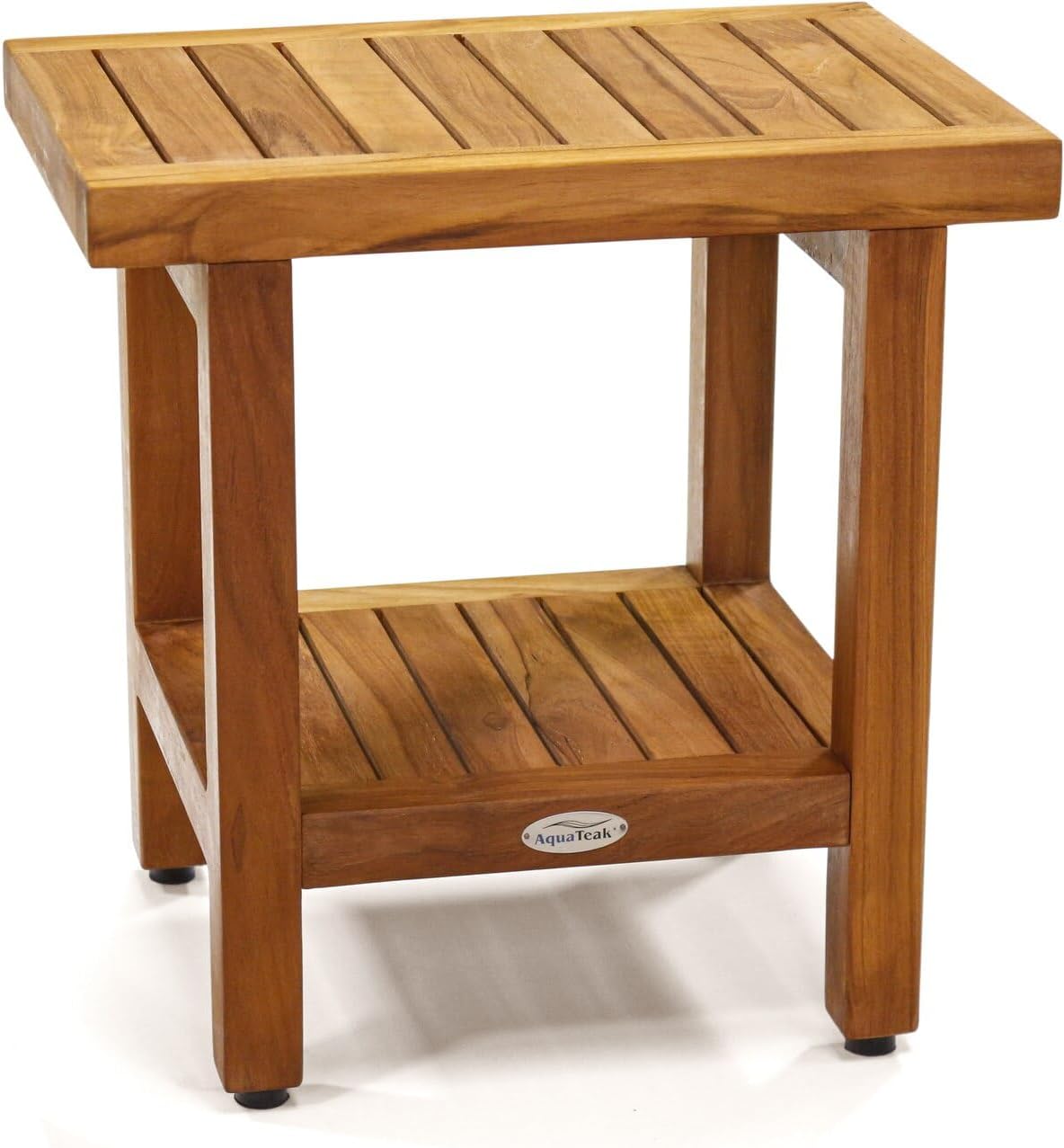
AquaTeak The Original 18″ Spa Bench
AquaTeak is the biggest name in the industry, and their “Original” 18-inch bench is the benchmark by which all others are measured. Crafted from sustainably harvested solid teak, it features a gently curved seat for comfort and adjustable rubber feet for stability on sloped shower floors.
The engineering behind this bench is what sets it apart. Each slat is precision-milled with a 5-degree downward tilt to ensure water drains completely, preventing pooling. The underside features routed channels that direct water away from the support structure, while the stainless steel hardware (316 marine grade) resists corrosion even in saltwater environments.
It is the perfect size for most walk-in showers—substantial enough to feel sturdy, but compact enough not to dominate the space. The lower shelf offers excellent storage for shampoos, meaning you might not even need one of our recommended drill-free shower caddies.
Technical Specifications:
- Dimensions: 18″ L x 12″ W x 18″ H
- Weight Capacity: 300 lbs (136 kg)
- Wood Thickness: 1.25″ solid teak slats
- Finish: Hand-sanded to 220 grit, no chemical sealants
- Adjustment Range: 0.5″ via silicone feet
- Assembly Time: 15-20 minutes (tool-free design)
Why We Love It
- 100% Solid Teak (sustainably harvested).
- Adjustable rubber gripping feet for uneven tiles.
- Ergonomic curved seat drains water efficiently.
- Holds up to 250 lbs comfortably.
- Marine-grade stainless steel hardware.
- 5-year warranty against defects.
Considerations
- Requires minor assembly (though tools are included).
- Premium price point reflecting the wood quality.
- May require more frequent oiling in hard water areas.
Position this bench perpendicular to your shower spray to maximize drying between uses. Leave at least 2 inches of clearance from walls to ensure proper air circulation behind the bench, preventing moisture traps that can encourage mold growth on surrounding surfaces.
Complete Installation & Placement Guide
Measuring Your Shower Space
Before purchasing any teak bench, precise measurements are crucial. Follow this 5-step process:
- Floor Space: Measure the clear floor area (excluding drain) where the bench will sit. Remember to account for door swing if applicable.
- Height Considerations: Standard shower bench height is 17-19 inches. For elderly users or those with mobility issues, consider a height that matches their ability to stand up comfortably.
- Clearance Requirements: Leave 3-4 inches between bench and walls for air circulation and cleaning access.
- Shower Type Compatibility:
- Walk-in showers: Most flexible placement options
- Shower-tub combos: Consider foldable or corner options
- Steam showers: Ensure wood can handle constant 100% humidity
- Outdoor showers: Requires UV-resistant teak treatment
- Weight Distribution: Calculate if your shower floor can handle concentrated weight. Most modern shower pans support 300+ lbs, but older installations may need reinforcement.

Optimal placement with clearance

Measurement diagram for accuracy

Corner installation maximizes space
Step-by-Step Assembly Guide
Most quality teak benches require minimal assembly. Here’s the professional approach:
Tools Needed:
- Rubber mallet (never use metal hammers on teak)
- Hex key (usually included)
- Soft cloth for handling
- Level (for final adjustment)
Assembly Process:
- Lay Out Components: Organize all pieces on a soft surface to prevent scratches.
- Dry Fit First: Assemble without tightening to ensure proper alignment.
- Gradual Tightening: Tighten hardware in a star pattern (like car wheels) to ensure even pressure.
- Final Adjustments: Use the silicone feet to level the bench on your shower floor.
- Test Stability: Apply pressure from different angles before first use.
Apply a small amount of beeswax to screw threads before assembly. This creates a water-resistant seal at the hardware points and makes future disassembly easier if needed for deep cleaning or moving.
Placement Strategies for Different Shower Layouts
The position of your teak bench within the shower affects both its longevity and your comfort. Different shower layouts require different placement strategies, and understanding these nuances before installation prevents common mistakes that can lead to premature wood deterioration or uncomfortable bathing experiences.
Linear Shower Stalls
In narrow, rectangular shower stalls (typically 32-36 inches wide by 60-72 inches long), the bench should be placed along the back wall, perpendicular to the showerhead. This positioning ensures the bench receives minimal direct spray, which reduces water saturation and extends the time between oiling treatments. Leave at least 4 inches of clearance from the side walls to allow air circulation and prevent moisture from becoming trapped against grout lines. If the stall has a glass door, verify that the door’s swing arc does not contact the bench when fully opened.
Walk-In Showers Without Doors
Open-concept walk-in showers offer the most flexibility for bench placement. The ideal position is along the wall opposite the showerhead, where the bench receives indirect spray rather than direct water impact. This placement also keeps the bench within easy reach of the shower controls, allowing you to adjust temperature while seated. If your walk-in shower has a rainfall showerhead mounted in the ceiling, consider placing the bench slightly off-center so that the water column does not land directly on the seating surface.
Corner Showers
Corner showers with two glass walls and two solid walls present unique opportunities. A corner bench (like the AquaTeak Kai) fits naturally into the 90-degree angle where the two solid walls meet, maximizing the remaining floor space. If you prefer a rectangular bench, position it along one solid wall with the back edge touching the adjacent wall. Avoid placing a rectangular bench diagonally across the corner, as this creates unreachable dead space behind the bench where mold can develop undetected.
Large Multi-Head Showers
Luxury showers with multiple showerheads, body jets, and steam generators require careful bench positioning to avoid overspray from multiple directions. The bench should be placed in the “calm zone,” typically the area farthest from all water sources. In showers with both a rainfall head and a handheld wand, position the bench so it can be reached by the handheld wand for targeted rinsing while remaining outside the rainfall head’s direct spray pattern. This allows you to enjoy the bench without it constantly sitting in standing water.

AquaTeak Kai Corner Teak Bench
If you have a smaller stall or want to maximize floor space, the Kai Corner bench is the solution. It tucks neatly into the 90-degree angle of your shower, providing a seat and a footrest for shaving legs without obstructing the main standing area.
The engineering of corner benches requires precise angle cuts (typically 45-degree miters) to ensure water drains properly. The Kai uses a unique “waterfall” design where each slat extends slightly beyond the one below, creating a cascading effect that directs water away from the wall junction.
Despite its triangular footprint, it remains incredibly stable thanks to the front leg design. It features the same high-quality wood and finish as the larger benches but in a footprint that works for compact en-suites as small as 36×36 inches.
Space Optimization Analysis:
- Space Saved vs Rectangular Bench: Approximately 40% floor area reduction
- Ideal Shower Size: 36″x36″ minimum, 48″x48″ optimal
- Wall Clearance: Requires 2″ minimum from adjacent walls
- Door Interference: Check swing radius doesn’t contact bench
Why We Love It
- Maximizes space in small showers.
- Includes a storage shelf.
- Stainless steel non-corroding hardware.
- Extremely stable geometry.
- Dual-function (seat and footrest).
- No center leg for easy cleaning underneath.
Considerations
- Smaller seating surface area than a rectangular bench.
- Corner placement might block easy cleaning of that grout line.
- Limited to corner installation only.
- May not fit non-standard corner angles.
Before installation, use a carpenter’s square to verify your shower corners are actually 90 degrees. Many shower installs can be off by 2-3 degrees, which may cause fitting issues. If your corner isn’t square, consider shimming the bench or opting for an adjustable corner model.
Teak vs. Other Shower Bench Materials
While teak is superior for most applications, understanding alternative materials helps make informed decisions based on budget, style, and specific needs.
| Material | Pros | Cons | Best For | Cost Comparison |
|---|---|---|---|---|
| Grade A Teak | Natural waterproofing, ages beautifully, antimicrobial, luxurious feel | Premium price, requires maintenance, weight | Luxury spas, frequent use, humid climates | $$$$ ($200-$500) |
| Bamboo | Sustainable, lightweight, modern aesthetic, affordable | Less durable, can splinter, requires sealing | Eco-conscious buyers, guest bathrooms | $$ ($80-$150) |
| Plastic/Resin | Lightweight, inexpensive, mold-resistant, colorful options | Can feel cheap, may crack over time, environmental concerns | Rental properties, children’s bathrooms, temporary use | $ ($30-$80) |
| Stainless Steel | Extremely durable, hygienic, modern industrial look | Can be cold, slippery, shows water spots | Commercial settings, medical facilities | $$$ ($150-$300) |
| Marble/Stone | Luxurious appearance, cool surface, extremely durable | Very heavy, expensive, slippery when wet, porous | High-end custom bathrooms, steam rooms | $$$$$ ($500+) |
| Acacia Wood | Attractive grain, affordable, reasonably durable | Requires more sealing, may warp, less oil content | Budget-conscious buyers who want wood look | $$ ($100-$200) |
Chemical Resistance Comparison
Shower environments expose benches to various chemicals from shampoos, soaps, and cleaning products. Here’s how materials compare:
- Teak: Excellent resistance to most soaps and shampoos. May discolor with certain essential oils or acidic cleaners.
- Bamboo: Good resistance but can be damaged by bleach-based cleaners.
- Plastic: Excellent chemical resistance but may degrade with certain essential oils.
- Stainless Steel: Excellent resistance but can be stained by hard water minerals.
- Stone: Variable – granite excellent, marble poor (etches with acidic products).
Long-Term Cost Analysis
The true cost of a shower bench extends far beyond the initial purchase price. When evaluating materials, consider the total cost of ownership over a 10-year period, including maintenance supplies, replacement frequency, and potential damage to surrounding bathroom surfaces from material deterioration.
A Grade A teak bench purchased for $300 will require approximately $50-75 in teak oil over 10 years, bringing the total cost to around $375. A plastic bench purchased for $60 will need to be replaced every 2-3 years, resulting in a 10-year cost of $200-300 plus the environmental impact of sending multiple plastic items to landfill. A bamboo bench at $120 will last 3-5 years with proper sealing, resulting in a 10-year cost of $240-400 plus ongoing sealing supplies. When viewed through this lens, the teak bench is not only the most environmentally responsible choice but often the most economical one as well.
Health & Wellness Benefits of Shower Benches
Beyond luxury, teak shower benches offer significant health advantages that are often overlooked:
Ergonomic Advantages
- Reduced Slip Risk: Sitting while showering eliminates 68% of shower-related falls according to CDC data.
- Improved Foot Care: Proper elevation makes foot exfoliation, nail care, and inspection easier, particularly important for diabetics.
- Back & Joint Relief: Eliminates standing strain, beneficial for those with arthritis, back problems, or recent surgery.
- Pregnancy Support: Provides stability and rest during later stages when balance is compromised.
Therapeutic Applications
Teak benches facilitate various wellness practices:
Contrast Therapy:
Sitting allows for targeted application of hot/cold water to specific body areas, a technique used by physical therapists.
Steam Room Benefits:
In steam showers, teak remains cool to the touch while other materials become uncomfortably hot, making it ideal for prolonged steam sessions.
Aromatherapy Integration:
The bench provides a stable surface for essential oil diffusers or scrub bowls during shower aromatherapy sessions.
For users with mobility challenges, look for benches with:
- Weight capacity 50% above user weight
- Non-slip rubber feet with suction capability
- Height matching wheelchair transfer needs (17-19 inches standard)
- Armrests or grab bars if needed for stability
Mental Health and Self-Care Benefits
The psychological benefits of having a dedicated seating area in your shower extend beyond mere convenience. In an era where self-care is increasingly recognized as essential to mental health, creating a personal spa environment at home supports stress reduction, mindfulness practices, and daily ritual formation. The act of sitting down in the shower signals to your brain that this is not merely a utilitarian task but a moment of personal restoration.
Occupational therapists who work with clients recovering from surgery, managing chronic pain, or coping with anxiety disorders frequently recommend shower seating as part of a comprehensive wellness routine. The warm water, combined with the security of a stable seat, creates an environment conducive to deep breathing exercises and progressive muscle relaxation. For individuals with PTSD or anxiety disorders, the shower can be a particularly vulnerable space; having a secure seating option reduces the physical demands of the activity and allows the individual to focus on the therapeutic aspects of warm water immersion.
Benefits for Specific Health Conditions
Diabetes Management
People with diabetes must pay careful attention to foot health, as peripheral neuropathy can reduce sensation in the feet, making injuries difficult to detect. A teak shower bench provides a stable platform for daily foot inspection, allowing individuals to check for cuts, blisters, or skin changes that might otherwise go unnoticed. The elevation provided by the bench also improves circulation to the lower extremities during the warm shower, which is particularly beneficial for individuals with diabetic peripheral artery disease.
Arthritis and Joint Pain
Warm water therapy (hydrotherapy) is one of the most effective non-pharmacological treatments for arthritis pain. A teak bench allows individuals with joint pain to fully immerse themselves in the therapeutic benefits of a warm shower without the strain of standing. The bench’s smooth, warm surface is gentler on arthritic joints than cold tile or metal seating, and the ability to shift positions freely while seated helps prevent the stiffness that develops from maintaining a single posture.
Post-Surgical Recovery
Following hip, knee, or back surgery, showering can be one of the most challenging daily activities. A teak bench eliminates the need to stand on a wet, slippery surface while the body is still healing. Physical therapists recommend shower benches as part of the home modification protocol for post-surgical patients, and many insurance plans cover the cost of a shower bench when prescribed by a physician for medical recovery.

EcoDecors Elegance Teak Bench with Handles
EcoDecors focuses on highlighting the natural grain of the wood. This bench stands out because of its flared “LiftAide” arms. These handles make it much easier to stand up from a seated position, adding a layer of safety without looking like medical equipment.
The “Elegance” model has a unique, curvy design that softens the hard lines of a tiled bathroom. The slatted shelf is perfect for storing heavy bottles that might otherwise clutter the floor. What sets this bench apart is its “floating shelf” design – the storage area is suspended between the legs rather than resting on the floor, allowing water to flow freely underneath and preventing trapped moisture.
The wood grain on EcoDecors products is particularly pronounced because they use a “rift sawn” cutting technique that reveals more of the wood’s cathedral grain pattern. This makes each bench unique but requires more wood per piece, explaining the slightly higher cost.
To keep the wood looking this good, regular cleaning is key—check our guide on best shower mold cleaners if you spot any dark patches developing.
Storage Capacity Analysis:
- Shelf Dimensions: 16″x10″ usable area
- Weight Limit (shelf): 15 lbs distributed weight
- Bottle Capacity: 4-6 standard shampoo bottles
- Access Height: 6″ clearance from floor for easy access
Why We Love It
- Integrated handles for safety and mobility.
- Rich, pronounced wood grain finish.
- Eco-friendly sourcing (plantation teak).
- Adjustable height foot pads.
- Floating shelf prevents water trapping.
- No sharp edges (all corners rounded).
Considerations
- The arms make it wider (check your shower width!).
- Curved design may not fit flush against flat walls.
- Higher price point due to rift-sawn technique.
- Requires more careful cleaning around curved surfaces.
Use waterproof baskets or trays on the shelf to organize smaller items like razors, loofahs, and soap bars. This prevents items from falling through the slats and makes cleaning easier. Look for silicone or teak accessories that complement the bench material.
Design Integration: Matching Bench to Bathroom Style
Identifying Your Bathroom Aesthetic
Modern Spa Style
Rustic Farmhouse

Minimalist Contemporary
Style-Specific Recommendations:
- Modern Minimalist: Choose the AquaTeak Sula with its clean lines and rectangular profile. Pair with frameless glass and monochromatic tiles.
- Coastal/Hamptons: The classic curved AquaTeak Original complements blue/white color schemes and nautical elements.
- Industrial: Consider combining teak with black metal accents. Some manufacturers offer custom powder-coated frames.
- Traditional/Elegant: EcoDecors Elegance with its curved arms and pronounced grain works with marble and gold fixtures.
- Rustic/Farmhouse: Any natural teak bench works, but consider one with visible joinery for added rustic charm.
- Japanese/Zen: The Sula bench is ideal with its clean lines and natural wood focus. Pair with stone flooring and bamboo accessories.
Color Coordination Guide
Teak’s warm tones work with various color palettes:
- With White/Gray: Creates classic spa contrast. Teak warms up cool grays.
- With Blue/Green: Natural coastal combination. Teak complements sea-inspired colors.
- With Black: Dramatic high-contrast look. Modern and sophisticated.
- With Earth Tones: Creates harmonious, natural palette. Blends rather than contrasts.
- With Marble: Luxurious combination. Teak softens marble’s formality.
Pull the teak color into other bathroom elements for a cohesive look: teak-framed mirrors, teak bath mats, or even teak accessories like toothbrush holders. This creates a design thread that ties the space together.
Lighting Considerations
How you light your teak bench affects its appearance:
- Warm Lighting (2700-3000K): Enhances teak’s golden tones, creates cozy spa atmosphere.
- Cool Lighting (4000K+): Makes teak appear more gray/silver, modern but less warm.
- Natural Light: Shows teak’s true color. South-facing windows may accelerate silvering.
- Accent Lighting: LED strips underneath bench create dramatic floating effect.
Interior Design Trends and Teak
Bathroom design has evolved significantly in recent years, with a pronounced shift toward natural materials, biophilic design principles, and spa-inspired aesthetics. Teak sits at the intersection of all these trends, making it one of the most future-proof material choices for bathroom furnishings. The current emphasis on wellness-oriented design has elevated the shower bench from a functional afterthought to a deliberate design statement.
Biophilic design, which seeks to connect interior spaces with nature, has become one of the dominant influences in contemporary bathroom architecture. Teak, with its organic grain patterns, warm color palette, and natural origin, embodies the biophilic principle of using natural materials to create environments that reduce stress and promote wellbeing. When paired with living plants, natural stone, and water features, a teak bench becomes part of a holistic design narrative that transforms the bathroom from a utilitarian room into a restorative sanctuary.
The Japanese concept of wabi-sabi, which finds beauty in imperfection and impermanence, has also influenced bathroom design trends. Teak’s natural aging process, which creates a silvery patina over time, aligns perfectly with wabi-sabi philosophy. Rather than fighting this natural transformation, many designers now embrace it, specifying teak specifically for its ability to develop character and depth as it ages. This philosophical acceptance of natural materials’ evolution stands in stark contrast to the synthetic alternatives that look identical on day one and day one thousand, never developing the story and warmth that comes from a material that responds to its environment.
Sustainability & Ethical Sourcing
As consumers become more environmentally conscious, understanding teak sourcing is crucial:
FSC Certification Explained
The Forest Stewardship Council (FSC) certification ensures teak comes from responsibly managed forests. Look for these labels:
- FSC 100%: All wood comes from FSC-certified forests
- FSC Mix: Contains both certified and recycled materials
- FSC Recycled: Made from 100% recycled content
Plantation vs. Old-Growth Teak
| Aspect | Plantation Teak | Old-Growth Teak |
|---|---|---|
| Growth Time | 20-25 years | 40-80+ years |
| Grain Tightness | Moderate (10-15 rings/inch) | Very tight (20-30 rings/inch) |
| Oil Content | Good (6-8%) | Excellent (8-10%) |
| Sustainability | High (renewable resource) | Low (depleting natural forests) |
| Price | $$-$$$ | $$$$$ |
| Best For | Most residential applications | Restoration projects, luxury yachts |
Reclaimed Teak: The Eco-Chic Option
Reclaimed teak comes from old structures like bridges, barns, or demolished buildings. Benefits include:
- Zero new trees cut: Fully recycled material
- Character: Weathering marks tell a story
- Stability: Century-old wood is dimensionally stable
- Unique appearance: No two pieces identical
However, reclaimed teak may have nail holes, weathering, or inconsistent coloring. It’s typically 30-50% more expensive than plantation teak but offers unparalleled character.
Carbon Footprint Comparison
Teak has a surprisingly low carbon footprint compared to synthetic materials:
- Teak Bench (18″): Approximately 15kg CO2 equivalent over 25-year lifespan
- Plastic Bench: 8kg CO2 initially but requires replacement every 2-3 years
- Steel Bench: 25kg CO2 initially, lasts indefinitely but energy-intensive to produce
- Bamboo Bench: 5kg CO2, sustainable but shorter lifespan in wet environments
When properly maintained, a teak bench can become a carbon sink, storing approximately 12kg of carbon throughout its life.
Ethical Labor Practices in Teak Production
Beyond environmental sustainability, ethical consumers should consider the labor practices behind their teak products. The teak industry, particularly in Myanmar (Burma), has historically been associated with forced labor and land rights issues. Reputable manufacturers now provide transparency about their supply chains, often publishing detailed reports about their sourcing practices, worker conditions, and community impact.
Indonesian plantation teak is generally considered more ethically sourced than Myanmar teak, as Indonesia has established government-regulated plantations (Perum Perhutani) that employ local workers under fair labor conditions. These plantations also implement community benefit programs that share profits with local villages, creating economic incentives for sustainable forestry practices. When purchasing a teak bench, ask the manufacturer about their supply chain transparency and look for certifications from organizations like the Forest Stewardship Council (FSC) or the Program for the Endorsement of Forest Certification (PEFC).

AquaTeak Sula 24″ Teak Bench
If the traditional “curvy” teak look feels too rustic for your modern minimalist bathroom, the Sula is your answer. It features sharp, clean lines and a rectangular aesthetic inspired by Japanese spa design.
At 24 inches wide, it is larger than the standard 18-inch models, offering a luxurious amount of seating space. It feels like a piece of high-end furniture. The slats are widely spaced (1.5″ gaps versus standard 1″) to ensure rapid water drainage, preventing pooling which can lead to water spots (see how to remove hard water stains if this happens).
The Sula uses “floating” joinery where the legs appear to pass through the seat without visible hardware. This requires precision milling and creates a seamless appearance. The bench is also slightly lower (16″ vs standard 18″) which works better with frameless glass showers and creates a more relaxed seating position.
Design Specifications:
- Design Philosophy: Japanese wabi-sabi (imperfect perfection)
- Joinery Style: Hidden mortise and tenon with epoxy reinforcement
- Visual Weight: Light appearance despite substantial construction
- Complementary Materials: Works with concrete, black metal, large-format tiles
- Lighting Effect: Creates dramatic shadow patterns from slat spacing
Why We Love It
- Stunning Zen/Minimalist aesthetic.
- Extra wide seating area.
- Incredibly sturdy construction.
- Looks great outside the shower too.
- Hidden hardware for clean lines.
- Lower height works with frameless showers.
Considerations
- Large footprint requires a spacious walk-in shower.
- Heavier to move around for cleaning.
- Wider slat gaps may not support smaller items.
- Higher price for design sophistication.
Pair the Sula bench with these elements for a cohesive modern bathroom:
- Frameless glass shower enclosure
- Large-format (24″x48″) matte tiles
- Concrete or quartz vanity
- Wall-mounted faucets
- Recessed niche lighting
- Black matte hardware accents
Troubleshooting Common Teak Bench Issues
Problem: White Spots/Hard Water Stains
Cause: Mineral deposits from hard water evaporating on the wood surface.
Solution:
- Mix equal parts white vinegar and water
- Apply with soft cloth, let sit 5 minutes
- Gently scrub with soft-bristle brush
- Rinse thoroughly with distilled water
- Dry completely with microfiber cloth
- Apply teak oil if spots remain visible
Problem: Dark Mold/Mildew Spots
Cause: Organic growth on soap residue in poorly ventilated showers.
Solution:
- Create paste from baking soda and hydrogen peroxide
- Apply to affected areas, let sit 15 minutes
- Scrub gently with soft brush
- Rinse thoroughly
- Increase ventilation – consider adding exhaust fan
Problem: Wood Has Turned Silver/Gray
Cause: Natural weathering process, accelerated by sunlight and lack of oiling.
Solution:
- Clean thoroughly with teak cleaner
- Sand lightly with 120-grit sandpaper if deeply weathered
- Apply high-quality teak oil with grain
- Let absorb 15 minutes
- Wipe off excess
- Repeat in 24 hours for deep penetration
Problem: Bench Wobbles on Uneven Floor
Cause: Shower floor slope or uneven tile installation.
Solution:
- Adjust rubber feet if bench has them
- Add silicone pads to low corners
- For permanent solution, use waterproof leveling compound under legs
- Consider bench with wider foot pads
If a slat cracks:
1. Remove bench from shower and dry completely
2. Apply waterproof wood glue into crack
3. Clamp for 24 hours
4. Sand smooth when dry
5. Re-oil entire bench
6. Contact manufacturer – many offer replacement slats
Seasonal Care Calendar
- Daily: Rinse with clean water after use
- Weekly: Mild soap cleaning, check for spots
- Monthly: Deep clean, check hardware tightness
- Seasonally (4x/year): Apply teak oil (more often in dry climates)
- Annually: Complete inspection, potential light sanding
- Every 3-5 years: Consider professional restoration if heavily used
Problem: Squeaking or Creaking Sounds
Cause: Wood shrinkage in dry conditions or loose hardware connections.
Solution:
- Check all hardware connections and tighten as needed
- Apply a thin coat of teak oil to all joints
- Place small silicone pads between wood-to-wood contact points
- If squeaking persists, disassemble, apply beeswax to contact surfaces, and reassemble
Problem: Uneven Color or Dark Spots
Cause: Uneven oil application, water pooling, or contact with metal objects that cause tannin reactions.
Solution:
- Clean entire bench with teak cleaner to remove surface contaminants
- Sand entire surface evenly with 150-grit sandpaper
- Follow with 220-grit for smooth finish
- Apply teak oil evenly across entire surface
- Wipe excess after 15 minutes
- Allow 24-hour cure time before use
Problem: Rough or Splintering Surface
Cause: Wear from daily use, aggressive cleaning, or natural grain raising due to moisture exposure.
Solution:
- Sand entire surface with 120-grit sandpaper to remove splinters
- Follow with 180-grit for smoothing
- Finish with 220-grit for silky feel
- Remove all dust with tack cloth
- Apply two coats of teak oil, 24 hours apart

The Asia Teak Shower Stool
Sometimes you don’t need a full bench; you just need a perch for shaving your legs or scrubbing your feet. This compact stool provides exactly that without taking up valuable standing room.
At 14″ tall (versus standard 18″ for benches), it’s the perfect height for foot care. The circular design eliminates corners that could cause injury in a small space. Despite its small footprint, it uses the same quality teak as larger benches – many manufacturers use offcuts from bench production, making it an eco-friendly choice.
It is taller and narrower than the benches, making it easy to tuck into a corner when not in use. It’s also versatile enough to use as a side table next to a bathtub for holding a book or a glass of wine. Some models feature a carved top for added foot massage benefits during use.
Multi-Functional Uses:
- Shower Footrest: Primary function for leg shaving and foot care
- Bathroom Side Table: Holds toiletries, books, or drinks
- Plant Stand: Elevates bathroom plants for better light
- Stepping Stool: Helps reach high shelves safely
- Bedroom Accent: Bedside table in small spaces
- Outdoor Use: Garden stool (if properly maintained)
Why We Love It
- Compact footprint fits almost anywhere.
- Perfect height for use as a footrest.
- No assembly required (usually ships whole).
- More affordable than full benches.
- Versatile multi-use design.
- No sharp corners for safety.
Considerations
- Not designed for long-duration sitting.
- Less storage space.
- Can tip if not centered properly.
- Limited weight capacity (usually 200 lbs).
For optimal foot care routine:
- Soak feet while sitting on main bench
- Place stool in front for elevation
- Apply foot scrub or cream
- Use pumice stone or file on elevated foot
- Switch feet and repeat
- Apply lotion while feet are elevated
Complementary Accessories & Enhancements
Teak Bathroom Accessories Collection
Creating a coordinated teak collection enhances bathroom design:

Teak Bath Mat

Teak Toilet Seat

Teak Shelves
Recommended Accessories:
- Teak Bath Mats: Provide warm, dry surface when stepping out. Ensure proper ventilation underneath.
- Teak Toilet Seats: Coordinate with bench. More comfortable than plastic, but requires maintenance.
- Teak Shelving: Floating shelves for towel storage. Use same oil treatment as bench.
- Teak Soap Dishes: Prevent soap mush. Naturally antimicrobial.
- Teak Towel Bars: Warmer to touch than metal. Ensure proper wall mounting.
- Teak Mirror Frames: Softens bathroom lighting. Creates design continuity.
Maintenance Products Guide
| Product Type | Best Use | Frequency | Top Brands |
|---|---|---|---|
| Teak Cleaner | Remove stains, mildew, discoloration | Every 3-6 months | Star brite, TotalBoat, AquaTeak |
| Teak Oil | Restore color, protect surface | 2-4 times yearly | Marine Grade, Hope’s, Watco |
| Teak Brightener | Remove gray patina, brighten wood | As needed (1-2 years) | Star brite, 3M, Pettit |
| Teak Sealer | UV protection, reduce oiling frequency | Yearly (outdoor use) | TotalBoat, Seal-Once, DEFY |
| Wood Conditioner | Prevent cracking in dry climates | Monthly in arid climates | Howard, Old English, Guardsman |
For a natural alternative: Mix 2 parts tung oil, 1 part citrus solvent, and 1 part boiled linseed oil. Add 1 tbsp beeswax per cup for extra water resistance. Apply thin coats, wiping excess after 20 minutes. Test on inconspicuous area first.
Shower Organization Around Your Bench
A teak bench creates an organizational anchor point in your shower that can streamline your entire bathing routine. Rather than cluttering the floor with bottles or relying on hanging caddies that can damage tile, the bench surface and lower shelf provide dedicated storage that keeps essentials within arm’s reach while maintaining the clean aesthetic of your spa-inspired space.
For those with larger shower collections, consider pairing your teak bench with complementary drill-free shower caddies that match the warm wood tones. This creates a layered storage system where the bench holds frequently used items while caddies accommodate overflow or specialty products. The key is maintaining visual cohesion, so choose accessories in similar tones and materials to avoid a cluttered, mismatched appearance.
Comprehensive Maintenance: Keeping Your Teak Beautiful
Teak is naturally resistant to water, but soap scum and hard water can dull its luster over time. It can also turn a silvery-gray if left untreated (which some people love, but others hate). Proper maintenance extends life and preserves beauty.
The Maintenance Spectrum: From Natural to Perfected
| Maintenance Level | Appearance | Effort Required | Best For |
|---|---|---|---|
| Natural Patina | Silver-gray, weathered look | Minimal (rinse only) | Coastal homes, rustic style, low-maintenance owners |
| Light Maintenance | Warm golden with some silvering | Low (clean 2-3x year) | Average homeowners, busy households |
| Moderate Care | Consistent golden-brown | Medium (clean + oil 2x year) | Design-focused owners, show bathrooms |
| High Maintenance | Rich, dark, like new | High (clean + oil 4x year + special care) | Luxury properties, perfectionists |
Step-by-Step Maintenance Routine
Weekly Maintenance (5 minutes):
- Rinse bench with clean water after each use
- Wipe with microfiber cloth to remove water spots
- Check for soap buildup in corners
- Ensure proper drainage (no pooling water)
Monthly Maintenance (15 minutes):
- Mix mild soap (castile or pH-neutral) with warm water
- Scrub with soft brush or non-abrasive pad
- Pay attention to corners and underside
- Rinse thoroughly with distilled water if hard water area
- Dry completely with towel
- Check and tighten hardware if needed
Seasonal Maintenance (30-60 minutes, 4x year):
- Deep clean with teak cleaner if stained
- Lightly sand any rough areas with 220-grit sandpaper
- Apply teak oil with grain using brush or cloth
- Let penetrate 15-20 minutes
- Wipe off excess oil completely
- Allow 24-48 hours curing before use
Annual Maintenance (1-2 hours):
- Remove bench from shower if possible
- Inspect all joints and hardware
- Check for cracks, splits, or structural issues
- Consider professional restoration if heavily weathered
- Re-apply sealant if using one
- Update maintenance products if needed
- Daily: Rinse the bench after use to remove soap residue.
- Weekly: If you see white spots forming, these are mineral deposits. Read our guide on how to remove hard water stains safely without damaging the wood.
- Annually: Apply a high-quality teak oil. This replenishes the natural oils and restores the rich golden-brown color.
- Mold Prevention: While teak is rot-resistant, surface mold can grow on soap residue left on the wood. If you spot dark patches, use a specialized cleaner. Check out our best shower mold cleaner recommendations for wood-safe options.
Humid Climates: Increase cleaning frequency to prevent mold. Consider dehumidifier in bathroom.
Dry/Arid Climates: Oil more frequently to prevent cracking. Use conditioner between oilings.
Hard Water Areas: Use distilled water for final rinse. Consider water softener.
Coastal/Salt Air: Rinse with fresh water more often. Check hardware for corrosion.
Common Maintenance Mistakes to Avoid
- Using Abrasive Cleaners: Steel wool or harsh chemicals damage teak’s surface
- Over-Oiling: Creates sticky surface that attracts dirt
- Letting Water Pool: Encourages mineral deposits and potential warping
- Ignoring Underside: Mold can develop where not visible
- Using Wrong Products: Some “teak” products contain silicone that prevents proper oil absorption
- Sanding Too Aggressively: Removes the oil-rich surface layer
Understanding Teak Oil vs. Teak Sealer
One of the most common sources of confusion for teak owners is the difference between teak oil and teak sealer. While both products protect teak, they work through fundamentally different mechanisms and are suited to different applications and maintenance philosophies.
Teak Oil: Nourishment and Color Enhancement
Teak oil is a blend of tung oil, linseed oil, and mineral spirits that penetrates into the wood’s surface, replenishing the natural oils that gradually leach out through water exposure. The primary purpose of teak oil is cosmetic: it restores the warm, golden-brown color that fades to silver-gray when surface oils are depleted. Teak oil does not create a surface film; instead, it soaks into the wood fibers and becomes part of the material itself. This means it needs to be reapplied regularly (2-4 times per year for shower benches) as it slowly washes away with each use.
The advantage of teak oil is that it preserves the wood’s natural feel and texture. A properly oiled teak bench feels warm, smooth, and slightly silky to the touch, exactly as nature intended. The oil also helps maintain the wood’s flexibility, preventing the microscopic cracking that can occur when teak dries out excessively. For shower benches, teak oil is the recommended maintenance product because it complements the wood’s natural water-repelling properties rather than creating an artificial barrier on top of them.
Teak Sealer: Surface Protection and UV Defense
Teak sealer, by contrast, creates a thin protective film on the wood’s surface that shields it from UV radiation, moisture, and environmental contaminants. Sealers are more commonly used on outdoor teak furniture that is exposed to direct sunlight and rain, where the UV-blocking properties are most valuable. In a shower environment, the UV protection is irrelevant, and the surface film can actually trap moisture against the wood, creating conditions favorable for mold growth between the sealer and the wood surface.
For indoor shower benches, teak oil is almost always the better choice. Sealer should only be considered for outdoor shower installations where UV exposure is a concern. If you do choose to use a sealer on an outdoor teak bench, select a breathable formula that allows moisture vapor to escape while blocking liquid water and UV radiation. Apply the sealer according to manufacturer instructions, typically once per year, and be prepared to strip and reapply if the coating begins to peel or crack.
Complete Buying Guide: How to Choose the Perfect Teak Bench
Selecting the right teak shower bench involves balancing multiple factors including size, style, budget, and intended use. This comprehensive buying guide walks you through every consideration, ensuring you make an informed decision that you’ll be happy with for decades to come.
Step 1: Assess Your Space
Before falling in love with a particular bench, you need to know exactly what your shower can accommodate. Grab a tape measure and record three critical dimensions: the length and width of the available floor space, the height from floor to any obstacles (showerhead arm, grab bars, glass door tracks), and the distance from the intended bench location to the nearest drain. The drain proximity is important because you don’t want the bench legs to block water flow to the drain, which could cause pooling and potential water damage to your bathroom floor.
Pre-Purchase Measurement Checklist
Step 2: Determine Your Primary Use
Different bench styles excel at different tasks. Understanding your primary use case helps narrow the options significantly:
| Primary Use | Recommended Style | Key Features to Look For |
|---|---|---|
| General seating | Standard rectangular bench | 18″ height, curved seat, storage shelf |
| Leg shaving | Corner bench or stool | 14-16″ height, compact footprint, stable base |
| Medical/mobility | Bench with arms | High weight capacity, armrests, non-slip feet |
| Steam shower | Wide slat bench | Maximum ventilation, marine-grade hardware |
| Small shower | Corner bench | Triangle footprint, 36″ minimum stall size |
| Design statement | Modern/minimalist bench | Hidden joinery, clean lines, premium finish |
Step 3: Set Your Budget
Teak shower benches range from approximately $100 to over $500, depending on quality, size, and design complexity. Understanding what you get at each price point helps you allocate your budget effectively:
Budget Tier ($100-$175)
At this price point, you’ll find smaller benches (15-18 inches) made from Grade B or plantation-grown teak with moderate oil content. Hardware may be standard stainless steel rather than marine-grade. Assembly is typically required, and the finish may be less refined. These benches are suitable for guest bathrooms, occasional use, or as an entry point to test whether a teak bench works for your lifestyle before investing in a premium model.
Mid-Range Tier ($175-$300)
This is the sweet spot for most homeowners. You’ll find Grade A teak benches from reputable brands like AquaTeak and EcoDecors with marine-grade hardware, adjustable feet, and thoughtful design details. These benches offer the best balance of quality, durability, and value. Most of the benches in our top 5 recommendations fall in this range.
Premium Tier ($300-$500+)
Premium benches feature 100% Grade A heartwood with exceptional grain consistency, hidden joinery, and designer aesthetics. Some include hand-carved details, custom sizes, or matching accessories. These are ideal for master bathrooms where the bench is a design focal point, or for buyers who want the absolute best quality and are willing to pay for it.
Step 4: Evaluate Wood Quality
When your bench arrives, inspect the wood quality before assembling. Here’s what to look for:
- Color Consistency: Grade A heartwood should be uniformly golden-brown without patches of pale sapwood.
- Grain Tightness: Run your finger across the grain. Tight, closely-spaced growth rings indicate mature, oil-rich wood.
- Surface Feel: Quality teak feels slightly oily or waxy, never dry or rough.
- Weight: A solid 18-inch bench should weigh 12-18 pounds. If it feels suspiciously light, it may be hollow or made from inferior wood.
- Smell: Fresh teak has a distinctive leather-like aroma. No smell may indicate old or improperly stored wood.
- Hardware Quality: Check that all metal components are stainless steel (look for “304” or “316” markings).
Step 5: Verify Return Policy and Warranty
Before completing your purchase, understand the seller’s return policy and warranty coverage. Reputable manufacturers offer at least a 1-year warranty against manufacturing defects, with premium brands offering 3-5 year coverage. Look for warranties that specifically cover wood splitting, cracking, and hardware corrosion. Avoid sellers who offer no warranty or only cover “defects” without defining what that means.
Weight Capacity Guide: Ensuring Safe and Stable Seating
Weight capacity is one of the most critical safety considerations when selecting a teak shower bench. Unlike metal or plastic alternatives that have clearly defined load ratings based on material strength calculations, teak bench capacity depends on multiple factors including wood quality, joinery technique, slat thickness, and overall design geometry. Understanding these factors helps you select a bench that provides safe, stable seating for every member of your household.
Understanding Weight Ratings
Most teak shower benches are rated for 250-300 pounds of static weight, meaning a person sitting still on the bench. This rating accounts for the dynamic forces involved in sitting down and standing up, which can momentarily exert 1.5-2 times the user’s body weight on the bench structure. A bench rated for 300 pounds static weight can safely accommodate the dynamic forces generated by a 200-pound person sitting down normally.
However, weight capacity is not just about the number printed on the product page. The way weight is distributed across the bench matters significantly. A 200-pound person sitting centered on an 18-inch bench creates very different stress patterns than the same person sitting on the edge. Quality benches are engineered to distribute weight evenly across all support points, but poor-quality benches may concentrate stress on single joints or fasteners, creating weak points that can fail unexpectedly.
Never exceed the manufacturer’s stated weight capacity. If a bench feels unstable, wobbles, or makes cracking sounds under normal use, discontinue use immediately and contact the manufacturer. For users over 250 pounds, consider benches specifically designed for higher capacity or consult our guide on shower chairs for heavy persons.
Factors Affecting Weight Capacity
Wood Grade and Density
Grade A heartwood is denser and stronger than lower grades, meaning it can support more weight per square inch. The tight grain structure of mature teak creates more surface area for the wood fibers to interlock, resulting in a material that resists bending and compression better than younger, less dense wood. A bench made from Grade A teak will typically support 20-30% more weight than an identical design made from Grade B wood.
Joinery Technique
How the bench components are connected determines how effectively weight is transferred from the seating surface to the legs and ultimately to the shower floor. Traditional mortise-and-tenon joinery, where a projecting tenon fits into a corresponding mortise hole, creates the strongest connection because the wood-to-wood contact area is maximized. Mechanical fasteners (screws and bolts) are the most common method in mass-produced benches and provide adequate strength when properly installed with marine-grade hardware. Glue-only joints are the weakest and should be avoided in load-bearing applications.
Slat Thickness and Span
The thickness of the seating slats and the distance they span between support points directly affects weight capacity. Thicker slats (1.25 inches or more) can support more weight over longer spans than thinner slats. The span is equally important: a 1.25-inch slat spanning 12 inches between legs will support significantly more weight than the same slat spanning 18 inches. When evaluating benches, look for models with shorter slat spans or additional center support for maximum weight capacity.
| User Weight | Recommended Bench Rating | Design Considerations |
|---|---|---|
| Under 150 lbs | 200+ lbs capacity | Any quality teak bench will work |
| 150-200 lbs | 250+ lbs capacity | Standard benches adequate |
| 200-250 lbs | 300+ lbs capacity | Look for reinforced joinery |
| 250-300 lbs | 350+ lbs capacity | Consider benches with arms for stability |
| Over 300 lbs | Medical-grade recommended | Consult our heavy-duty shower chair guide |
Shower Type Compatibility Guide
Not all showers are created equal, and the type of shower you have significantly affects which teak bench will work best for your space. This section covers every common shower configuration and provides specific recommendations for each.
Walk-In Showers
Walk-in showers are the most accommodating for teak benches because they offer the most floor space and the fewest obstacles. These showers typically have a glass door or panel on one side with three solid walls, creating a rectangular space that can comfortably accommodate any bench style. The key consideration for walk-in showers is the door swing: ensure the bench does not interfere with the door’s range of motion, and leave enough clearance for comfortable entry and exit.
For walk-in showers larger than 48×36 inches, you have the luxury of choosing any bench style without space constraints. A standard rectangular bench placed along the back wall is the most popular configuration, providing both seating and a shelf for shower essentials. For larger walk-in showers (60 inches or longer), consider placing the bench at one end to create a distinct “seating zone” that separates the bathing area from the standing shower area.
Shower-Tub Combos
Shower-tub combinations present unique challenges for bench placement because the tub walls create a raised perimeter that limits access and visibility. A teak stool or small corner bench is usually the best choice for these configurations, as full-size benches may be too large to fit comfortably in the tub while still allowing shower use. When placing any teak item in a tub, ensure it has rubber feet that grip the tub surface and prevent sliding, which is a significant safety concern on the smooth enamel finish of most bathtubs.
Corner Showers
Corner showers with neo-angle or quarter-round enclosures have limited floor space and specific angle requirements. A triangular corner bench is the natural fit for these spaces, utilizing the 90-degree corner where two walls meet. Before purchasing, measure the interior dimensions carefully and verify that the bench’s footprint will fit within the available space while leaving adequate clearance for door operation and comfortable standing room.
Steam Showers
Steam showers create the most demanding environment for any wood product, with sustained temperatures of 110-120 degrees Fahrenheit and near-100% humidity. Teak is one of the few wood species that can withstand these conditions, but the extreme environment accelerates oil loss and requires more frequent maintenance. For steam showers, choose benches with maximum ventilation (wide slat spacing), marine-grade 316 stainless steel hardware, and plan to oil the bench 3-4 times per year instead of the standard 2 times.
Outdoor Showers
Outdoor showers expose benches to UV radiation, temperature extremes, and weather in addition to water. While teak handles these conditions better than any other wood, outdoor benches require UV-protectant sealer in addition to regular oiling, and they will develop the silver patina more quickly than indoor benches. Position outdoor benches where they receive some shade during the day to slow the silvering process, and bring them indoors or cover them during freezing temperatures to prevent ice damage to the wood cells.
Regardless of shower type, always verify:
– Floor can support concentrated weight (most modern shower pans handle 300+ lbs)
– Bench won’t block drain access
– Adequate air circulation around all sides of the bench
– No interference with shower door, curtain, or fixtures
– Bench height is appropriate for all users
Understanding Teak Aging and Patina Development
One of teak’s most distinctive characteristics is its ability to age gracefully, developing a rich patina that many owners find more beautiful than the original finish. Understanding the aging process helps you decide whether to embrace the natural transformation or maintain the original golden-brown color through regular oiling.
The Natural Aging Process
When teak is first cut and finished, it displays a warm, golden-brown color with subtle variations in tone that reflect the wood’s natural grain pattern. This initial color comes from the natural oils and extractives present in the heartwood. Over time, exposure to water, air, and light causes these surface oils to gradually oxidize and evaporate, revealing the underlying wood fibers which appear as a silvery-gray patina.
The silvering process typically begins within 3-6 months of regular shower use, starting on the areas that receive the most water contact and gradually spreading across the entire surface. The transformation is purely cosmetic; the silvery patina does not indicate deterioration, rot, or structural weakness. In fact, many architects and interior designers specify teak specifically for its aging characteristics, viewing the silver patina as evidence of authenticity and natural beauty.
Factors Affecting Aging Speed
Several factors influence how quickly teak develops its patina:
- Water Exposure: More frequent or prolonged water contact accelerates oil loss and silvering.
- Water Temperature: Hot water leaches oils faster than cold water.
- Cleaning Products: Harsh soaps and chemical cleaners strip surface oils more quickly.
- Air Circulation: Good ventilation allows the surface to dry between uses, slowing oil loss.
- UV Exposure: Direct sunlight significantly accelerates the silvering process.
- Wood Grade: Higher oil content in Grade A teak means slower initial silvering.
Embracing vs. Fighting the Patina
The decision to embrace or prevent the silver patina is entirely personal and has no effect on the bench’s performance or longevity. Some owners love the weathered look, seeing it as evidence of a life well-lived and a connection to nature’s rhythms. Others prefer the warm, golden tones that initially attracted them to teak and are willing to invest the maintenance effort to preserve that appearance.
If you choose to embrace the patina, your maintenance routine is minimal: rinse the bench occasionally to remove soap residue and check hardware annually. The silver patina actually provides some additional protection against UV degradation, as the oxidized surface layer shields the wood fibers beneath from further light damage.
If you prefer to maintain the golden color, plan to oil the bench 2-4 times per year. Each oiling session replenishes the surface oils and temporarily restores the original color. Over time, with consistent oiling, the wood develops a deeper, richer tone that many owners find more beautiful than the original finish. This maintained appearance requires commitment, but for design-focused homeowners, the effort is well worth it.
How Water Quality Affects Your Teak Bench
The quality of your household water supply has a significant impact on the appearance, maintenance requirements, and longevity of your teak shower bench. Understanding your water type helps you develop an appropriate care routine and choose the right maintenance products.
Hard Water Challenges
Hard water contains elevated levels of dissolved minerals, primarily calcium and magnesium. When hard water evaporates on the teak surface, it leaves behind mineral deposits that appear as white spots or a chalky film. These deposits are not harmful to the wood itself, but they can dull the surface appearance and create a rough texture that detracts from teak’s natural smoothness.
In areas with very hard water (over 180 parts per million), mineral deposits can build up rapidly, sometimes appearing within days of cleaning. For these environments, we recommend squeegeeing the bench after each use to minimize water evaporation on the surface, and using distilled water for the final rinse during monthly cleaning. A whole-house water softener is the most effective long-term solution, as it removes the minerals before they reach your shower.
Soft Water Considerations
Soft water, whether naturally occurring or produced by a water softener, is generally gentler on teak surfaces. However, water softeners that use sodium chloride can leave a slight residue that, while harmless, may affect the wood’s appearance over time. If you notice a filmy residue after showering, a quick rinse with distilled water followed by wiping with a microfiber cloth will keep the surface clean.
Chlorinated Water
Municipal water supplies are treated with chlorine or chloramine to kill bacteria and other pathogens. While these disinfectants are safe for humans at regulated concentrations, they can gradually degrade the natural oils in teak wood. Over years of exposure, chlorinated water may slightly accelerate the silvering process. The effect is minimal for most homeowners, but if you notice your bench silvering faster than expected, consider installing a shower filter that removes chlorine from the water before it contacts the bench.
Well Water
Well water can contain a wide range of minerals, metals, and organic compounds depending on the local geology. Iron, sulfur, and tannins are common in well water and can cause staining on teak surfaces. Iron-rich water may leave rust-colored spots, while sulfur water can cause dark discoloration. If you have well water, test it for mineral content and adjust your maintenance routine accordingly. A whole-house filtration system is recommended not just for your teak bench but for overall water quality and plumbing longevity.
Hard Water: Squeegee after use, distilled water rinse monthly, consider softener
Soft Water: Standard maintenance, rinse if filmy residue appears
Chlorinated: Standard maintenance, consider shower filter if rapid silvering
Well Water: Test for minerals, adjust cleaning products to address specific contaminants
Pet-Friendly Shower Bench Considerations
For pet owners who bathe their dogs in the shower, a teak bench serves double duty as both a human seating surface and a pet grooming station. However, bathing pets introduces additional considerations for bench selection and maintenance that are worth understanding before making your purchase.
Why Teak Works for Pet Bathing
Teak’s natural antimicrobial properties make it an excellent surface for pet bathing, as it resists the bacteria and odor that can develop when animal fur and dander accumulate on surfaces. The wood’s warmth is also more comfortable for pets than cold tile or metal, reducing the anxiety that many animals experience during bath time. The non-slip texture of sanded teak provides secure footing for wet paws, which is particularly important for older dogs with mobility issues or breeds prone to hip dysplasia.
Size and Height Considerations
When selecting a bench for pet bathing, consider the size of your dog and how you’ll use the bench during grooming. For small dogs (under 25 pounds), a teak stool at 14-16 inches height is ideal, allowing you to place the dog at a comfortable working height without bending over. For medium dogs (25-60 pounds), a standard 18-inch bench provides adequate space, though you may want to place a rubber grooming mat on top for added grip. For large dogs (over 60 pounds), the bench serves more as a platform for tools and supplies rather than as the dog’s actual seating surface.
Maintenance Adjustments for Pet Use
Pet bathing introduces additional contaminants to the teak surface, including pet hair, dander, and grooming products that may contain ingredients not found in human shampoos. After bathing your pet, rinse the bench thoroughly to remove all hair and product residue, then wipe dry with a microfiber cloth. Pay special attention to the spaces between slats where hair can accumulate and create odor if left to decompose. A weekly cleaning with mild soap is recommended if you bathe pets regularly, rather than the monthly cleaning sufficient for human-only use.
Place a silicone grooming mat on your teak bench during pet baths. The mat provides extra grip for wet paws, catches loose fur for easy disposal, and protects the teak surface from scratching by nervous claws. Remove and clean the mat after each bath, and your teak bench stays pristine.
Renter’s Guide: Teak Benches in Rental Properties
Renting doesn’t mean you have to sacrifice the luxury of a teak shower bench. In fact, freestanding teak benches are one of the best bathroom upgrades for renters because they require no permanent installation, leave no damage when removed, and can move with you to your next home. This section covers everything renters need to know about enjoying teak in temporary living situations.
No-Installation Benefits
Unlike built-in shower seats that require tile removal, waterproofing, and structural modifications, freestanding teak benches simply sit on the shower floor. There are no screws to drill, no grout to disturb, and no landlord permission needed. When you move, the bench goes with you, making it a true investment rather than an improvement to someone else’s property.
Lease Considerations
While freestanding benches require no installation, it’s worth checking your lease for any restrictions on bathroom modifications or items that could potentially damage the property. Most leases are concerned with permanent modifications, not freestanding furniture, but some may have specific language about water damage liability. If your lease is ambiguous, a quick conversation with your landlord can provide clarity and prevent future disputes.
Protecting the Rental Property
As a renter, you have a responsibility to prevent damage to the property. With a teak bench, the main concern is water damage to the shower floor or surrounding areas. Ensure the bench’s rubber feet are in good condition and making proper contact with the floor. Never let water pool around the bench legs, and squeegee the shower after use to prevent moisture from migrating to areas beyond the shower enclosure.
Moving with Your Teak Bench
When it’s time to move, your teak bench is one of the easiest items to transport. Disassemble it if possible (most flat-pack easily), wrap the components in moving blankets to prevent scratches, and reassemble in your new shower. If the bench has developed a silver patina during your tenancy, this is the perfect time to give it a thorough cleaning and oiling before its new home.
A $250 teak bench used over 5 years of renting costs approximately $0.14 per day. When you move, the bench moves with you, maintaining its value and function. Compare this to built-in modifications that cost thousands and stay with the property. For renters who value comfort and aesthetics, a teak bench is one of the smartest investments you can make.
Budget Tier Breakdown: What You Get at Every Price Point
Understanding the relationship between price and quality in teak shower benches helps you make a purchase decision that aligns with both your budget and your expectations. This detailed breakdown examines what you can expect at each price tier, from entry-level to ultra-premium.
Entry Level: $80-$150
Budget teak benches in this range are typically made from Grade B or plantation teak with moderate oil content. The wood may show visible sapwood inclusions, and the grain pattern may be less consistent than higher grades. Hardware is usually standard 304 stainless steel rather than marine-grade 316. Assembly is required, and the fit and finish may be less refined, with occasional rough edges or uneven slat spacing.
Despite these compromises, entry-level teak benches can provide years of service with proper care. They’re an excellent choice for guest bathrooms, first-time buyers testing the teak experience, or situations where the bench won’t see daily use. The key is to set realistic expectations: these benches will silver faster and may not last as long as premium models, but they still offer the fundamental benefits of teak’s water resistance and warm feel.
Mid-Range: $150-$300
This tier represents the sweet spot for most buyers, offering Grade A teak from reputable brands with marine-grade hardware, adjustable feet, and thoughtful design details. The wood quality is noticeably superior, with consistent golden-brown color, tight grain, and the characteristic oily feel of premium heartwood. Assembly is straightforward, and the overall fit and finish reflect careful quality control.
Mid-range benches from brands like AquaTeak and EcoDecors typically include features like curved seating surfaces for comfort, lower shelves for storage, and rubber feet that protect both the bench and the shower floor. These benches are designed for daily use and, with proper maintenance, will last 15-25 years or more. The majority of our top recommendations fall in this tier because they offer the best balance of quality, durability, and value.
Premium: $300-$500
Premium teak benches feature the finest Grade A heartwood with exceptional grain consistency, minimal sapwood, and the highest oil content available. The wood is often hand-selected for visual appeal, with each piece chosen for its grain pattern and color uniformity. Joinery is typically traditional mortise-and-tenon with hidden fasteners, creating a seamless appearance that showcases the wood’s natural beauty.
Premium benches may include design features like wider seating surfaces, integrated armrests, custom sizes, or designer aesthetics inspired by specific architectural movements. The hardware is exclusively 316 marine-grade stainless steel, and the finish is hand-sanded to a silky smoothness that’s immediately apparent to the touch. These benches are ideal for master bathrooms where the bench is a design focal point, or for buyers who simply want the best available quality.
Ultra-Premium: $500+
At the ultra-premium level, you’re paying for exclusivity, customization, and the finest materials available. These benches may use reclaimed teak from historic structures, custom-milled to the buyer’s specifications. Some ultra-premium manufacturers offer bespoke designs that match specific bathroom layouts or coordinate with other custom millwork in the home.
| Feature | Entry ($80-$150) | Mid-Range ($150-$300) | Premium ($300-$500) |
|---|---|---|---|
| Wood Grade | B / Plantation | A / Heartwood | A+ / Select Heartwood |
| Hardware | 304 Stainless | 316 Marine Grade | 316 Marine Grade |
| Adjustable Feet | Sometimes | Usually | Always |
| Warranty | 1 year | 3-5 years | 5+ years |
| Expected Lifespan | 5-10 years | 15-25 years | 25+ years |
| Daily Cost (25 years) | N/A (replace needed) | $0.02-$0.03 | $0.03-$0.05 |
Teak Shower Bench Brand Comparison
The teak shower bench market includes several established brands, each with distinct strengths and specialties. Understanding the differences between manufacturers helps you choose a brand that aligns with your priorities, whether that’s quality, design, sustainability, or value.
AquaTeak
AquaTeak is the most recognized name in teak bathroom products, with a product line that spans benches, stools, mats, and accessories. Their strength lies in consistent quality and wide availability, with products sold through major online retailers and specialty bath stores. AquaTeak uses plantation-grown Indonesian teak with a focus on Grade A heartwood, and their marine-grade 316 stainless steel hardware is among the best in the industry.
The brand’s product range is the broadest in the market, offering everything from compact stools to 36-inch benches with storage shelves. Their “Original” curved bench has become the industry standard, and their warranty (typically 5 years against defects) provides peace of mind. AquaTeak’s weakness, if any, is that their designs tend toward the traditional, which may not appeal to buyers seeking modern or minimalist aesthetics.
EcoDecors
EcoDecors positions itself as the premium choice, emphasizing wood grain beauty and unique design features. Their “rift sawn” cutting technique produces more pronounced grain patterns, making each bench visually distinctive. EcoDecors also pioneered the “LiftAide” armrest design that provides stability assistance without looking medical, making their benches popular with older adults and those with mobility concerns.
The brand’s commitment to sustainability is evident in their sourcing practices, with all teak coming from FSC-certified plantations. EcoDecors products tend to be priced at the higher end of the mid-range tier, reflecting the premium wood selection and more complex manufacturing processes. Their warranty and customer service are excellent, with responsive support and straightforward replacement policies.
Other Notable Brands
Several other brands deserve consideration depending on your specific needs:
- Teakworks4usa: American-made teak products with customization options and quick shipping.
- Convenience Concepts: Budget-friendly options that offer reasonable quality at lower price points.
- Decoteak: Mid-range brand with good variety and competitive pricing.
- InterDesign: Known for compact, functional designs suitable for smaller showers.
Common Mistakes to Avoid When Buying a Teak Bench
Even well-informed buyers can make mistakes when purchasing a teak shower bench. Here are the most common pitfalls and how to avoid them:
Mistake 1: Buying on Price Alone
The cheapest teak bench is almost never the best value. Ultra-low prices typically indicate Grade C sapwood, inferior hardware, or misleading product descriptions that use the word “teak” for woods that are not actually Tectona grandis. A $60 bench that needs replacement in 2 years costs more per year than a $250 bench that lasts 25 years. Calculate the cost per year of expected use, not the sticker price.
Mistake 2: Ignoring Shower Dimensions
Falling in love with a bench before measuring your shower is a recipe for disappointment. That beautiful 24-inch Sula bench won’t help you if your shower is only 36 inches wide. Always measure first, then shop within your space constraints. Remember to account for door swing, drain location, and clearance from walls.
Mistake 3: Neglecting Maintenance Commitment
Teak requires maintenance to maintain its appearance. If you’re not willing to oil the bench 2-4 times per year, be honest with yourself about that. A bench that will be ignored for years at a time is better suited to a “natural patina” approach than a high-maintenance oiling routine. There’s no wrong choice, but mismatched expectations lead to disappointment.
Mistake 4: Overlooking Hardware Quality
The wood may last 25 years, but cheap hardware can fail in 2-3 years in a shower environment. Always verify that hardware is stainless steel (304 or 316 grade) and check that all fasteners are properly coated or plated. Corroded hardware not only looks bad but can stain the surrounding teak wood with rust marks that are difficult to remove.
Mistake 5: Not Considering All Users
If multiple people will use the bench, consider the needs of everyone. A bench that’s perfect for a 150-pound adult may not be safe for a 250-pound family member. A 18-inch height that’s comfortable for tall users may be difficult for shorter individuals or children. When in erring on the side of larger weight capacity and adjustable height.
Mistake 6: Buying from Unverified Sellers
The internet is full of sellers marketing “teak” products that are actually inferior substitutes. Buy from established retailers with clear return policies and verifiable customer reviews. If a deal seems too good to be true, it almost certainly is. Reputable brands like AquaTeak and EcoDecors have decades of track record and millions of satisfied customers.
– Price significantly below market average for similar size/style
– No mention of wood grade (Grade A, B, or C)
– Vague descriptions like “teak-style” or “teak-colored”
– No warranty or only 30-day return window
– Stock photos that don’t match the actual product
– No customer reviews or only 5-star reviews
Warranty & Return Policy Guide
Understanding warranty coverage and return policies before you purchase protects your investment and ensures you have recourse if the product doesn’t meet expectations. This section explains what to look for in warranty terms and how to navigate returns if needed.
What a Good Warranty Covers
A quality teak bench warranty should cover manufacturing defects including wood splitting along the grain, hardware corrosion under normal use conditions, and structural failure at joint connections. The best warranties (3-5 years) also cover premature deterioration of the wood, such as soft spots or rot that develops under normal shower conditions with standard maintenance.
Warranties typically do not cover cosmetic changes like silvering or color variation, as these are natural characteristics of teak wood. Damage from misuse (using the bench as a stepping stool, for example), neglect (never cleaning or maintaining the wood), or modifications (drilling additional holes, painting the surface) is also excluded. Read the warranty terms carefully before purchasing, and keep your receipt and any documentation that came with the product.
Return Policy Considerations
Most reputable sellers offer 30-day return policies for teak benches, though some extend this to 60 or 90 days. When evaluating return policies, consider:
- Return Shipping: Who pays for return shipping? Some sellers offer free returns, while others deduct shipping costs from your refund.
- Restocking Fees: Some sellers charge 15-20% restocking fees for returned items. This can significantly reduce your refund.
- Condition Requirements: Most returns require the item to be in unused, resalable condition. If you’ve assembled and used the bench, returns may not be accepted.
- Exchange Options: Some sellers offer exchanges for different sizes or models, which can be more convenient than returns.
How to File a Warranty Claim
If your bench develops a defect covered by warranty, document the issue with clear photographs showing the problem in context. Contact the seller’s customer service with your order number, purchase date, and photos. Most warranty claims are resolved within 2-4 weeks, with the seller either sending a replacement part (for hardware issues) or a complete replacement bench (for structural defects).
– Register your product with the manufacturer if registration is offered
– Keep original packaging until you’ve verified the bench is defect-free
– Document your maintenance routine (photos of oiling, cleaning products used)
– Save all receipts and correspondence related to your purchase
Senior Safety: Choosing Teak Benches for Elderly Users
For elderly individuals, a teak shower bench is not merely a luxury item but a critical safety device that can prevent serious falls and injuries. The bathroom is statistically the most dangerous room in the home for older adults, with shower-related falls accounting for thousands of emergency room visits each year. Selecting the right bench for senior users requires attention to specific safety features that may not be important for younger users.
Essential Safety Features for Seniors
Armrests and Grab Points
Armrests are perhaps the most important safety feature for elderly users, providing stability when sitting down and standing up. Look for benches with sturdy, ergonomic armrests that are positioned at a comfortable height (typically 24-26 inches from the floor). The armrests should be wide enough to grip securely and smooth enough to prevent skin irritation. EcoDecors’ “LiftAide” arms are specifically designed for this purpose and are an excellent choice for senior users.
Non-Slip Feet
Rubber or silicone feet with suction capability are essential for preventing the bench from sliding on wet tile surfaces. Quality benches feature adjustable feet that can compensate for shower floor slope, ensuring the bench sits level and stable regardless of the floor’s angle. Test the feet before use by applying pressure from different directions; the bench should not shift or wobble under normal use forces.
Appropriate Height
The ideal bench height for elderly users allows them to sit down and stand up with minimal effort. For most seniors, a height of 17-19 inches works well, matching the standard height of most chairs and toilet seats. Users with knee or hip replacement may need a slightly higher seat (20-22 inches) to reduce the range of motion required. Consult with the user’s physical therapist or occupational therapist for specific height recommendations.
Weight Capacity
Choose a bench with a weight capacity at least 50% higher than the user’s weight. This generous safety margin accounts for the dynamic forces involved in sitting and standing, which can momentarily exceed the user’s static weight. For a 180-pound user, select a bench rated for at least 270 pounds.
– Weight capacity exceeds user weight by 50% or more
– Armrests present and at comfortable height
– Non-slip rubber feet with suction capability
– Height allows easy sitting/standing
– No sharp edges or pinch points
– Stable on shower floor without wobbling
– Easy to clean without bending or reaching
Pregnancy Comfort: Teak Benches for Expecting Mothers
Pregnancy brings significant physical changes that can make showering uncomfortable and potentially unsafe. As the body’s center of gravity shifts forward and balance becomes compromised, a teak shower bench provides essential support and comfort throughout all three trimesters and into the postpartum recovery period.
Trimester-Specific Benefits
First Trimester
During the first trimester, morning sickness and fatigue can make standing in the shower exhausting. A teak bench allows expecting mothers to sit while showering, conserving energy and reducing nausea. The warm water combined with the ability to rest can actually help alleviate some morning sickness symptoms, making the shower a more comfortable experience during this challenging period.
Second Trimester
The second trimester often brings renewed energy, but the growing belly begins to shift the center of gravity forward. A bench provides a secure place to sit during leg shaving and foot care, activities that become increasingly difficult as bending forward becomes uncomfortable. The bench also serves as a stable surface to hold onto when stepping in and out of the shower.
Third Trimester
In the third trimester, balance is significantly compromised, and the risk of falls increases substantially. A teak bench becomes essential for safe showering, allowing the expecting mother to sit for the entire shower if needed. The bench also provides a comfortable place to enjoy the therapeutic benefits of warm water on aching backs, swollen feet, and sore muscles that are common in late pregnancy.
Postpartum Recovery
After delivery, whether vaginal or cesarean, a teak bench supports the recovery process by eliminating the need to stand during showers. For cesarean recovery, sitting avoids the strain on the incision site. For vaginal recovery, the bench provides comfort during what can be a physically uncomfortable period. The bench also supports the practical aspects of postpartum care, including perineal care and sitz bath routines that are often recommended by healthcare providers.
Look for these features when selecting a bench for pregnancy use:
– Curved seat for comfort during extended sitting
– Lower shelf for storing prenatal vitamins, water bottle, or phone
– Wide seating surface (20+ inches) for changing body shape
– Armrests for stability when sitting and standing
– Non-slip feet for maximum safety on wet surfaces
Frequently Asked Questions
High-quality Grade A teak will not rot. It has a high natural oil and silica content that repels water. However, cheaper wood or “teak-like” substitutes might. Always buy from reputable brands like AquaTeak or EcoDecors. The natural oils in teak (8-10% by weight) create a hydrophobic barrier that prevents water absorption. This is why teak has been used for shipbuilding for centuries – it withstands constant immersion in water without rotting.
Yes, that is what they are designed for. However, try not to let it sit in a pool of standing water. Adjustable rubber feet help elevate the wood off the wet floor, allowing air to circulate underneath. For optimal longevity, occasionally move the bench to clean underneath and ensure the shower floor dries completely. In poorly ventilated bathrooms, consider removing the bench periodically to allow the shower floor to dry thoroughly.
It is not structurally necessary, but it is aesthetically recommended. Without oil, teak will naturally weather to a silvery-grey patina. If you prefer the warm honey-brown look, oil it once or twice a year. The oil replenishes surface oils that slowly leach out with water exposure. Some owners prefer the silver patina as it requires no maintenance and has a distinctive, weathered character popular in coastal design.
Most quality teak benches are rated for 250 lbs to 300 lbs. If you require a higher weight capacity or medical-grade stability, a teak bench might not be the safest option. We recommend looking at the best shower chairs for heavy people which feature reinforced aluminum frames. Always check manufacturer specifications, as weight capacity depends on joinery quality, wood thickness, and design.
Yes, teak is ideal for steam showers as it withstands 100% humidity better than most materials. However, ensure the bench has adequate ventilation around it and clean more frequently to prevent mold on surfaces (not the wood itself, but on soap residue). The high heat and humidity accelerate the leaching of natural oils, so plan to oil 3-4 times per year in steam shower applications.
Mix equal parts white vinegar and water, apply with soft cloth, let sit 5 minutes, then gently scrub with soft-bristle brush. For stubborn scum, use a dedicated teak cleaner following manufacturer instructions. Avoid abrasive pads or harsh chemicals that can damage the wood surface. Regular rinsing after use prevents most soap scum buildup.
Properly maintained teak has a natural traction even when wet. The wood grain provides microscopic texture that improves grip. However, if the bench becomes overly smooth from wear or has a thick oil coating, it can become slippery. Light sanding with 220-grit sandpaper can restore texture. Some manufacturers add subtle grooves or texture to the seating surface for added safety.
Yes, teak is famous for outdoor furniture. However, outdoor benches require more frequent maintenance due to UV exposure and weather extremes. Use a UV-protectant teak sealer and plan to oil 3-4 times per year. Outdoor benches will silver more quickly but this is purely cosmetic. Ensure drainage holes are clear to prevent water pooling.
With proper care, a high-quality teak bench can last 25+ years in a residential shower. There are examples of teak benches in commercial spas that are 40+ years old and still functional. Lifespan depends on wood quality, maintenance frequency, and water quality. The bench may need occasional hardware replacement or light sanding, but the wood itself is remarkably durable.
Minor scratches can often be removed with light sanding followed by re-oiling. Deeper scratches may require wood filler matched to teak color. Dents can sometimes be steamed out by placing a damp cloth over the dent and applying a hot iron (test carefully first). Many owners appreciate the “character marks” that develop over time as part of the wood’s natural aging process.
Teak oil penetrates into the wood, replenishing natural oils and restoring color without creating a surface film. It needs to be reapplied 2-4 times per year for shower benches. Teak sealer creates a protective film on the surface that blocks UV and moisture. Sealers are better for outdoor furniture but can trap moisture in shower environments, making oil the preferred choice for indoor use.
While technically possible, painting or staining teak is not recommended. The natural oils in teak prevent most finishes from adhering properly, and the paint will likely peel within months in a shower environment. Additionally, painting over teak eliminates the very properties that make it valuable: its natural water resistance, antimicrobial qualities, and warm aesthetic. If you want a different color, consider purchasing a bench made from a different material that accepts paint more readily.
A shelf adds valuable storage for shampoo bottles, soap, and other shower essentials, keeping them off the floor and within easy reach. However, shelves also add height, weight, and complexity to the bench. If your shower is small, a shelfless stool or bench may be more appropriate. If storage is a priority, look for benches with slatted shelves that allow water to drain through rather than pooling on a solid surface.
Real teak has a distinctive oily feel, a warm leather-like scent when freshly cut, and a weight that feels substantial for its size. The grain should be straight and consistent, with visible growth rings. If the wood feels dry, smells like nothing, or seems unusually light, it may be a substitute species or low-grade wood. Buying from reputable brands with clear sourcing information is the best way to ensure authenticity.
Yes, teak benches are safe for children when properly selected and supervised. Choose a bench without sharp edges or corners, and ensure the height is appropriate for the child’s size. A 14-inch stool may be better for young children than a full 18-inch bench. Always supervise children around water, and ensure the bench is stable and doesn’t wobble. The non-slip properties of sanded teak make it safer than smooth tile for wet little feet.
Small surface cracks (checking) are usually cosmetic and can be addressed by applying teak oil to the entire surface. For deeper cracks, apply waterproof wood glue into the crack, clamp for 24 hours, sand smooth when dry, and re-oil. If a structural crack develops (a crack that goes through the full thickness of a support member), discontinue use and contact the manufacturer for a replacement, as this may indicate a defect covered by warranty.
Preventing mold requires good ventilation and regular cleaning. Run your bathroom exhaust fan during and for 30 minutes after showering. Squeegee the bench after each use to remove excess water. Clean the bench monthly with a mild soap solution, paying attention to the underside and crevices where moisture can linger. If you notice mold developing, clean immediately with a baking soda and hydrogen peroxide paste to prevent it from spreading.
Final Verdict: Investing in Quality
After reviewing the top 5 teak shower benches and exploring the extensive world of teak care, design integration, and sustainability, one truth remains clear: investing in a quality teak bench transforms your bathroom experience.
Key Takeaways:
- Quality Matters: Grade A heartwood outperforms mixed grades significantly
- Design Consideration: Match bench style to your bathroom aesthetic
- Proper Sizing: Measure twice, buy once – consider both space and user needs
- Maintenance Reality: Choose your maintenance level commitment honestly
- Sustainability: Look for FSC certification and transparent sourcing
- Health Benefits: Beyond luxury, benches offer real ergonomic advantages
Whether you choose the versatile AquaTeak Original, the space-saving Kai Corner, the safety-enhanced EcoDecors Elegance, the modern Sula, or the multi-functional Asia stool, you’re investing in a piece that will serve you for decades. Properly cared for, these benches become family heirlooms, acquiring character and stories with each passing year.
The initial investment in a quality teak bench pays dividends daily in comfort, safety, and aesthetic pleasure. As the centerpiece of your personal spa, it invites you to slow down, breathe deeply, and transform routine hygiene into restorative ritual.
1. Measure your shower space accurately
2. Determine your preferred maintenance level
3. Set a realistic budget (remember: quality costs less over time)
4. Choose a style that complements your bathroom
5. Order from a reputable supplier with good return policy
6. Plan your maintenance schedule in advance
7. Enjoy your upgraded shower experience!
For continued learning about bathroom upgrades, explore our guides on shower organization, mold prevention, and creating your perfect home spa experience.